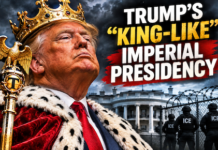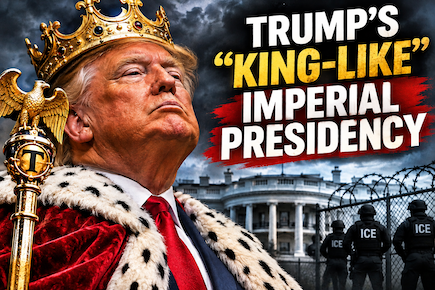
Michael Sozan is co-author of a recent article, “The Trump Administration is Interfering in the 2026 Midterm Elections to Entrench the Imperial Presidency,” offering a comprehensive examination of Trump’s multi-pronged plot to subvert this November’s midterm election. He’ll discuss his current assessment of the danger posed by Donald Trump and Congressional Republicans to the free and fair administration of the election, and the preparations being made to resist/repel attempts to subvert the outcome by Democrats and democracy defender groups across the country.
SCOTT HARRIS: We begin our program tonight with an interview recorded earlier today with Michael Sozan, a senior fellow with the Center for American Progress. So we’re going to go to that interview right now.
With a critically important 2026 midterm election just one day away, concerns are growing over the Trump administration’s efforts to influence the outcome of congressional races that will determine control of the House and Senate and potentially the future of American democracy. A report from the Center for American Progress titled, “The Trump Administration is Interfering in the 2026 Midterm Elections to Entrench the Imperial Presidency,” was co-authored by Michael Sozan and Ben Olinsky in August. The report examined the threats posed by the administration’s actions and the danger that legitimate election results could be challenged or undermined.
And joining us to discuss these concerns and what political leaders, election officials, and pro-democracy organizations are doing right now to defend the integrity of the vote is Michael Sozan. He’s senior fellow at the Center for American Progress. Thank you so much for making time for us on this day before the critical election. Michael, I know your attention is probably a million places, so appreciate you fitting us in your schedule.
MICHAEL SOZAN: It’s my pleasure to do so.
SCOTT HARRIS: So Michael, your Aug. 12 report co-authored with Ben Olinsky, identified 15 interlocking tactics that you argue are intended to undermine the midterms. These include voter roll purges, restrictions on mail-in voting, mid-decade gerrymandering, pressure on election administrators, threats of federal troop deployments and possible challenges to seating elected members of Congress. As we talk on the eve of this important midterm election on Monday, Nov. 3rd, which of the many Trump and Republican party schemes to subvert the outcome of the election that will determine which party will control Congress, which of those many things concerns you most?
MICHAEL SOZAN: Well, I mean, underlying all of it, the foundational element that is so concerning of course is Donald Trump’s continued lie about widespread voter fraud. We know that is not happening. It’s extremely rare in our electoral process, yet he and his allies continue to say it over and over again. And of course that drives mistrust in elections. But what he’s done is he has stocked the administration full of election deniers and his allies and key positions throughout the Department of Justice, the Department of Homeland Security, and tons of other agencies and departments. He’s also neutered important programs either by taking away their funding or having people fired. And these are programs that were meant to uphold and protect the security of our elections. And so all of those are combining right now so that we just see multiple attempts at sabotage and subversion by these election deniers and his allies.
And it’s really unfortunate. And I think that one that I’m really looking at for the coming days is how he continues to try to interfere with the vote counting process. And will the administration try to involve troops or federal personnel in some way to do that? You’ll remember that Donald Trump famously said just a few months ago that he regretted not having the National Guard seize voting machines in the 2020 election. So I think that there are going to be additional pieces of the puzzle that are going to emerge in the coming days, and we’re going to be in a chapter right after tomorrow, right after Election Day, during the vote counting period where we’re going to have to stay very, very alert. But all that being said, I’m still optimistic, cautiously optimistic that we will have a free and fair election, especially when we see so much early voting, so many new voters coming out.
I think that the American people are going to make their voices heard.
SCOTT HARRIS: Yeah, no, that’s very optimistic and I’m on board that, but I think as you laid out very clearly in your article, there’s a lot to be worried about. And the tactics, some of which you just mentioned there that we see the Trump administration and his Justice Department mostly focus on in recent weeks has been the filing of lawsuits challenging the certification of winners of campaigns in states like Alaska and the public announcement of lists of tens of thousands of alleged illegal voters in states including California, Washington state and Nevada. And linked to those voter lists were explicit threats of criminal prosecution of state election officials who refused to segregate and purge these voters ballots from the final vote counts. Tell us about the status of this Trump tactic to instill doubt and fear in the election outcome. Some of these things have been dealt with by federal courts, but they are on appeal.
At least a couple of them are on appeal to the Supreme Court.
MICHAEL SOZAN: That’s exactly right. The Supreme Court is going to get a bite at this apple in the next few days in at least one of the cases most likely. Yeah, this continues to be an important piece of the puzzle for the administration now that it’s specifically suing various states over again this myth of widespread voter fraud. As we know, the administration keeps producing lists in the tens of thousands where it alleges that the lists contain names of non-citizens and ineligible voters. But these lists fall apart upon any scrutiny. They are trash, they’re unreliable, and what they do is they risk preventing actual eligible voters from voting. These are some people who are erroneously on these lists. And luckily, the federal courts have been a big bulwark here against the administration’s efforts and I think they will continue to be a bulwark. And we’ve seen this time and again, whether it’s Nevada, whether it’s California now.
And I think one thing that unfortunately the state and local election officials are having to endure is threats of prosecution regarding these lists and regarding them trying to do their job and protect eligible Americans’ right to vote. And that’s really unfortunate when you see dedicated state and local officials, many of whom are our neighbors. They’re part of our neighborhoods. They are local officials who are just trying to uphold the law and they’ve now got this big weapon hung over their heads in a really unfair way. And I’ll also just say that it really struck me a few weeks ago when the top election official in Utah, and she’s a Republican, Utah votes a lot by mail and she’s been on the receiving end of these threats as well. She said, as have others, that the federal government right now is the biggest threat to free and fair elections, our own federal government.
So it’s a threat from within as opposed to foreign adversaries or others. And so this is why so many of us are concerned and why luckily people like you continue to shine a spotlight on these issues.
SCOTT HARRIS: Michael, as you said a few moments ago, there’s concern about the possible deployment or involvement of federal law enforcement, ICE agents, the U.S. military in election-related activities. Trump, as you mentioned again a few minutes ago, he said that he regretted not sending in the military to seize voting machines and ballots in the 2020 election when he lost to Joe Biden. What legal authority, if any, does the president have to intervene in state-administered elections and what safeguards exist, if any, to prevent federal officials and the U.S. military possibly from intimidating voters or interfering with the voting process?
MICHAEL SOZAN: I will answer that quite plainly and emphatically. The president has zero authority under the Constitution, under federal law, under any other authority or mechanism to involve himself in elections. The founding fathers wrote the Constitution in a way that it was very clear and explicit and gave the authority to run elections to states with Congress as a backstop and no role for a president. And that’s true even in the case of an alleged national security emergency. That’s something that many of us have been following, tracking very closely and doing a lot of research and writing about. I’ve written about it. Even in that situation, a president cannot somehow take over elections to protect national security. He has still got to work with the states and leave them the primary authority to do such. So the administration is trying to stretch the bounds of whatever the law says.
They’ve done it in lots of other contexts, not just election-related context. And I fear that the more that the election results show perhaps a big loss for Trump and his allies in Congress, the administration will get even more desperate in its attempts to try to stretch the law. Again though, luckily, I think most judges are staying attuned to it. I also think that the American people don’t want to cower these threats. And we’re already seeing part of the turnout, this is what the polling is revealing and this is what our research shows. There’s actually a good segment, a healthy segment of U.S. voters that get angry and motivated, extra motivated to go vote when they see that hurdles are being put in front of their cherished right to vote. And so it can actually motivate people, so in essence, have the counter-effect of what Donald Trump and the administration are trying to achieve.
SCOTT HARRIS: Michael, what are viable responses if Trump should declare a national emergency, invoke the Insurrection Act or martial law to disrupt or invalidate election results that he and the Republican Party may want to dismiss to illegitimately hold on the power? And I guess an important part of that whole question is if this goes up to the U.S. Supreme Court, we’ve seen time and again the right-wing majority on the Supreme Court, these justices seem to ignore some basic tenants of the Constitution too often to even recount here.
MICHAEL SOZAN: That’s right. I think that the lower court judges have acted fairly responsibly. I was also heartened by the U.S. Supreme Court decision several weeks ago in the case involving the postal service. The court rejected the administration’s attempt to weaponize the postal service. So I think that day by day, judges are becoming very attuned to what’s going on here with the election subversion techniques. It doesn’t mean that the administration will not find a sympathetic judge along the way. We know that there are several justices on the Supreme Court who seem to be acting in almost every case as partisan cheerleaders for Donald Trump, but they I think are in the minority.
I also want to say that apart from litigation, there are state and local officials who are really standing up and are acting bravely across the ideological spectrum and they’re going to uphold the laws of their state, and that might have to result in some litigation as well. But it’s amazing to see how many of them, the vast majority of state and local election officials are refusing to cower and are speaking up and against any attempt at subversion. And then of course, I always come back to the other bulwark is the American people themselves. We have seen through the No Kings protests and others of the peaceful mass mobilizations over the past many months that there are some bright lines. There are some lines in the sand that if crossed, I predict that there will be mass mobilizations in the streets.
I hope people will keep it peaceful. They have thus far. But throughout history, when we’ve seen at least 3.5 percent of a populist stand up in a sustained way, at key moments to an autocratic sort of leader, it can get them to back down. In almost every case, it has made it impossible for the regime to listen to the demands of the people.
SCOTT HARRIS: Yeah, that’s an important lesson of recent history all around the world, as you said. We’re speaking on this election eve with Michael Sozan, senior fellow at the Center for American Progress. I wanted to turn to the sort of certification at the level of the House and Senate. If Democrats should win enough seats in tomorrow’s election to regain control of the House or the Senate, there’s concern that Republicans under the direction of Donald Trump or House Speaker Mike Johnson, they could challenge the results certainly in closely contested districts. And I’m wondering what mechanisms could be used to delay certification, prevent duly elected representatives from being seated or otherwise attempt to subvert the election results to preserve Republican control? And one of the things I’ve heard about is it’s a theory that Mike Johnson could replace what I believe is a neutral clerk of the House and maybe put a MAGA loyalist in there to just scrub the list of certain numbers of Democratic candidate winners.
I wonder how realistic you think those scenarios are and what legal barriers stand in the way?
MICHAEL SOZAN: Yeah, it’s a great question. I’ll say it this way. I’m approaching the next couple months as a few chapters. So tomorrow is Chapter One, Election Day. Then Chapter Two starts right after Election Day for the 60-day period, six zero, the two-month period between the election, which is Nov. 3rd, and the Jan. 3rd seating of the new members of the House and the Senate, the duly elected certified people who must be sworn into those chambers. And then if there’s any contesting of that, we perhaps enter another chapter for a period of days or weeks, which would be unprecedented. I will say that there is really almost zero constitutional or legal path for the administration and its allies in Congress to be able to change the balance of the House or the Senate. Once the votes have been counted and the results are certified and every state is responsible for certifying the elections that happened within its own state, those certifications are supposed to be transmitted to the House and the Senate.
And the clerk of the House, for example, is supposed to read off all the names and allow all the certified winners to be sworn in. Yes, you are right that there are some creative and doomsday scenarios that have been floated about how current House Speaker Mike Johnson could try to abuse the process, perhaps try to fire the sitting clerk. I think it could be futile to go down the road of exploring all those paths because there’s really almost no way that Trump and his allies would be able to sway the balance of the House in that way. And I will say that according to public reporting, the leadership, the Democratic leadership in the House and the Senate, along with lots of different experts, have been war gaming this and are very prepared for that sort of subversion technique. That’s why I think it’s also so important that people get out and vote and vote in huge numbers and maybe this election becomes too big to rig.
And so that path that you just described and that I mentioned Jan. 3rd, the seating of the House and the Senate, that it just becomes futile for anyone to try to subvert those election results and keep those new members and returning members from being seated.
SCOTT HARRIS: Thanks, Michael. In your view, has the Democratic party and several of the primary democracy defender groups, have they done enough in advance of this election to build a legal and organizational infrastructure capable of responding rapidly to voter suppression, election interference, all the things we’ve been talking about to invalidate legitimate ballots? Are there sufficient numbers of attorneys, poll monitors, rapid response teams in all these key battleground states to defend voters and election officials if serious disputes arise?
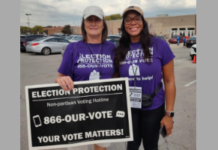
MICHAEL SOZAN: Yes and yes. The pro-democracy infrastructure is stronger than I’ve ever seen it and I work within that infrastructure in various ways, and I can tell you that the preparation has been astounding, multiple layers deep, both to protect voters at the polls, to be able to protect during the whole period after Election Day, to be ready for the types of scenarios that you and I have just been discussing. The preparation has been incredible. There are enough attorneys, there are enough organizations that exist and there are resources for voters and anyone else who feels that things aren’t going in the way that a free and fair election should go. So I feel very good about it. There’s been lots of reporting even in recent days how the top Democrat in the Senate, Chuck Schumer, the top Democrat in the House, Hakeem Jeffries, have taken multiple steps. And there are even staffers who work in each of those chambers who are going to fan out across the country to be poll watchers and to be keen watchers of how the elections are being administered, especially I think in some battleground areas.
That’s just one of many additional steps that are being taken. So I feel pretty good.
I still have concerns, maybe that’s because I’m paid to have concerns. I work in this area, and you’ve been monitoring things so closely as well. We’ve seen how the train has gone off the track in recent years and especially on the notorious day of the Jan. 6th insurrection. But I think this time the preparations are much deeper and I think that Americans are better attuned to it. And that’s why I still have a lot of optimism that we will have free and fair elections, even if there are a few bumps along the way.
SCOTT HARRIS: That’s good to hear. Michael, one potential danger on Election Night is that political leaders could declare victory before all the ballots are counted, especially in places like California where we know it’s going to take many days to get a final count. These things, they’re designed to have the public question the results and the questions of fraud and all the other unfounded suggestions from these politicians. How should journalists, election officials, and political leaders respond to these tactics, particularly in closely contested races where final results, as we’ve been saying like in California, may not be known for many days?
MICHAEL SOZAN: Everyone needs to reject these tactics. These are subversion tactics. They’re meant to call valid election results into question. They really should have no place in our system, in any country system. It’s sad that it is happening. It’s dangerous that it is happening, but everyone needs to know that every state will be following its laws to their logical conclusion, counting votes, certifying the vote. Some states are going to take longer. We know that California takes longer and it’s a huge state. We know that Maine will probably take a bit longer because they have ranked choice voting, and that makes it a little more complex. Alaska might take a little bit longer as well because of ranked choice. States that rely heavily on vote by mail might take a little bit longer, especially in a state like Pennsylvania where the law unfortunately doesn’t even allow ballots to be pre-processed as they come in through the mail until Election Day.
So there’s lots of permutations. People should have trust in their state and local officials. And we now have, I think, a little bit of muscle memory from the last few elections. We know that results will take a little bit of time. We have to be patient, and most importantly, we have to reject the misinformation and disinformation that is being shoveled onto us and just know that the results are going to be correctly tallied and we’ve got to reject the subversion attempts.
SCOTT HARRIS: Michael, in your August report, you warned that the Trump administration is interfering in the 2026 midterm election as part of a broader effort to entrench what you describe as an imperial presidency. And Donald Trump, the Supreme Court, and the Heritage Foundation’s Project 2025, they all advocate for something called the unitary executive theory, really in my mind, a euphemism for ignoring institutional checks and balances embodied in the U.S. Constitution. And I think they want to establish what in essence is a presidential dictatorship. What’s your concern that Trump has succeeded in normalizing his version of this dictatorship and the critical actions Congress and the American people, regardless of the election results, what do we need to do to eliminate this, what I believe is a fascist threat to our democracy, this unitary executive theory?
MICHAEL SOZAN: Yes, that is one of the many reasons why we are in such a challenging chapter for our democracy. And you’re right, the unitary executive theory, it’s really a fringe theory, and it really hasn’t up until recently gotten any sort of currency. It’s something that’s been rejected before and it’s something that really would help to build what I call an imperial presidency. That’s what the report that you’ve referenced is a series that I’ve written with my co-author, Ben Olinsky, about how Trump is trying to build an imperial presidency and has taken many steps towards it. We started tracing this all the way back to Project 2025, which you allude to. So there’s got to be a concerted effort going forward to knock down this theory, to knock down this march towards an imperial presidency, to knock down the authoritarian playbook that has been imported from abroad now into this country.
And that’s why I know many people are hoping that pro-democracy forces, including Democrats, have a very strong day tomorrow on Election Day, and that a message can be sent that Americans don’t want an imperial president. I mean, we fought a war to gain our independence against a monarchy. And so that’s why we’re at an important inflection point, and I think that we’ll see how the people register their voices here and how they want to chart the course for our country. But yeah, I think that there’s going to have to be a lot of rebuilding in the future. I shouldn’t even say rebuilding. We’re going to have to build for the first time a democracy that is strong, resilient, has checks and balances that can survive a president who might try to tear them down, and can survive a president who may be thoroughly corrupt, and also just a democracy that can finally make sure that everybody has a fair shot at the American dream.
So there’s a lot that’s going to unfold over the next days, weeks, months, and even years. And I know that so many of us are working to try to make sure that fringe theories like the unitary executive theory or notions that somehow this country can turn into an autocracy, get tossed into the trash bin, and that we can really open a new healthy chapter.
SCOTT HARRIS: Yeah, so important that guardrails have to be rebuilt and certainly go a lot farther than even the post-Watergate reforms that happened. Thank you so much, Michael. It’s been great talking with you. I think we gain a sense of optimism from the things you’re looking at very closely, and I hope it all turns out okay. How can our listeners access the reports we’ve been talking about and a lot of other important resources that you have over there at the Center for American Progress?
MICHAEL SOZAN: Well, you can go to americanprogress.org. It’s where your audience can go. They can find my bio page on there, but we also have a page dedicated to elections and you’ll see that on the main page. We have a whole host of resources just about the topics that we’ve just been discussing plus others, and so they can find our work there. And going forward, I will also say that Center for American Progress, where I work, is really going to continue to be actively involved in putting forward bold, common sense solutions to build the strong democracy across all of the issue areas. We work on a ton of different issues, and so they are on the website as well.
So yeah, I definitely invite people to check out americanprogress.org. Got it.
SCOTT HARRIS: Well, thank you so much on this very busy day for you to spend time with myself and our audience. I’m looking forward to staying in touch with you after this election is over.
MICHAEL SOZAN: You’re welcome. Yeah, me too. Thank you.
SCOTT HARRIS: Thanks, Michael. Take care. Good luck to us all.
MICHAEL SOZAN: Thank you. Bye-bye.
SCOTT HARRIS: Bye-bye. We’ve been speaking with Michael Sozan, senior fellow at the Center for American Progress and co-author along with Ben Olinsky of a report from the Center for American Progress titled, “The Trump Administration is Interfering in the 2026 Midterm Elections to Entrench the Imperial Presidency.” And Michael Sozan was right there in an interview I recorded earlier today.