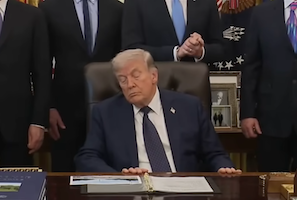
Dr. Henry Abraham talks about a group of 36 leading physicians and other doctors with expertise in mental health, who he’s acting as a spokesperson for, “who issued a statement calling for President Donald J. Trump’s immediate, lawful removal from office for medical reasons. His mental instability, coupled with his sole, unchecked authority to launch nuclear weapons, makes him a clear and present danger to the safety of all Americans.”
Dr. Abraham is co-recipient of the 1985 Nobel Peace Prize for his role as the co-author of the Constitution of the International Physicians for the Prevention of Nuclear War and author of After the Genocides: Immigration, Education and the Prevention of Nuclear War.
DR. HENRY ABRAHAM: Well, it’s a pretty big question. Certainly, Dr. Lee has been a pioneer in this problem area. But it seems like a lot of the original observations had to do with the president’s character and whether it was a disordered character and whether that disordered character was appropriate for a person to be the president of the United States. But as time has gone on … and I was not a part of that process. I’m a lifelong peace activist, but I wasn’t convinced that there was any strong psychiatric arguments to be made that Donald Trump was in some way a particularly defective president. We’ve had some pretty tough customers who’ve been presidents throughout our history and I was not an early believer that he was a true danger to the country. It took me 10 years to figure that out.
And in that time what accrued was a series of simply clinical signs and symptoms. We can never make a real diagnosis without a comprehensive assessment of a person. And whether or not they are voluntary is almost a secondary question because we diagnosed The Unabomber (Ted Kaczinski) and he was not necessarily signing up as a patient. And we put together evidence painstakingly over time to come up with a psychiatric diagnosis and even then it’s a label and it doesn’t really do justice to the larger context of the story.
And I was, for one, very slow to come to any conclusion that there should be a label applied to Donald Trump. And at this moment I still don’t feel confident about applying a label. But, that being said, I feel absolutely certain that he has exhibited a large number of psychiatric and some soft and neurological symptoms over time that have gotten worse and I’m afraid more dangerous. And finally, I have to say Donald Trump smoked me out and forced me to come forward and say, “This is not normal. This is not worse than not normal. This is dangerous stuff and I have to come out and speak out about this.” And my colleagues and I felt that way and I’m not sure why they asked me to be the tip of the spear of it.
I’m one of the oldest tips of the spear, so maybe I’m one of the dullest, so they thought, “Well, we’ll have Dr. Abraham do it.” In any event, the bottom line is that I’m representative of a large number of top flight American psychiatrists and neurologists and those people are … I have every confidence that they were on the right path and they asked me to do this job and so I’m happy to do it. But in other words, we don’t have a diagnosis for this guy. We shouldn’t. It doesn’t have scientific integrity as part of it, but what we do have are undeniable red flags on the field and whether or not they’re getting worse I think is a matter of clinical judgment. My own feeling is yes, they’re getting worse.
There’s a great quote from a psychologist who has been early on an observer of Trump and he has made a great, great point. He says, “Look, he believes that the president is developing dementia—more on that in a minute—but he believes that the president is developing a dementia, which is of course a terrible thing and absolutely the worst possible disorder for someone who’s a president in control of nuclear weapons. But he has a really good description of what dementia is like. And I’ve worked with dementia patients for many years. He says the person you see today is as good a person as you’re going to get going forward. And I think that’s true with respect to Donald Trump. The best version of Donald Trump is the one that we saw today and what that means is that it’s all downhill from this point.
Now the question is how quickly downhill? And I think that’s an argument. That’s a matter of debate. Some feel that he’s dropping off a cliff. I do not believe that, but I do believe that he’s getting worse in his collection of symptoms and signs. And I’ve written about that. I’ve gone public with it and Scott, I’m talking to you about it tonight.
SCOTT HARRIS: Right. Let me reintroduce you. We’re speaking with Dr. Henry Abraham, professor of psychiatry emeritus at Tufts University School of Medicine. And Dr. Abraham is acting a spokesperson for the statement signed by 36 medical experts who declare that President Trump is too unstable to remain in office citing the nuclear weapons risk as maybe number one on their list. Dr. Abraham, I wonder if you’d review for our listeners some of the symptoms and examples of Donald Trump’s behavior that have raised the red flags that have you and the other 35 medical experts saying that he’s really not fit to hold office.
DR. HENRY ABRAHAM: Well, I think the 25th Amendment has really never been applied and it’s hard from a historical point of view for me to imagine that his cabinet would say, “Yeah, Dr. Abraham, you’re making some serious points here. And we’re as worried as you are about him possibly nuking Tehran.” From a human and from a political point of view, I’d like to see the 25th Amendment applied, but I have a feeling that I don’t have great hope in that regard. The single best thing that I can think of, perhaps it’s a little cynical, but the single best thing would be for Donald Trump to take the money and run—that he’s essentially grifted out of the treasury and from the Saudis and from his business partners—and resign. That would be, I think, the least traumatic way in which we could get out of this terrible dilemma that we’re in, that this man seems to be declining and he has dangerously large powers available to him.
SCOTT HARRIS: Absolutely.
DR. HENRY ABRAHAM: It’s not my job. I mean, as a political person, I guess I could say there are three reasons why the president should be impeached. The impeachment is in addition to the 25th Amendment. Impeachment’s a possible solution to the problem. He can be impeached because he has moral turpitude, which is debatable. The MAGA people don’t think he does and I do.
Just for moral reasons, he should not be president. Then there are policy issues. He shouldn’t have gone to war in Iran. He shouldn’t have closed down the USAID. It’s going to cause the deaths of millions of kids in Africa. It’s terrible, terrible policy. It’s wrong policy, but it’s not mental illness. The third path is in fact psychiatric and neurological—that is, this man is losing the ability to function on a normal level and that threatens all of us. And that’s the only basis for impeachment that I would support.
SCOTT HARRIS: Well, Dr. Abraham, we’re almost out of time. I wanted to —
DR. HENRY ABRAHAM: Okay.
SCOTT HARRIS: Yeah, unfortunately we are. Definitely, there’ll be more to talk about in the coming weeks, I’m certain, but yeah, we will have you back. But how do our listeners find this statement of the 36 medical experts of which you’re a spokesperson for?
DR. HENRY ABRAHAM: Well, they can log onto my Substack page. I have written extensively about it and the documents are there and that’s henryabrahammd.substack.com. And that would be a good way to start.
SCOTT HARRIS: All right. Well, thank you so much for spending time with us and for your energy and time that you’re putting towards alerting the public to this menace, this danger to us all. And appreciate you spending time with us tonight. So thanks, Dr. Abraham.
DR. HENRY ABRAHAM: Thanks for the chance to share.
SCOTT HARRIS: Great. We’ll talk soon again. I hope we’ll be in touch. Thank you, Dr. Abraham.
SCOTT HARRIS: Take care. That’s Dr. Henry Abraham, professor of psychiatry emeritus at Tufts University School of Medicine. This is Counterpoint. My name is Scott Harris.