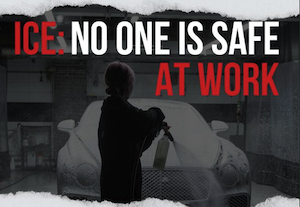
Robert Greenwald talks about his important new documentary film, “ICE: No One Is Safe at Work,” which highlights how ICE immigration raids affect workers’ and their family’s lives and how listeners can view the film and support Brave New Film’s important work.
Brave New Films is a nonprofit production company that creates and distributes investigative political and social justice documentaries.
SCOTT HARRIS: Right now, I’m very happy to welcome to our program, Robert Greenwald, the founder and president of Brave New Films, a nonprofit production company that creates and distributes investigative political and social justice documentaries. We’ve invited Robert to talk about his brand new short film titled, “ICE: No One is Safe At Work.” Much appreciation for you making time for us this evening, Robert, and congrats on the new film.
ROBERT GREENWALD: Thank you. Glad to be with you and glad to talk about the important issues and what people can do.
SCOTT HARRIS: Right. Yeah, we’ll get to that for certain. So this new short film, “ICE: No One is Safe At Work,” really captures the visceral stress and fear for millions of people across the country who rightly are afraid that they could be targeted by ICE agents and be subjected to violent assault as we’ve seen so many times and it’s certainly in this film as well. And that goes to whether or not they are guilty of any crime or even a violation of immigration law. It’s just kind of random violence that has everybody on edge. And I think these workers that you talk with at the carwash who were subjected to this and their own personal stories really is very powerful. So thank you for doing that. Maybe I’ll play a short audio clip of this film, but I wonder if you just set it up in terms of how you came upon the carwash and the folks who were there and how this film came about basically.
ROBERT GREENWALD: Well, I live in Los Angeles, as do many of my colleagues at Brave New Films. And Los Angeles attacked viciously, brutally early on by ICE and they didn’t focus exclusively—but they put a lot of time, energy and frankly some of our—just remember this—our billions of dollars that are paying for ICE. They used some of that to go after the carwash workers. There are, I think, over 350 of them who were harassed, attacked, jailed, deported, a whole combination of horrible litanies for patriotic, hard-working, decent people. So we decided to do the story. We had worked at Brave New Films with Clean Car Wash years ago and Andres, who’s the head of the immigration work we do, with Tim, our head of production, went out. They interviewed carwash workers and then we spent some time editing and creating this very short eight- minute documentary and it’s on all the social media platforms.
And then we took the eight minutes and cut it into even shorter pieces. I think it was yesterday we reached 30, 40, 50,000 people just with clips from the film. So thank you for giving us the time to talk about it. A reminder to all of your listeners. All of our Brave New Films films—short, longer or in between—are free and they’re all available if you go to bravenewfilms.org.
SCOTT HARRIS: Great. And we’ll repeat that before we say goodnight. But let me go to an audio clip just about a minute of this trailer. Again, the title of which is “ICE: No One is Safe At Work.”
FEMALE NARRATOR TRANSLATING: There was so many workers that were taken on that day.
MALE VOICE TRANSLATING: Three big people were sitting on my back. The way they threw me down, sitting on me and I asked them to let me go. The only words they say, “You do not ‘F’ with ICE. You do not ‘F’ with ICE.”
SCOTT HARRIS: Well, that’s just a short audio clip of the film. We’re speaking with the producer director. That’s Robert Greenwald and the “ICE: No One Is Safe At Work” film is available to be seen. We’ll tell you how to do that before we say goodnight. But Robert, tell us about some of the comments you heard from the mayor of Los Angeles who was at the premiere of this film. And I believe the premiere took place just last week. I think it was Thursday and I think you held the premiere at the carwash, which was the subject of the film. So that’s great. So yeah, I’d like to hear about the comments that Karen Bass had of the film, the mayor of L.A.
ROBERT GREENWALD: Well, the mayor, I’ve known her for a long time before she was mayor. I’ve known her as an activist, as a progressive, as an organizer when she was in office in Sacramento and in Washington, D.C. And this has forever been an important moral, personal, political and practical issue for her. And as expected, she spoke eloquently and passionately about the abuse that ICE has subjected Los Angeles to, about what she has done as a mayor to push back, fight back and protect. And the value of the film, how it can be used. When people ask me, “What do you do at Brave New Films?” I’ll say, often trying to find a simple summary, “We put a face on policy.” And that’s what Andres, who directed this film did. That’s what my other colleagues did, the editors, the researchers, all of the social media, everything that goes into not just making it. But even more important, making sure we’re reaching people.
So that means getting it on all the social media platforms, whether it’s Brave New Films or it’s Robert Greenwald and reaching as many people as we possibly can and encouraging, hopefully inspiring, motivating them to take action. Every single person can do something.
SCOTT HARRIS: I’m hoping many of our listeners will find this film and watch it. It’s a short film. And Robert, I wonder if you just describe some of the trauma that the families, the subject of the film, these carwash workers and their loved ones went through. Family separation, people being detained in prison. Maybe you could tell us just a short vignette or a story that would sort of speak to the impact of capturing what you did here in the film.
ROBERT GREENWALD: Well, yes, it both infuriates and breaks my heart. One of the gentlemen in the film was locked up. He’d been beaten and he was in enormous pain. His teeth were hurting him. He couldn’t eat. Went on for weeks, maybe a couple of months and ultimately as he says on camera and can you imagine this? He pulled out his own teeth just to stop the extraordinary pain. That’s what our tax dollars are paying for. That’s what each of us must stand up and say, “No.” And there’s a whole series of ways we can say, “No.” The carwash workers for the most part—hard-working, honest people and the combination of racism and classism has been a factor in choosing them. Going after them and abusing them in very large numbers in Los Angeles. And there are iterations of this all over the country.
SCOTT HARRIS: Well, Robert, I did want to ask you to talk about some of the other powerful films that you’ve produced over the years, most recently about journalists in Gaza, which will be another place people can stop at your website to check out these films. But speak briefly, if you would, about the Gaza film and journalism, because unlike any other story I think in the world, the fact that hundreds of—or maybe it’s even close to a thousand—journalists have been targeted and killed in Gaza over these past several years and your film speaks to that.
ROBERT GREENWALD: As a New York Jew, I feel a particular passion about telling the story of what is going on in Gaza. And as I was reading about it and looking at the videos that were coming from the incredibly courageous Palestinians in Gaza, I kept searching for a way to tell a story that might reach people who didn’t care or were neutral and I landed on the idea of journalists. I felt that no matter what your political persuasion, you would not be in favor of targeting, killing and murdering journalists. Israel has killed over 250 Palestinian journalists. And then they say, “Well, you don’t know the real story because there’s no one telling you the real story and people turn to Israel for ‘an official story.'” But meanwhile, there are fewer and fewer journalists and they will not allow international journalists into Gaza without being accompanied by the military.
So the way to get information and stories from the truth-tellers, the observers who are independent like Amnesty International, like Reporters Without Borders, like doctors are limited in what they can do, how much they can see. But thank goodness in this case for Instagram, where there are so many different Palestinians posting painful reminders that this is the policy of the United States government.
SCOTT HARRIS: Well, Robert, before we say goodnight, tell our listeners about your filmography. The immigration, criminal justice reform, government corruption, inequality, gun violence, racial justice. You have so many topics and literally hundreds of films that people can find on your website. Maybe you could just say a word about how a good approach to checking out this archive of films and the way you would have them approach such a sort of large job of trying to comb through there in terms of their own interest.
ROBERT GREENWALD: Well, thank you for that. Yes. If you go to the Brave New Films website, you can choose from so many, from two minutes to two hours past, present and future. If you sign up and follow me or follow Brave New Films on any of the social media platforms, you will get updates about the films. You’ll get clips from the films. And probably easiest—if you go and sign up for our newsletter once a week, you will hear from us what’s going on, what we’re doing, why we’re doing it and the thought and ideas that go into the decision-making for each of these films. Again, some are very short, some are very long, more and more we’re relying on social media now, although we like others are being repressed on social media around certain topics. So that’s another reason to get the newsletter. You would make sure to get alerts and clips and sometimes the full films rather than if you’re on social where sometimes the algorithm and the owners refuse to let our stories be told.
ROBERT GREENWALD: Well, thank you for that. Yes. If you go to the Brave New Films website, you can choose from so many, from two minutes to two hours past, present and future. If you sign up and follow me or follow Brave New Films on any of the social media platforms, you will get updates about the films. You’ll get clips from the films. And probably easiest—if you go and sign up for our newsletter once a week, you will hear from us what’s going on, what we’re doing, why we’re doing it and the thought and ideas that go into the decision-making for each of these films. Again, some are very short, some are very long, more and more we’re relying on social media now, although we like others are being repressed on social media around certain topics. So that’s another reason to get the newsletter. You would make sure to get alerts and clips and sometimes the full films rather than if you’re on social where sometimes the algorithm and the owners refuse to let our stories be told.
SCOTT HARRIS: Yeah. Well, some other time we’ll have to make room for a discussion about artificial intelligence and filmmaking. I’ll be curious to hear your take on that, but we’ll save that for our next conversation. Well, Robert, thank you so much for being here. Congrats on this new film, an important topic that we all need to really feel viscerally as I did when I watched this film, as I know others will. And just give out the web address one more time and we’ll say goodnight.
ROBERT GREENWALD: Bravenewfilms.org and I’m glad you felt viscerally because one of my mottos is first you reach the heart, then you reach the brain.
SCOTT HARRIS: Absolutely true. Thanks so much, Robert. Appreciate you being here today.
ROBERT GREENWALD: Okay, do well. Take care.
SCOTT HARRIS: You too. That’s Robert Greenwald, founder and president of Brave New Films.