

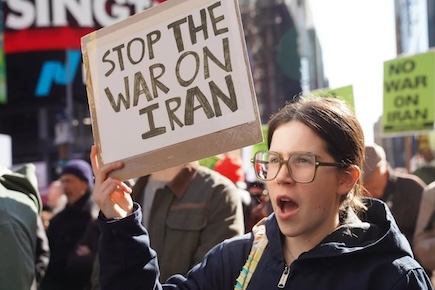
Kevin Martin talks about what his and other anti-war groups are doing to oppose Donald Trump and Benjamin Netanyahu’s illegal war in Iran and Lebanon, action being taken to pressure Congress to invoke the War Powers Act, and how listeners can get involved.
Martin is president of Peace Action and the Peace Action Education Fund, the nation’s largest grassroots peace network with chapters and affiliates in states across the U.S.
And on the other side, the Democrats, for the most part, are opposing the war and trying to uphold their constitutional authority. That may continue because in both the House and the Senate, they’re talking about the Democrats continuing to force these war powers resolutions. And Republicans are whining about that like, “Oh, this is just a messaging bill and they’re trying to gum up the works and they’re taking up floor time, blah, blah.”
Well, that’s okay. That’s appropriate as far as I’m concerned when there’s illegal war of aggression going on. So Republicans can whine about that if they want, but they can’t really stop these votes from coming forward. But again, as I said, and if you want to move on to this, we could. The votes last week were really remarkable in terms of stopping particular weapons transfers to Israel.
SCOTT HARRIS: Yeah. I want to get to that in a moment. Let me reintroduce you to our audience. This is Counterpoint here on listener-sponsored WPKN in Bridgeport. And we’re speaking tonight with Kevin Martin, president of Peace Action and the Peace Action Education Fund. And Kevin, explain to our listeners a bit about how the War Powers Act, the war powers resolution have passed. What effective change could it mandate on where the United States is now with this war on Iran, which is in this very precarious ceasefire. We don’t know if this war is going to resume any minute.
SCOTT HARRIS: Right. But it would be an expression of the public opposition, which is quite lopsidedly against this war.
KEVIN MARTIN: It is. And the clock is also ticking because without a formal declaration of war, which we don’t have—or even the dubious authorization for the use of military force, the AUMF, which is not really a constitutional matter, but it’s what the United States has been doing for a long time where Congress defers to the president and basically says, “Well, we’re giving you the authority if you decide you need to have a war.”
Remember, Congress has not officially declared war since Pearl Harbor was attacked in 1941 and yet the United States is almost constantly at war. So we’ve never even been following the Constitution. And this is part of the problem that the congressional branch needs to take back its authority from the executive branch. But the clock is ticking without either a declaration of war or even this AUMF process, which would be dubious, the president doesn’t have unlimited authority, especially because the United States was not attacked.
The War Powers Act says that the president can engage in military action, but only in defense. And this is not in defense, right? It was Israel and the United States that illegally, in an act of aggression attacked Iran. But the clock is ticking and I believe it’s May 1st that unless there is some authority and some Republicans have even said, if we get to May 1st and the war isn’t over, or there isn’t some either declaration of war or AUMF, then they would start voting against the war.
Now, there’s also the possibility of a 30-day extension that the executive can take, but the clock is ticking and the political pressure … People often ask me, “What about this procedure or what about this? ” And I’m like, “You got to understand this is all political. And if Trump is smart, which that’s a dubious proposition, but he understands how unpopular this is and how it’s going to hurt Republicans at the ballot in the midterms and all of that.
So the pressure needs to keep up even if you don’t think you’re going to achieve a change in policy because of the congressional vote if I’m being clear about this, because people seem to exist in a place where they think the theoretical procedures will be followed and clearly with a president like this, they’re not.
SCOTT HARRIS: Yeah. Yes, indeed. Kevin, I did want to ask you about how politics plays a role in all this. How does presidential politics in particular, in the ambition of some U.S. senators who are thinking about running for the White House in 2028, how has that impacted the votes on the War Powers Act? And we’ll get to the supplying weapons to Israel question in a moment.
KEVIN MARTIN: Well, it’s more on the latter. So on the former, again, it’s almost entirely a partisan divide. Almost all the Democrats in both Houses, the House and the Senate are voting correctly on this. Jared Golden was the only one in the House who voted wrong last week and John Fetterman, the only one in the Senate. The good news in terms of the people that think they’re going to run for president, regardless of what you think of whether they should be president or whether they’re fit or not, is that some of them have been changing their behavior on the votes to stop specific weapons transfers to Israel, which is a little bit more specific legislative process that a lot of people don’t know about. But Bernie Sanders has been the only one forcing votes in the Senate to stop. And you can’t, well, you could do just a blanket arms embargo to Israel—and we should, according to the U.S. and international law, Israel should be ineligible to receive US military assistance—but unfortunately we’re nowhere near having the ability to pass that.
So Bernie Sanders has been bringing forward these specific, what are called Joint Resolutions of Disapproval to stop this or that weapon sale to Israel. And last week, we had the biggest success we’ve ever had. We had 40 of the 47 Democratic senators vote to stop bulldozers to Israel, which are used for home demolitions of Palestinians. That’s by far the highest we’ve ever gotten. Twenty-seven was the previous high. And again, all Democrats, no Republicans. Twenty-seven last year voted against assault rifles to Israel. That was the end of July. And this most recent vote last week, myself and others who advocate on these things thought maybe we get in the low 30s, but we actually got 40. We got 40 of the 47 Democratic senators, including all of the ones who are thought to be thinking of running for president. And some of them have been voting wrong all along, including Corey Booker.
Corey Booker has voted wrong every stinking time on every weapon sale to Israel and he finally voted right last week. And I don’t think it’s because all of a sudden he’s a great guy. People in his state and state of New Jersey have been pressuring him very hard and he knows if he wants to run for president, he’s got to get right with the Democratic base, which is very much against Israel’s actions, both in Gaza and now Iran.
SCOTT HARRIS: That’s important news. And I wanted to drill down on the influence of AIPAC, the Israel Public Affairs Committee that spends hundreds of millions of dollars every year on U.S. politics. They lobby, they spend a lot of money on campaign contributions on behalf of their allies and oppose their enemies in both primaries and general elections. Tell us about how America’s public approval of Israel’s actions, both in Gaza with what has been certainly at the level of international law, there are charges against Netanyahu and the state of Israel for those 70,000 plus Palestinian civilians who have been killed in this multi-year assault on the civilian population of Gaza. Tell us a bit about how U.S. public opinion about Israel’s actions has changed the politics in Washington and the power of AIPAC to influence our politics.
KEVIN MARTIN: Well, it’s changing radically and every poll that has been done over the last few years has shown a big partisan divide that there used to be among the public, but even more so among lawmakers in Washington, bipartisan support for the state of Israel. And again, in terms of how does that play out in U.S. politics, it’s $3.8 billion a year of U.S. military aid to Israel. And it’s important to remember, the people of Israel have universal healthcare. We don’t have that here in the United States and Israel is a prosperous country, but they’ve been getting $3.8 billion a year in military aid. And of course, since the war in Gaza, it’s been much more than that. It’s been well over $20 billion, but that has changed radically. Now Democrats and especially younger people are much more sympathetic to the Palestinian cause than they are to the actions of the state of Israel.
And I want to be careful because I’m saying the actions of the state of Israel and the Netanyahu government, not necessarily against the existence of the state of Israel or not necessarily against Judaism or anything like that. It’s against the policies of this current government. If you have a change in government and Israel makes peace with its neighbors, that could change radically, right? But that’s nowhere on the horizon right now. It should be, and Netanyahu should be in prison, right? But until that happens, you are seeing a big partisan shift that it’s almost all Republicans. And some Republicans support Israel because they want to hasten the Rapture. So how is that even pro-Israel? I can’t even talk to people about that, right?
SCOTT HARRIS: Right.
KEVIN MARTIN: So putting that aside for a minute, looking at how they’re voting, again, not a single Republican in any of the joint resolutions of disapproval on specific weapons transfers to Israel.
Not a single Republican has voted in favor of those. And it was low when it started. It started, geez, at the end of … Biden was still president, but Harris had lost the election. So it was the lame duck session at the end of 2024 is when Sanders started bringing forward these joint resolutions of disapproval. And the first one, we only got 11 votes and now we’re up to 40. And that’s been a big shift, but again, entirely among the Democrats. And I did a quick statistical analysis of the votes last week, which is not my strength, but it’s pretty stark. There were 355 individual votes cast by members of the House and the Senate on the two war powers resolutions and the two joint resolutions of disapproval. So four different votes, 355 congressional votes among the Democrats, and they only got 12, I believe it was, or 11.
So they only got 4 percent. So AIPAC’s wasting their money on Democrats, although they are and have put their sum on the scale to elect what they consider to be more pro-Israel Democrats in the primaries. But when you look at these votes last week, you had, again, almost entirely Republican voting wrong, voting to continue the illegal war and continue weapons transfers to Israel and very few Democrats doing that. So when you look at that, you think, “Well, gosh, tens of millions of dollars that AIPAC is giving to Democratic politicians. They’re wasting their money, especially, again, as we said, the ones that are thinking of running for president.
SCOTT HARRIS: Thank you so much for being here with myself and our audience tonight, Kevin. Just a quick last question, which we could do an entire show on this. I always come up with these ill-timed questions, but I was speaking with a university professor who translates a lot of Farsi-language stories coming out of Iran during the course of this war. And one question that she said had come up is, where’s the U.S. peace movement? And of course, we’ve been talking about your efforts in pressuring Congress to take action here. So that’s certainly one focus of attention for the U.S. peace movement, but in terms of street protest and the like, I’m wondering what kinds of things would you like our audience to know about? And do leave our listeners with a website so they can get in touch with you and we can continue this conversation down the road too.
KEVIN MARTIN: Well, I would point to three recent things. First of all, the No Kings protests were huge. And while they were planned in advance and were planned even before the Iran war had started, there was a huge anti-war contingent. And that was one of the major demands of the No Kings protest just a few weeks ago—all around the country was people demanding an end to this illegal war of aggression. Just last week, led mostly by Jewish peace groups in New York, a sit-in with several hundred people and at least a hundred got arrested at the offices of Chuck Schumer and Kirsten Gillibrand, the two New York Democratic senators who, while they’ve been voting right on the war powers resolutions, they’ve been voting wrong time and again and continuing to send weapons to Israel. And just today, some veterans groups did a sit-in and got arrested inside the Capitol rotunda.
So there is a lot of street protests, a lot of sit-in actions, building, etc. So I would say that and again, it bears out the public opposition to the war, which is well over two-thirds. And you can find out about these kinds of actions and also what you can do in terms of supporting good candidates in the elections and taking action on legislative work by going to peaceaction.org.
SCOTT HARRIS: All right, Kevin, as always, thanks for your important work and spending time with us. Appreciate it and we will be in touch with you again soon. So thank you.


