SCOTT HARRIS: This is WPKN in Bridgeport. My name is Scott Harris. The program is Counterpoint, and right now I’m very happy to welcome to our program Dan Schwartz, legal affairs lead with the group National Security Leaders for America. Dan, thanks so much for making time to be on our program tonight.
DAN SCHWARTZ: Thank you for including me.
SCOTT HARRIS: As we get started here, talk a little bit about the mission and work of your group, the National Security Leaders for America.
DAN SCHWARTZ: Certainly, I’m glad to. Let me use the initials that they’re known by. NSL4A is an organization, a network of really of about 1,600 nonpartisan members, former members of the military and the civilian national security workforce and the government who are committed to upholding democratic principles and an impartial national security system in the United States. We began working with issues relating to, for example, the deployment of the National Guard. We were heavily involved in litigation last year in that regard and have been in front of the Supreme Court as an amici curiae in a number of different cases and most recently including the postal service case involving the proposed rule to limit mail order ballots.
SCOTT HARRIS: Thank you for that, Dan. So as we’ve been talking about for many months now in this program, since Donald Trump returned to the White House in January 2025, his administration has been methodically implementing a multifaceted strategy to exert federal control over the 2026 midterm elections when the Constitution clearly states it’s the states themselves that control and organize the elections. Both legal experts and nonpartisan observers describe the president’s effort as an unprecedented scheme to interfere with and likely attempt to manipulate the outcome of the election where control of the U.S. House Representatives and the U.S. Senate are at stake. So given that, Daniel, I think much of that is not debatable. I wondered if you would talk about your concern, your general concern about President Trump’s schemes and threats to interfere with the election coming up in November.
DAN SCHWARTZ: Thank you, Scott. Let me add some texture to what you just described. Let me go through a couple of data points. We obviously have all witnessed efforts to control voting, most so far unsuccessful with the executive orders having been struck down or put on hold. The SAVE Act has not passed in the Congress, excuse me, in the Senate really, but still efforts are being undertaken to control and limit voting. Let me give you some examples. The president has said he’s sorry that he did not send the military to take voting machines in 2020.
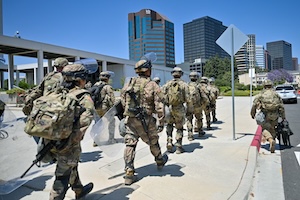
Department of Homeland Security (Markwayne) Mullen has said he doesn’t see anything wrong with having ICE agents at the polls, although it’s clearly illegal. In fact, the city of Denver has recently sued the Department of Homeland Security because of the aggressive presence of ICE at the polls during their primaries. In addition, the president, Mullen and Secretary Hegseth have declined to say categorically they would not use military forces or paramilitary forces, which we consider ICE to be at the polls. Recently, Chairman (Dan) Cain, chairman of the Joint Chiefs, told Democratic Sen. Elissa Slotkin that there were no plans for the military to be posted at the polls, but all it says is there are no plans today. It doesn’t mean there won’t be plans tomorrow. And the 82nd Airborne will move in 18 hours to anywhere on earth at the order of the president. And in fact, it was the 82nd Airborne that brought into Virginia, but not into Washington, D.C. during the riots, during demonstrations during the first term of President Trump.
Beyond that, let’s recognize that protection of elections by the federal government has severely been constrained. The Cybersecurity and Infrastructure Security Agency known as CISA, C-I-S-A, has laid off over a third of their staff last year. The Foreign Malign Influence Center, part of the Federal Bureau of Investigation has been closed. The Foreign Influence Task Force has been closed and most importantly probably the Election Assistance Commission has basically been defanged. The Election Assistance Commission was the agency of the federal government that went from state to state helping state election officials prepare for the upcoming election, both in terms of just very logistical kinds of issues, mundane issues, but also in terms of the threat analysis and deciding how to address those threats.
Beyond that, there has been a substantial increase, as all your listeners know, of false narratives about illegal voting. The administration said that there had been 278,000 improper votes in the last election. Improper votes meaning votes by people who are not citizens. This was tested by Nevada. Originally, the federal government had said there were 16,000 false votes in Nevada of illegal voting. When the Nevada asked to look at those numbers, it turns out that they were just talking about 185 people, and the state showed that all of those 185 people were in fact citizens. In addition, in order, I think in part to increase concern by the populace, the federal government has been charging small numbers of people around the country for illegal voting. Recently charged 16 persons in five states, in five states, so it’s two votes here and six there, and none of which would have had any impact on the outcome.
Because of that, we have been very aware of how to prepare for what may be—we all hope it isn’t—but what may be a effort to deploy military or military forces at voting places around the country. And we have done some legal analysis of the issues and have suggested face-to-face to a number of state attorneys general that they consider preemptive litigation to anticipate and prevent—get an injunction preventing deployment of military or ICE agents around polling places. We’re not asking people to just make this stuff up. We understand the issues of standing and ripeness, but we’re asking the state attorneys general to prepare, prepare their briefing schedule, prepare their briefs, get their information data in line, try to figure out how to anticipate whether there could be deployment coming. And in the most vulnerable state and cities, take proactive steps to demonstrate that, for example, civil order is being protected so that the government cannot act, cannot take action to claiming that the local government is not functioning properly.
SCOTT HARRIS: Well, thank you, Dan. I wanted to drill down on what you just talked about. Your group’s call on state attorneys general to prepare to block armed forces from the federal government interfering in the election in any way. What kind of effective preemptive action can be taken by state governments, and what’s been the response of the state attorneys general to your call to take that preemptive action?
DAN SCHWARTZ: Well, let me start with the backend first. The states have been very interested in what we have said. We have begun to provide, because of the concern about ripeness, about the concern about moving on just mere speculation, we have been preparing and generating on a daily basis what we call indications and warnings material, which has reviewed through the use of IA, I’m sorry, AI, through the use of AI, gathered all the public information that we can in a 24-hour period, and then sorting it in a way that will help identify activities that could signal government action. So we will pick up cases from all over the country and issues from all over the country and put them in a format that the states can use to help them prepare for this. In addition, what we have done is provide what I have come to call the back end of the brief.
If the government were to seek to invoke the Insurrection Act, for example, the front end of the brief will be fairly simple for attorney general offices to put together, because those will be the facts in front of them. But the back end of the brief is always the hardest. That’s the part we have to send lawyers to the library. Back in the days when I was a young lawyer and they were libraries, now they go to the computer terminals, of course, and come up with arguments. And we have started to prepare those arguments and distribute them so that state attorneys general will have a step up on how to deal with that.
The first question you asked was what impact can it have? What is clear is that the district court judges in the government, in the federal system, have been fairly open to looking at issues in which the democratic principles of fair voting and similar issues have been raised and are more willing than higher courts, particularly the Supreme Court, to take action.
We are dealing here with a situation, unlike most litigation, where there’s really only one day that counts, and that’s the Election Day. So this is not going to be litigation that goes on meaningfully for days and weeks, months at a time.
If the armed forces are going to be enjoined from participating or interfering in an election, that’s something that a district court judge can rule on, and it will take some time before it gets up to the Supreme Court. So even though we all have some concern about how the Supreme Court would rule on something like that, if we can get a district court judge to rule, then we have two things. One, we have some immediate restraint, and two, we have brought the issue to the public’s attention. And like all of these kinds of issues, the public’s attention and the public’s outrage by the abuse of power by the federal government is going to be the most significant weapon we have.
SCOTT HARRIS: Right. We’re almost out of time, Dan, and I did want to just inject this and get your quick reaction to it. As we know, courts and judges can be slow to act. And as you pointed out, Election Day in November, November 3rd is going to be a critical point in time. If Donald Trump and his administration plan to declare an emergency or invoke the Insurrection Act, things will go down quickly. And I know you’re concerned that judges may not act in time to prevent what might be in essence a military coup d’etat. That sounds outrageous, but I think it’s a failure of imagination, as many people said, to underestimate what Donald Trump will do to retain power and prevent the loss of his Republican majority in the House and Senate.
DAN SCHWARTZ: Let me just respond by saying that you are correct that courts can act slowly and particularly, courts of appeals and sometimes even the Supreme Court. But District Court judges can act quickly. They can issue an injunction in moments, and we have seen that in a number of recent cases involving, for example, the banning of news reporters from the White House. The decision came down in a matter of about nine hours, and we’ve seen that in other situations. You’re right, it’s a huge risk, but it’s really all we got.
SCOTT HARRIS: Yeah. And I just will say that it could be that, as you mentioned a moment ago, public opinion and people getting active and getting out in the streets, as we’ve learned in other mobilizations of people in democracies to prevent an authoritarian takeover, that may be the last tool in the toolbox.
DAN SCHWARTZ: That and early voting, you can’t be interfered with on Election Day if you voted two weeks ahead of time.
SCOTT HARRIS: True enough.
DAN SCHWARTZ: Get out and vote.
SCOTT HARRIS: Good advice to leave our conversation on. Daniel, I’ll look forward to talking more about this as the election approaches in less than a month, but leave our listeners with your website for your organization, National Security Leaders for America.
DAN SCHWARTZ: NFL4A.org.
SCOTT HARRIS: All right. Appreciate you making time and the important work you’re doing there to protect democracy.
DAN SCHWARTZ: Thank you, Scott, and thank you for including me.
SCOTT HARRIS: Take care. Good night.
DAN SCHWARTZ: Good night.
SCOTT HARRIS: That’s Daniel Schwartz, legal affairs lead with the group National Security Leaders for America. This is Counterpoint. My name’s Scott Harris, here on listener-sponsored WPKN in Bridgeport.