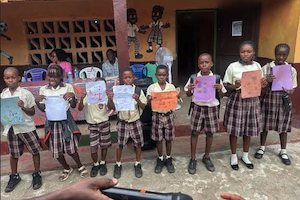
Faith Kasor Bright talks about her group’s work in Liberia, West Africa to educate, inspire, and empower young women and girls through scholarships, leadership programs, and health and wellness workshops. Girl Uplift’s annual Gala Dinner Ball will take place on Saturday, Nov. 7. Visit Girl Uplift at GirlsUplift.org.
SCOTT HARRIS: This is Counterpoint. My name is Scott Harris, and right now I’m very happy to welcome to our program, Faith Kazor Bright, founder and president of the group Girl Uplift, Inc., a nonprofit organization based in Connecticut, which works in Liberia, West Africa to educate, inspire, and empower young women and girls. Faith, thanks so much for making time to be on our program this evening.
FAITH KASOR BRIGHT: Thank you so much for allowing me to do this interview with you. Thank you, out there, everyone.
SCOTT HARRIS: So, tell our listeners about the group that I believe was founded back in 2018, and maybe the backstory about how this all got started with your work with women and girls in Liberia, West Africa.
FAITH KASOR BRIGHT: Yes. In 2018, I visited Liberia, West Africa. Liberia is my birth country. So I went to visit and I saw how girls were not even in school. Liberia was in a civil war in 1990 that lasted for 14 years. And it has been very, very difficult for Liberia to come back to where it used to be. So education is very important, but schools are not available for girls. And these girls were all on the streets and doing business, selling goods to survive. And when I went and saw all of that, and I say to myself, “We have so much and look at what these girls don’t have.” So I came back to the States and then I started to form the organization and get it started as a nonprofit organization.
SCOTT HARRIS: Thank you for that. Tell us about some of the programs that you’ve created and funded with help here from residents in Connecticut. But I guess maybe we should also start with the notion that, as you described, so many years of civil war have done a lot to hold people back in Liberia. So I guess we can really discuss some of the obstacles, especially for girls and young women in Liberia that your program addresses.
FAITH KASOR BRIGHT: Well, most of the programs we conduct in Liberia, especially for girls, one of the things that we provide is education. And the reason why, because education is like a privilege for girls or for poor people in Liberia to be able to send the kids to school. So because of the poor economic standard in Liberia right now, most parents or most families don’t have the means to send the kids to school. So these kids are not in school. So we took upon ourselves to start a scholarship program where we can educate most of these girls so they can get off the streets because in the streets they are very vulnerable. So we started this mentorship program as well, which will help teach them, encourage them, develop confidence and leadership skills. And then we started also with the health and hygiene education, which is another program that girls need to be educated, especially about menstrual health.
So we brought that menstrual health, we have a organization also in Orange, Connecticut who’s collaborating with us to supply us with menstrual kits for girls. And they have been doing it for the past two years. So that program with the menstrual health and wellness education for girls has been working really well in Liberia with the supplies that we are getting in partnership with Base of Girls of Orange, Connecticut. And the other workshop we also do is also life skills training because it’s not only for the young girls, it’s also for the parents because the young parents who having babies, we need to also educate them, give them some parental skills. So we also have workshop for young women, teach them some life skills that they will help themselves as well. One of the things that the new program that we starting right now is an afterschool initiative program.
And this program will help girls also develop new skills in terms of learning other skills to help sustain them, which can be cooking, can be crochet, sewing, etc. So those are the trainings that we are doing right now. But one of the things that we want to do and we’re doing most of the time when we get to Liberia is the mentorship and leadership. And that program is continuous because we do the STEM program, we do the games, we do educational games and the kids are so thrilled when they hear when they even participate in those things. They are very open to learn, but they don’t have the resources to do it.
SCOTT HARRIS: Thank you for that, Faith. We’re speaking with Faith Kasor Bright, founder and president of the group Girl Uplift Inc. It’s a nonprofit group based here in Connecticut, which works in Liberia, West Africa to educate, inspire, and empower young women and girls. And Faith, I don’t want to forget to mention, you have a fundraiser and a gala event to raise funds for this project on, is it Saturday, Nov. 7th? Do I have the date correct?
FAITH KASOR BRIGHT: Yes. We have our annual gala ball. It’s a dinner ball and that would be on Saturday, Nov. 7th. That would be in Branford, Connecticut. So it’s a fundraiser to help support the girls, give them the resources they need to pay their tuitions, to buy school supplies, because usually we buy school supplies from here, the U.S. and we ship them to Liberia. We also ship their menstrual kits from here to Liberia. So this fundraising is to support the girls’ education, support their resources they need for the education, and also do our workshops as well.
SCOTT HARRIS: Okay. We can’t mention a price on the air and on commercial radio, but we can refer people to the website or any place else where they can find out more about the group as well as this gala ball coming up. Is there a website you’d like to share with the audience?
FAITH KASOR BRIGHT: Sure. Our website is www.girlsuplift.org.
SCOTT HARRIS: Got it.
FAITH KASOR BRIGHT: Okay. And we also have a Facebook page. It’s Girl Uplift Inc. You can see all the work that we do around Liberia, the U.S. All our work is up on our website, on our Facebook page.
SCOTT HARRIS: Thank you for that, Faith. I did want to ask you about challenging cultural norms because certainly discrimination against women and girls is something unfortunately that exists in a lot of cultures, even here in the U.S. And I’m wondering how you take on that challenge because there may be people that you encounter in Liberia who aren’t all that happy sort of ensuring that there’s equal treatment for women. Is that something you’ve had to deal with?
FAITH KASOR BRIGHT: Well, yeah. Africa as a whole is mostly a male-dominant kind of population where men will be in control and women should not go to school. But things are changing all over the world. Things are changing. Even back in the days when parents would tell the girls, “Stay home and cook and don’t go to school, learn how to sew and you don’t have to go to school, let your brother go to school.” Because parents would do that. They would send the boys to school and the girls would stay home and learn those domestic things and hoping that somebody will marry their daughter and she doesn’t have to work or go to school to earn anything. But things have changed. Parents now, even the guys, the men, it is a struggle, but we set them down and make them to understand if you educate a girl, you are trying to build your family to educate not just the boys, but to give the girls the opportunity that they prepare themselves to be a provider for their home.
So it is a challenge, but it’s something that gradually we are trying to just let them know that it is also important for girls to be educated because the culture, we’re not trying to change their culture. We’re trying to blend whatever we doing, blend it into their culture so they can understand that by changing, by doing something a little different, educating your daughter instead of your son or both children, not just one. I think everybody should have the equal opportunity to learn or to experience something. But girls, I know when my parents were growing up, I know it was a little difficult for them because they wanted the boys to go to school and they stay home. But things are changing because parents are hoping that their family will get better, things will change because if not, we tell them every time we go, it’s not only the girls, but even the parents, we sit them down and tell them, “This is the way how life is going forward. You have to change. You have to try something.”
So it is a challenge, but we are trying to let them understand the reason why education is important, especially for girls.
SCOTT HARRIS: Well, Faith, we’re almost out of time. Leave our listeners with a website and the Facebook page one more time and we’ll remind folks that you’re having a gala ball fundraiser for your organization, Girl Uplift Inc. I believe that’s happening in Branford on Saturday, Nov. 7th. But leave the websites and again, the Facebook if you would.
FAITH KASOR BRIGHT: So our website again is www.girlsuplift.org and the Facebook page is Girl Uplift INC. We also, if you are interested, want to send us an email. We also have our email address that is info, I-N-F-O, info.girluplift@gmail.com.
SCOTT HARRIS: Well, thank you so much, Faith. We’ve run out of time, but I wish you all the luck in this upcoming fundraiser, and we’ll look forward to staying in touch with all the important work you’re doing in Liberia. Appreciate it.
FAITH KASOR BRIGHT: Thank you so much. Thank you for having us on the air and we welcome everybody to our gala board on Saturday, Nov. 7th.
SCOTT HARRIS: Got it. Thanks, Faith.
FAITH KASOR BRIGHT: Thank you so much. Bye-bye.
SCOTT HARRIS: Goodnight. That’s Faith Kasor Bright, founder and president of the group Girl Uplift Inc.