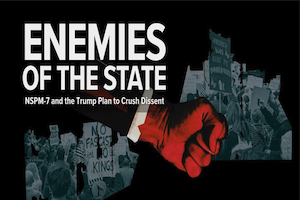
Shilpa Jindia talks about her group’s recent report, “Enemies of the State: NSPM-7 and the Trump Plan to Crush Dissent,” which she co-authored, warning that the Trump administration has established a coordinated federal strategy to criminalize political dissent, intimidate opposition groups and undermine constitutional protections for free speech and assembly.
SCOTT HARRIS: Right now, I’m happy to welcome Shilpa Jindia, policy counsel with the media democracy group, Free Press. And we’re very happy to have Shilpa here this evening. She’s co-author of a new report issued by Free Press, titled “Enemies of the State, NSPM-7”, which stands for National Security Presidential Memo-7, and the “Trump Plan to Crush Dissent,” an important report. Shilpa, thanks so much for making time to be on our counterpoint program tonight.
SHILPA JINDIA: Thanks so much for having me.
SCOTT HARRIS: First, briefly talk about the work you and your colleagues do at Free Press. We’ve had guests from the group for many years. I know it’s important for our listeners to know about the critical work you guys do over there.
SHILPA JINDIA: Yeah, thanks so much. Yeah, I know Free Press is a friend of the show. And so we’re a media and technology advocacy organization that’s fighting for a more just and equitable media ecosystem. And we do that in various ways. One is fighting for free speech and against media consolidation. So we were working with the Block the Merger Coalition against the Paramount Warner Brothers merger. But then we also take more offensive work online to help seed a more innovative and better public media system in the future. So right now we have been running campaigns in different states to pass laws to fund public media, and we’ve had great success in New Jersey and California and just recently in Pennsylvania. And we’re hoping that one day we’ll be able to fight at the federal level as well to have a public media system that really supports local independent media outlets.
SCOTT HARRIS: Yes. Local media newspapers in particular have been disappearing at a record rate, very disturbing to have access to local news about your community. So really important work.
SHILPA JINDIA: Yeah, it’s been more important than ever.
SCOTT HARRIS: Yeah. As we start here on the report of which you’re a co-author, “Enemies of the State: NSPM-7 and the Trump Plan to Crush Dissent,” tell our listeners about this presidential memo as a blueprint for the Trump administration to crush political dissent and how much legal authority it holds. And of course, we’re going to get to the goal of this report, which is certainly to call attention to this dangerous authoritarian path that the Trump regime is currently on and how it can be stopped.
SHILPA JINDIA: Yeah, thanks. So as you said, NSPM-7 stands for National Security Presidential Memorandum-7, which is both a clunky title and a clunky acronym that disguises how dangerous of a directive that it is. In terms of its legal authority, it holds no more weight than an executive order. It’s really an internal memo to the agencies under the executive branch that directs them to investigate, surveil, and prosecute organizations that are considered dangerous to its agenda. So this presidential memo was released last September, in September 2025, weeks after Charlie Kirk was killed. And its stated goal is to “uproot and disband networks and organizations that promote political violence.” And it does this by citing the threat of Antifa or anti-fascism. But the way that it describes that, this memo would apply to any group that it considers anti-American, anti-capitalist, extreme on migration and gender. And really it’s a response to the anti-ICE protests that had been the most visible and consistent opposition to this administration and their mass deportation agenda.
And so what it really does is gives the administration the pretext of domestic terrorism to again, investigate, surveil, and prosecute a wide range of civil society groups. And within days after it was issued, there was news that the DOJ was starting to prepare an investigation into the Soros Foundation, which didn’t ultimately end up happening at this time, but they’ve been threatening the Soros or OSF as well as CARE, the Council on American Islamic Relations and other organizations that have really been at the forefront of challenging the Trump administration.
SCOTT HARRIS: Thank you for that, Shilpa. Your report warns that ordinary activities, exchanging text messages, sharing political literature, participating in protests and organizing in community resistance can be used as evidence of terrorism by this administration. Can you explain how prosecutors are transforming constitutionally protected activities into the basis for criminal charges? And we have examples, of course, with the Prairieland Texas defendants. There are 15 defendants. They were convicted on July 4th or connected to the July 4th, 2025 attack or protest at the Prairieland ICE Detention Center. Those 15 defendants received a combined total of over 556 years in federal prison. We also have an example of the Minnesota 15 case where organizers of basically peaceful protest have been indicted. But tell us about this situation of how constitutionally protected speech can be turned into charges of terrorism.
SHILPA JINDIA: Yeah, thank you. And thanks for pointing out those two important cases in Texas and Minnesota. So at its core, NSPM-7 is about labeling enemies based on ideology. It’s really about targeting people based on their beliefs. And at its core, that is core First Amendment activity. And they’re doing this to suppress opposition and dissent. And so you’ll see in the cases they’ve brought against the protesters in Texas and in Minnesota that with these charges of a criminal conspiracy, the evidence that they’re using are the most common activities that make up political organizing. So in the Prairieland case, the DOJ cited evidence like creating and distributing zines, which they call insurrectionary material or making plans to attend a protest. This all becomes evidence of a criminal conspiracy and they cite chats from Signal, they use their Signal names, and this is supposed to be encrypted technology.
And so it’s a very clear sign to protesters and activists that these communications are no longer secure.
And the way that the DOJ is treating this, it’s similar to how they have prosecuted groups like the mafia or gangs. Again, as a conspiracy, as an entire network of people. And as long as you charge people with just a conspiracy, all you need to show is an agreement amongst people that they show up to a protest together, and that becomes evidence of some kind of terroristic conspiracy. And we’ve seen in the past authoritarian regimes, they always use criminal investigations and charges to go after their dissidents, to try to scare people into silence. But we’re really seeing here how that kind of weapon is being scaled up to go after groups of people as a whole. And in doing so, they’re really trying to strike at the heart of political organizing and political education because that’s really the lifeblood of resistance to the administration and to authoritarianism as a whole.
SCOTT HARRIS: You have very prominent cases like former FBI Director and Attorney General James Comey, who he’s been indicted for taking a picture of 8647, right? It was somehow a conspiracy of an assassination attempt against Trump. I mean, some of these things are laughable, but the examples of the Prairieland, Texas defendants and the Minnesota 15, this is very serious business and it doesn’t make the headlines, unfortunately. I wanted to ask you about your concerns with this election coming up Nov. 3, next Tuesday. Your report warns that this presidential memo on terrorism could become a tool for intimidating voters, investigating voter registration organizations, which I believe it already has been used for that purpose. Yeah, that’s correct. As well as suppressing opposition to election interference. There’s the expectation that if Trump does interfere or attempt to manipulate the outcome of the election, that will very well trigger massive peaceful protests around the country.
And what are your concerns around that? Because certainly with Trump’s threat to call in the military that we’ve heard in recent months, it very well could result in a lot of state-sponsored political violence targeting those protesters.
SHILPA JINDIA: Yeah, exactly. That was one of our concerns that was animating why we wanted to write this report. And we needed to walk a fine line because we don’t want to necessarily predict what’s going to happen or lay out specific scenarios as to how this is going to go down. But as you just laid out, we see NSPM-7 as this loaded gun that the administration can deploy at any time to go after anyone. It could be within the first week of the midterms or it could be months down the line. This is a way again for them to go after their political opposition and try to really dismantle them.
And what’s really dangerous about it is the limitless mandate that NSPM7 gives to these federal agencies. There’s no terms or real definitions in it. There are no guardrails or any guidelines. And so for this kind of confrontation that we’re concerned may be coming, having a potential sustained mobilization and violent confrontation like we saw in Minneapolis, there is a chance that we could see these types of charges being leveled against groups in the pro-democracy space that do voter registration or poll workers—which we already saw those types of prosecutions against poll workers in Georgia after 2020. Or, against protesters who come out in the streets. And we know that that’s really scary. And as you were saying before, what’s really terrifying about this, about NSPM-7 is the prospect of the full force of the federal government coming after you. There may not be any real evidence at the bottom of any of these prosecutions, but the whole point is the financial and psychological toll that it takes on people.
And again, I think that’s one other sort of insidious aspect of it is that they’re going after these networks of organizers and activists who really care about these causes and have relationships with each other. And these types of prosecutions and this type of targeting is really about isolating people. And so, as scary as it is, that’s why we urge people to continue acting and working with each other in solidarity. It’s the strength in numbers that ultimately scares them. And again, they wouldn’t have implemented NSPM-7 if we weren’t doing something right. Like I said, I think this is all because the anti-ICE protests were the most visible and continuous protests to the administration and they were impeding the mass deportation agenda. So as terrifying as these types of charges or surveillance and investigations are, it’s so important to, as Maria Ressa says, hold the line because every day that you don’t fight for your rights, you then start to lose them.
And really the truth is that Trump has lost on a majority of First Amendment cases in the courts. And so even though these cases take a long time to make their way through the courts, ultimately in the First Amendment context, he is typically on the losing end of them. So again, I can only just stress that at this time, solidarity in community is the most important thing, even though that’s what’s being targeted by NSPM-7.
SCOTT HARRIS: We’re speaking with Shilpa Jindia, policy counsel with the media and democracy group Free Press. And we’re talking about Free Press’ recent report of which Shilpa is a co-author, titled, “Enemies of the State, NSPM-7 and the Trump Plan to Crush Dissent.” Shilpa, what are the most effective ways that ordinary citizens and people in Congress, the House or Senate, what can they do to effectively challenge this clearly apparent breach of the First Amendment of the US Constitution?
SHILPA JINDIA: Yeah, so we have a number of recommendations in our report, both for lawmakers and for civil society. And so, I really urge people to check out the report to see the kind of array of suggestions that we have for people because ultimately we need a multi-pronged strategy to stop something like NSPM-7 from being implemented. One thing about it that I think is important to note is that the memo itself doesn’t create any new powers or tools for the administration. It’s using existing criminal statutes on the books. It’s using existing surveillance infrastructure that’s on the books. And a lot of this is the vestige of the war on terror and the surveillance state, but also of course has deeper roots to COINTELPRO and other targeting of dissident groups in the U.S. And so a lot of our recommendations are actually geared at trying to start to roll back the national security states excesses in this way.
There are specific things like trying to narrow and reform the material support statutes that have been used to wreak havoc on so many lives and to urge the next Congress to provide oversight over the implementation of NSPM-7.
There was a recent Senate judiciary hearing with Kash Patel where he said that there have been 250 indictments under NSPM-7 already, which to my ears and other allies ears is a somewhat questionable figure. And so we want to know more about that. And I think it’s just really important to stop this in its tracks as we can. And so that also requires them, the voice of the people to push these types of recommendations at both the state and the federal level. Another state level recommendation that we made is for law enforcement to report any cooperation or coordination with DHS over investigations over NSPM-7 so that we have full transparency. But I think more largely, the bigger picture that we, again, want people to remember is that with the threat that NSPM-7 presents, the voice of the public becomes paramount. And this is the case with voting itself, with casting your vote on Election Day, but then also in protecting democracy.
And if there is election sabotage, then one of our best defenses is solidarity and community protection. So we urge people to stay engaged in the last eight days before the midterms, but then in the weeks afterwards and finding local community organizations that are on the front lines and seeing how you can provide them support is the most important thing that people listening to this can do.
SCOTT HARRIS: Shilpa, thank you so much for your important work on this report. And how can our listeners get a copy of an executive summary and the report itself, which is a lot lengthier? But yeah, tell us how they can connect with this important document.
SHILPA JINDIA: Yeah, they can visit freepress.net and they’ll find a copy of it on the front page of our website. And then also sort of deeper within, we also have blogs and other sort of smaller things about it, but just visit freepress.net.
SCOTT HARRIS: Perfect. Shilpa, thanks so much for spending time with us on this important report. Again, it’s titled, “Enemies of the State: NSPM-7 and the Trump Plan to Crush Dissent.”
SHILPA JINDIA: Thank you so much for having me.
SCOTT HARRIS: Look forward to staying in touch and having you back.