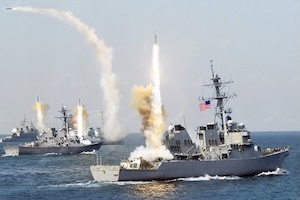
Steve Ellner talks about his recent commentary, “U.S. Imperialism Enters a New Stage: The Left Needs to Take a Close Look at It,” which examines Donald Trump’s rhetoric and actions against Iran, Venezuela and Cuba which have few parallels in modern history.
Ellner has lived in Venezuela for over 40 years and is author of more than a dozen books.
SCOTT HARRIS: Right now, I’m very happy to welcome to our program, Steve Ellner, retired professor at Venezuela’s Universidad de Oriente, where he lived in Venezuela for 40 years. Steve is the author and editor of more than a dozen books on Latin American politics and history. And he’s currently serving as associate managing editor of the publication Latin American Perspectives. And he just wrote a commentary for Counterpunch on April 21, titled “U.S. Imperialism Enters a New Stage,” that we’ll be talking about. Steve, thanks for making time for us this evening. Appreciate it.
STEVE ELLNER: Good to be on the program, Scott.
SCOTT HARRIS: So Steve, in this article, again, the title of which is “U.S. Imperialism Enters a New Stage,” you, of course, discuss Trump’s current military attack on Iran that’s now … We don’t know where these peace talks are going. There is a shaky ceasefire in place, but of course there was the kidnapping and invasion of Venezuela in early January, as well as the current oil blockade of Cuba. And you talk about the demonization of these nation’s leaders and these military offenses that you say are different from previous U.S. administrations’ military aggression against their declared enemies. And we’ve seen a lot of the administrations use our military in that fashion for decades and decades.
STEVE ELLNER: Yeah. Scott, I would say that there are two main aspects which define the moment and shed light on U.S. actions in the three cases that you just mentioned: Iran, Venezuela and Cuba. One is the weakness of the justification for the use of military force. There are always justifications. I mean, Hitler had justifications—so that’s a constant—but the weakness of the justification compared to past administrations. And the other element that I would emphasize is that since the end of the World War II and since the beginning of the Cold War, the United States has militarily intervened in countries throughout the world, but the military element is now predominant. And the military aspect was never so blatant and so simultaneously widespread. I mean, the Vietnam War lasted—U.S. involvement lasted about 10 years. But during that period, you didn’t have so many different military theaters of U.S. action taking place simultaneously with such flimsy justifications.
The U.S. blew up—since the beginning of the second Trump administration—it has blown up 55 boats in the Caribbean and the Pacific. They’ve killed at least 186 men. No names have been provided even though a spokeswoman from the Pentagon stated that they know the names of all these people who have been killed. And yet, they haven’t released the names of these supposed drug smugglers.
And even if they were drug smugglers, it didn’t justify their fate. In the past, interdiction was used. Boats would be taken over and these men would be apprehended. That’s been the standard practice up until the second Trump administration. In the case of the kidnapping of (Venezuelan President Nicolás) Maduro and (his wife) Cilia Flores that you mentioned, the justification being that they belonged—or that he, not Cilia Flores—but Maduro headed the Cártel de los Soles, a supposed military cartel. And that was used going back to the first Trump administration. (William) Barr, the attorney general used that shortly after the United States recognized Juan Guaidó as president of Venezuela.
In other words, that was a military maneuver. I’m sorry, there was a political maneuver on the part of the first Trump administration. So the justification for going after Maduro all along was that he headed this Cártel de los Soles. No evidence at all for that. No concrete specific evidence for that. And so much so that after Maduro, charges were brought against Maduro in New York in January, the Cártel de los Soles practically was not referred to. It was referred to one or two times, but referred to as something like a culture of corruption in the military. So that’s kind of a misnomer because a cartel is not a culture of anything. A cartel is a top-down organization, as we know in the case of the cartels of Mexico. So those are the two elements that I would emphasize. The military element is now dominant more so than in the past.
And the justification for these military actions are extremely flimsy. Legitimacy of the actions are very much up in the air.
SCOTT HARRIS: Thanks for that, Steve. You wrote in this commentary that since the Cold War era, the U.S. has perfected its use of economic sanctions to punish nations that weren’t compliant with Washington’s policy priorities. And for many years, the U.S. imposition of sanctions has been used in what I think people in the countries that are targets would interpret as collective punishment. And we’re talking about Cuba, Venezuela, Iran, Nicaragua. I mean, there are dozens of examples around the world and they’re sometimes predicated on a struggle for democracy, but of course there’s a double standard. The United States is allied with, provides money and arms to many countries that are not democracies, that are monarchies or brutal dictatorships. Again, that’s a double standard. What are the effects of sanctions on those nations’ internal policies that often leads to security states that close down space for dissent and/or repression of democratic movements that Washington often likes to say they support?
And Iran might be an example of that. Donald Trump talked about help was on its way to the democratic movements. There were, by many accounts, thousands of protesters in the streets in January that were killed by Iranian security forces. But these sanctions and this war certainly are not helping that movement by many accounts that I’ve heard.
STEVE ELLNER: Certainly, Scott. And there’s a double standard also. If you consider that all of the studies of international sanctions—there have been a lot of them used by the United States, mostly by the United States. The studies indicate that the sanctions really amount to acts of war and that war and democracy are incompatible. And you mentioned the case of Iran. Under Obama in 2015, a deal was reached. A treaty was signed. And as a result, the sanctions were eased. And as a result in Iran, there was a relative—I say relative, I don’t want to overemphasize that—but there was a sort of a liberalization process in the country. The hardliners associated with Mahmoud Ahmadinejad, who had been president prior to that, lost out. And there was somewhat of an opening up process.
Maybe it didn’t go very far. There wasn’t much time for that to happen because Trump came back in 2017 and John Bolton was largely in charge, was the architect of foreign policy for several years then. And his position was one of regime change in Iran. But there is a correlation there between sanctions and repression and sanctions and undemocratic behavior.
In the case of Venezuela, there’s a lot of talk about the elections of 2024, those elections being rigged. I’m not going to get into that, but I mean, there are two sides to the story, which I won’t render an opinion about. But in any case, I believe, and I state this in the article, that regardless of who won those elections, those elections never should have been held because the Venezuelan voters had a gun pointed at their head. And they knew full well that if they voted for Maduro, if Maduro was re-elected, the sanctions would remain in place and would be even, you know, made even worse. And if the opposition won, the sanctions would be immediately released. So that can’t be democratic.
And as a result, I argue in the article that Maduro should not have held those elections. He should have stated openly to the United States: “Look, if you want democracy in Venezuela, lift the sanctions and we’ll hold open, free, and honest elections.”
SCOTT HARRIS: Thank you for that, Steve. We’re speaking with Steve Ellner, a retired professor at the Universidad de Oriente in Venezuela where he lived for 40 years. And we’re talking about his article, “U.S. Imperialism Enters a New Stage” that you can find on the counterpunch.org website published on April 21. Steve, I did want to ask you about corporate media. Here in the United States, we find many examples of corporate media and even some progressive left activists who often don’t fully understand the connections between Washington’s sanctions and the economic collapse of nations that often provoke a mass exodus of refugees and internal political conflict, much as the U.S. has designed it to do. So it’s like a country is targeted economically, maybe militarily, and these countries clamp down on dissent inside the countries, as much as we just talked about a moment ago. But what’s the media coverage that we see that really discounts that link?
STEVE ELLNER: Yeah. I think that the demonization of a president, be it the president of Venezuela, be it Maduro, be it the Cuban government, be it the government of Iran—that the demonization goes hand in hand with sanctions and military action. The demonization is the first step. And you mentioned writers, even writers on the left, who participate in this demonization. I would make a distinction between criticism and valid criticism. I have plenty of it. I’ve been writing on Venezuela for my entire career as an academic and I have plenty of criticisms. I had them of Chavez and Maduro.
There’s a distinction between criticism and demonization and the demonization in which unfortunately some scholars on the left demonized Maduro. That demonization really plays in to the measures that are taken against Venezuela. It really began in 2014. There were demonstrations, they were known in Venezuela as the “guarimba.” It was four months of demonstrations, civil disobedience, violence. There was a certain amount of violence on both sides. Repression on the part of the government, but also there was shooting. There was all kinds of resistance on the part of the demonstrators and attacks on police and national guards, several of whom were killed.
So both sides were playing rough, but that kind of paved the way for the sanctions that began with Obama. They didn’t begin with Trump and his first administration. Obama declared Venezuela a threat to U.S. national security and that had economic ramifications. U.S. companies one after another pulled out of Venezuela, the credit rating companies. Moody’s for instance, downgraded Venezuela’s credit rating and there was what’s known as “over-compliance,” in which companies just refused to have anything to do with Venezuela just out of fear that there will be secondary sanctions against them. Companies throughout the world, not just U.S. companies.
So that there is a correlation between the demonization of a given president and the measures that are taken against that government that really affect the entire population. And I think that this can’t be emphasized enough because in the case of Maduro, the media, the New York Times, the so-called liberal media, the corporate media, the mainstream media—they all referred to Maduro as a dictator. Every time they referred to “Maduro, the dictator, Nicolás Maduro.” I compared that. I looked up, I Googled (Abdel Fattah) el-Sisi, the president of Egypt and the crown prince of Saudi Arabia. And Saudi Arabia gets referred to as the kingdom of Saudi Arabia. Sisi never got referred to as a dictator. I mean, that wasn’t a label as that word was with regard to Maduro every time his name was mentioned. So that really led into what happened on Jan. 3rd. The Jan. 3 (abduction) could not have taken place without the demonization of Nicolás Maduro.
SCOTT HARRIS: Right. Well, we only have a couple minutes left and I wanted to ask you briefly about the current situation in Venezuela. After Trump ordered the U.S. military to raid the Venezuelan capital, Caracas and kidnapped President Maduro and his wife, Trump has reached some kind of unknown arrangement with Delcy Rodriguez, the acting president of Venezuela that in exchange for U.S. access to Venezuela’s oil, Trump for the moment, won’t attempt to overthrow Delcy Rodriguez’s government of the United Socialist Party of Venezuela. And that’s, of course, both the party of Maduro—who got kidnapped and Hugo Chavez, who was enormously popular in Venezuela before his death. But yeah, tell us—and we only have a couple of minutes—but do you tell us what you know about the current situation. It’s a very strange situation between this arrangement between Washington and Caracas.
STEVE ELLNER: Yeah. Well, it is a kind of strange situation. A lot of people are wondering why the present government of Delcy Rodriguez is making so many concessions to U.S. capital. But one thing that has to be emphasized is that Delcy Rodriguez and Jorge Rodriguez’s brother—they’re running the show now. They’re the son and the daughter of a very important leftist leader back in the ’60s and ’70s, who in 1976 was captured and killed. He was tortured to death. So I think that’s background information that has to be kept in mind because some people are saying that the Rodriguezes have turned their backs on Chavez and on Maduro. But I think really to understand what’s happening, we have to keep in mind what happened on Jan. 3rd, how uneven the military balance.
I mean, we all know, I mean, it’s not surprising that the number one military power in the world was easily able to go into Venezuela and do what they did, but what was unanticipated was the use of cyber … There was a cyberattack Venezuela was unprepared for. Cyber instruments were used, they were debuted in the attack. And Trump made reference to that. He called this new instrument the “discombobulator” and he said that he wasn’t allowed to talk about it. But that it was used and it was used. And the security people who were killed, 32 Cuban security forces and the Venezuelans who were killed, I mean, their faces were blown to pieces. Venezuela had to identify these people by the use of DNA so that the threat—and this threat has been made to Delcy Rodriguez, that if she doesn’t tow the line, there’ll be a repetition and this is what she was told it could be even worse—which obviously means that she would be taken out. So that has to be kept in mind. And the other thing that has to be kept in mind is that the sanctions are still in place.
The media talks about the fact that the sanctions have been lifted by Trump. And that’s really a distortion because the sanctions have not been lifted. What they’ve done is they have issued licenses. The licenses that allow, for instance, that will allow U.S. investors to travel to Venezuela and make deals. So they’re given special permission to get around the sanctions, but the sanctions are intact, basically. And so Delcy Rodriguez is really doing what she can in order to maintain her government to avoid the right-wing from coming in because there’s all the evidence in the world that if Trump were to do what Marco Rubio wants and what the many Republicans are calling for, which is regime change, Mariá Corina Machado would come in and she stated that basically that she wants to see these people in jail, which really is a euphemism for something that would be worse. And so I think that those factors have to be brought into the equation. And this is really what’s motivating her in order to maintain some kind of rapport with the Trump administration.
SCOTT HARRIS: Right. Well, there’s a lot more to talk about and I’m sure we’ll be hearing more about it in the weeks and months to come and would love to have you back, Steve. You want to leave our listeners with any websites, your own or that of the publication Latin American Perspectives before we say goodnight?
STEVE ELLNER: Yeah, sure. Latin American Perspectives is a progressive journal. It comes out of California. It’s been around for 50 years. We just celebrated our 50th anniversary and some of our articles are open source and can be accessed for free. So if you go to our page, you can identify those articles that are free. And if you are students who have access to journals through their library, we come out once every two months and most of our issues are thematic issues on different topics related to Latin America.
SCOTT HARRIS: All right, Steve, we’ll be staying in touch. Thanks for spending time with us tonight to talk about all these important issues about Trump’s new era of imperialism, as well as what we talked about in Venezuela. Thanks, Steve.
STEVE ELLNER: Good to talk to you. Sure.
SCOTT HARRIS: Bye-bye. That’s Steve Ellner, a professor at Venezuela’s Universidad de Oriente where he lived for 40 years and is now with the publication Latin American Perspectives.
Subscribe to our Weekly Summary