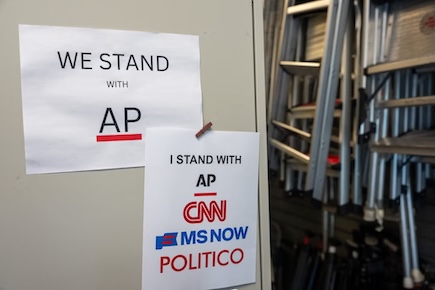
Victor Pickard, the C. Edwin Baker Professor of Media Policy and Political Economy at the Annenberg School for Communication at the University of Pennsylvania, discusses Donald Trump’s decision to ban CNN, MSNOW, and Politico from the White House grounds, revoking their press credentials and triggering a major constitutional showdown over press freedom. He focuses on this recent issue in the context of the many other instances of Trump regime attacks on journalists, media outlets and the constitutionally guaranteed freedom of the press.
SCOTT HARRIS: As we begin our program tonight, I want to thank Victor Pickard for joining us. Victor is the C. Edwin Baker Professor of Media Policy and Political Economy at the Annenberg School of Communication at the University of Pennsylvania. His most recent book is titled Democracy Without Journalism: Confronting the Misinformation Society. Victor, really good to hear your voice this evening here on our show.
VICTOR PICKARD: Thank you, Scott. It’s great to be back on the show.
SCOTT HARRIS: I’m very happy you could join us. I know you’ve got a lot going on in your professional life these days. So again, appreciation for making time. And I wanted to talk first off about President Trump’s order banning three media outlets from the White House. That would be CNN, MS Now and Politico. And a federal judge recently issued a temporary restraining order to reinstate the news outlets, although Trump for a time delayed compliance with that ruling. But this is of course just the most recent example of Donald Trump and his regime’s war against the media and the Constitution’s First Amendment, free speech and freedom of the press provisions. It’s really a foundation of our democratic form of government. And Trump, who always has called the media the enemy of the people, seems to be escalating his attacks. I know there’s a lot to talk about other actions that he’s taken against the media, Victor, but as we begin, just tell us some of your initial concerns and observations about this latest attack on the media.
VICTOR PICKARD: Right. Well, I think you contextualized it very well and I’m sure we’ll get into the bigger picture here because you’re absolutely right that this is just the latest in a slightly different type of attack on the press that we’ve come to expect from this administration. But this one was glaringly offensive for a number of reasons. One is that it just blatantly ran afoul of the First Amendment, freedom of the press in particular. And it is based on this posture that Trump takes. It’s almost dictatorial where he thinks he has this absolute power to dismiss the press if they displease him in some way. And really they do have a First Amendment right. I’m not an expert on constitutional law, but all the analyses that I’ve read convinced me that this will not hold up in court under First Amendment protections. But beyond that, this is how we keep our political elites accountable to the public.
And even though so much of this White House-based journalism is what we often call access journalism, it is very performative and ritualistic. It’s dependent on having access to these official sources, which is often a problem with our professional press. Nonetheless, it is a way that we are able as a society to communicate that politicians serve at our pleasure. They must be accountable to the public. And for Trump to summarily dismiss them was really a violation, not just the freedom of the press, but really of democratic society writ large. And the last thing I’ll say is that as much as we might prefer a different kind of journalism, obviously if we were given the choice, we would probably ask for more investigative reporting as opposed to this kind of just listening in on elites and hearing their oftentimes carefully manufactured sound bites. But every once in a while, the journalists force them to speak off the cuff and we do occasionally get some new information on very important political matters, which of course during an election year is especially important.
So these are all a number of reasons and there are others why this latest move by Trump was so glaringly anti-democratic and it’s something that we have to oppose obviously.
SCOTT HARRIS: Thank you for that, Victor. There was an interesting passage in a story written in the New York Times by Peter Baker. He wrote, “At the White House gate, a throng of Chinese journalists was being admitted onto the grounds of the executive mansion to cover President Xi Jinping of China’s visit to the White House. And then out on the street, several American journalists were blocked from entering the White House on the orders of President Trump.” So you have state media from China able to cover this event while several important U.S. media outlets were blocked. I don’t know if it’s funny or sad, alarming.
VICTOR PICKARD: Yeah, I’m not sure whether to laugh, but finding those kinds of contradictions and hypocrisies, there are so many and yet it doesn’t seem to shame Trump and his allies into better behavior, unfortunately.
SCOTT HARRIS: You’re right about that. Trump, through this whole banning of the media outlets, Trump has asserted that he can limit media outlets from covering the White House. A lot of discussion now has centered around what the Constitution and the courts say about a president’s right to pick and choose what media outlets and journalists get to cover his presidency. Trump says it’s a privilege and not a right, which I think directly contradicts the First Amendment. And then, of course, you also have Trump after his initial comments about not liking their coverage and not writing good stories about him, they resorted to that old chestnut “national security,” justifying the banning of these outlets on the basis of somehow these media outlets were jeopardizing national security.
VICTOR PICKARD: Yeah. I mean, obviously none of this passes the sniff test. I think in many cases they are fabrications on their face. But again, as we were both sort of suggesting earlier, so much of this is part of Trump’s broader attack on the press. And by now we understand that any news narrative that diverts from his official version of events, from his preferred talking points is automatically attacked. And really, I think the end goal for a lot of these kinds of attacks against the press is to undercut any capacity for independent journalism, for narratives and talking points that aren’t aligned with Trump’s official positions and his broader agenda. And we’ve seen him do everything from throw frivolous lawsuits against the press to trying to jail individual journalists, to weaponizing the Federal Communications Commission, to go after particular news organizations that have said things that he doesn’t like, or even comedians in evening television programming that make jokes that he doesn’t like that offend his ego.
And he’s doing everything, throwing every weapon that he can find at the press. And oftentimes it’s quite legally dubious. And in some cases, even when the law at least temporarily tempers the White House, he continues doing it anyway. So there’s a lot of illegal action going on in this front as well. And I think it’s shameful for any democratic society worthy of the name. It really is taking a page from the Viktor Orban playbook to try to bully the press into behavior, into subservience. And it’s been even more pronounced during his second administration. It’s something that historians are going to be writing about for a very long time, but unfortunately we’re living through it right now.
SCOTT HARRIS: Victor, one bright side of this whole mess and violation of the First Amendment from Trump and his regime was that for the first time in both of Trump’s terms as president, we saw major corporate media outlets demonstrate some solidarity with their collective decision to boycott the White House press pool as long as CNN, MSNow and Politico were excluded. This is certainly a welcome development, but we have to ask why this little bit of courage took so long.
VICTOR PICKARD: It does seem in many ways too little, too late, but I agree with you that we have to celebrate the wins and the bright spots whenever we can. And I was pleasantly surprised, to be fair, to see that kind of solidarity. People have been calling for that for a long time. There was a press ban at the Pentagon. Trump routinely attacks individual journalists, often female journalists. Excuse me. So we’ve been waiting for a long time to see this kind of spine from the fourth estate where they do practice this kind of solidarity. And hopefully we see more of it. I mean, if anything, I would hope that it emboldens them and makes them realize that when they do stick together, they really can be quite a force. I mean, there was that somewhat comical moment where Trump was trying to have a press event at the White House, but there was no television feeds or there was no audio feed to capture what he was saying.
So he’s also being disciplined a bit here, sort of turning the tables on him to show that he relies on the press and the press has this kind of power and they really should operate, utilize it accordingly.
SCOTT HARRIS: Definitely. Well, let me reintroduce you to our audience here on Counterpart. We’re speaking with Victor Pickard, the Edwin Baker Professor of Media Policy and Political Economy at the Annenberg School of Communication at the University of Pennsylvania. And I wanted to ask you, Professor Picard, to summarize for our audience, some of the Trump regime’s record of attacking free speech and attempting to censor the U.S. media that he has long described, as I mentioned earlier, as the “enemy of the people.” It’s a long list and I’m sure even if we were to recite each instance for the rest of the program, the next hour and 45 minutes, we wouldn’t have time. But I wondered if you would summarize some of the most alarming things apart from what we’re seeing here and discussing tonight about the exclusion of these three media outlets from the White House.
VICTOR PICKARD: Well, as you know, there are so many examples of these kinds of attacks. And I do think it is a form of authoritarian media capture where I mentioned the Viktor Orban regime of Hungary earlier where it’s an insight for many of these types of would-be autocrats that they don’t necessarily have to police the media directly. They don’t have to march in and take over newsrooms at gunpoint, but they often can rely on friendly media oligarchs to do the policing for them. And I think oftentimes it’s those subtle, less visible forms of media control where as we’ve been hearing in recent weeks with these ongoing mergers, especially Paramount and Warner Brothers I’m thinking of, where Trump is basically accommodating and helping to coordinate these huge media conglomerate mergers where he’s going to have friends take over the media. And we already saw what happened to CBS.
We might expect the same with CNN where the Ellisons are taking over newsrooms. So that’s the more kind of less visible, in some ways, more troubling form of capturing our media. But the more blatant one, and the one that probably keeps me up at night the most, and it might be because I’m a media policy scholar, so much of my work has focused on the Federal Communications Commission, especially the long history of this agency, and to see how the Trump administration has weaponized the regulatory agency. And I used to always call out various kinds of regulatory capture, but that was normally when the Federal Communications Commission was essentially performing customer service for the industries that it purportedly regulated. But now we’re seeing a different kind of capture where the current FCC Chairman Brendan Carr, essentially operates as Trump’s personal attack dog. And so when Trump singles out, whether it’s Jimmy Kimmel, earlier of course it was Stephen Colbert, there’s been various individuals that have upset Trump and he’s used different kinds of instruments to try to rein them in.
But the extent to which the FCC, especially under Brendan Carr, has been willing to pull out these obscure media policies like “equal time rules” or “news distortion rules” to try to club stubborn media organizations with these media tools and weapons, that has been especially troubling from my point of view. And that’s something, I mean, it really is straight out of a kind of authoritarian regime where a purportedly independent agency like the FCC is being weaponized in this way. It really is unprecedented. We’ve never seen anything like it in the agency’s history. So that’s one of the more, I’d say, glaring violations, but of course there are many others that we could pick out.
SCOTT HARRIS: Right. And on the score of the FCC’s involvement in chilling free speech or directly attacking it, we saw Jimmy Kimmel, a decision by his network not to air an interview that he had conducted with Texas Senate candidate James Talarico. And it kind of backfired in a way because he put it online on his TV show’s website and it got a lot more views than it may have gotten if it was aired live on his TV show. But that’s an example where the FCC and Brendan Carr may not have directly threatened the network to penalize them if they aired the interview, but the chilling effect was such that they just preemptively said, “No, we’re not going to air it, the lawyers at the network.”
VICTOR PICKARD: Yes, that’s a great example. And even that is an example that we’re aware of. And as you sort of imply, this whole process of chilling the media, getting them to kind of internalize these boundaries over what they’re allowed to cover, what might upset Trump, we have many of these more pronounced, more visible incidents where it’s so clear what the Trump administration is doing and what the FCC is doing, but it’s really hard to measure all the kinds of news stories that aren’t being covered, all the things that journalists are afraid to say, which they should be saying.
If we were living in a healthy democratic society when we see so many abuses of power by our government, by the Trump administration, this is something that journalists should be covering day in and day out. We should be seeing all kinds of exposés and investigative muck-raking journalism just uncovering all the rank corruption that really is so evident.
I mean, it really is so abundant, but our media has just been beaten into submission and there are courageous exceptions, but unfortunately this chilling effect has been all too successful.
SCOTT HARRIS: I did want to ask you, Professor Pickard, to comment on a recent article you wrote for the Progressive Magazine, how to fight media oligarchy. And you just mentioned the Ellisons and the other corporate concentration of ownership, Trump allies that now control important parts of our media system. And you argue that the growing concentration of U.S. media ownership in the hands of billionaires really poses a fundamental threat to democracy that require both structural reforms and as you say, building a strong independent nonprofit public media system that can be insulated from both corporate and government control. And we see that to some extent in a lot of European nations. So I know we could learn some lessons there, but maybe summarize a bit of what you would like to see happen in confronting this growing consolidation of these oligarchs buying up media properties.
VICTOR PICKARD: Sure. Yeah. I think the first thing I’ll say, which I’m sure many of your listeners would readily agree with at this point, is that we do need to break up these media conglomerates. We need to unwind, roll back some of these mergers, this kind of merger mania that we’ve been going through. And we do have the antitrust tools. We could go back to some old-fashioned trust-busting. There’s a growing anti-monopoly movement, and I think there are signs of hope in an otherwise dismal media landscape that there’s a real public appetite to go after the media oligarchs. And also seeing this as symptomatic of these broader problems in our society today where there are ever growing concentration of wealth and power amongst a handful of plutocrats. And this is reflected in our media landscape where they’re dominating so much of our core information and communication infrastructures.
But as you sort of suggested there, my argument goes a bit beyond that, especially in this piece that you mentioned that I wrote for the Progressive a couple months ago. I’m really trying to draw attention to the fact that as much as we must do that kind of trust-busting work, and that’s absolutely essential, it’s also insufficient. It’s not enough. We need to build out an alternative media system that’s not pegged to these commercial logics that doesn’t treat media just like commodities, that treats members of society not just as consumers, but engage citizens in a democratic polity. And the only way to do that is to create more of a public, independent, nonprofit media system. So as much as we want to see more competition in the commercial media landscape, we want to break up some of these media monopolies. But just having smaller commercial profit-driven news organizations isn’t going to provide the kind of journalism we need, especially at the local level where we just see our newspaper industry completely decimated and we’ve got news deserts all across the country.
And that is, as you noted, most democratic societies have always maintained robust public media systems because they know there’s certain things that a commercial media system will never do. And I would go beyond that as well. I’m not suggesting that we just need to throw more money at NPR and PBS, although that might be a start since of course at this point we’ve entirely defunded them, which is another tactic that the Trump administration used to weaken the press. But I think we also need to democratize our public media and again, really focus on the local level, create more news outlets like yours, Scott. We need more of your kind of journalism that really is devoted to public service and not just trying to make money.
SCOTT HARRIS: Yeah, we certainly don’t make boatloads of money here, so we could use a hand. But no, that’s an important subject I know we’ve talked about in the past and something we shouldn’t let go of in hopes for a better future in terms of our media system. One thing about the oligarchs that you pointed out in a recent social media post is that Elon Musk recently suspended the Catholic Bishop’s account in Brazil in advance of Brazil’s presidential election, which that process starts very soon in Oct. 4th. But maybe you could speak about how Elon Musk is using his platform to directly impact politics both in this country and abroad.
VICTOR PICKARD: Yeah, I think Elon Musk is a textbook example of why media ownership matters. It gives them this kind of gatekeeping power over what news and what communications, because it’s not just an information infrastructure, but it’s also how we can communicate with each other. It really should be seen more as a kind of public utility, but instead Elon Musk is able to use it as his own propaganda amplifier and algorithmically he’s able to determine what gets platformed and what gets de-platformed. And for example, news stories and things with particular kind of links do not get circulated as much and you need to pay him to get the blue check now. So he’s doing all kinds of things to really censor what circulates through what unfortunately, and I’ve mostly moved to Blue Sky. We really should try not to even use X anymore, but unfortunately governments around the world are still using it, still a very important means of information and communication.
So he’s using it to advance not just conservative, but in many cases fascistic and white supremacist politics. And this is very dangerous, but we also see this happening with Facebook, with Zuckerberg. You could even argue we see this with the Washington Post with Jeff Bezos where he’s determining what the editorials are allowed to focus on, what the op-eds should be focusing on. So we see all kinds of these types of gatekeeping where the media oligarchs are able to weaponize their holdings and their assets. And it’s really antithetical to a healthy democratic public sphere. It’s something that we definitely have to stop.
SCOTT HARRIS: Well, we only have a couple minutes left and there were just some insane things that have happened regarding media and media access recently. I though I’d mentioned that we haven’t talked about yet. And that’s Trump paying for—with U.S. tax dollars—Trump advertisements that are appearing, I guess on some media outlets now, that boldly say at the end of these advertisements, some of them drawn directly from his 2024 presidential campaign, that these ads were paid for by U.S. taxpayers, blatant violation of some basic laws surrounding that.
And then we also have this other thing I thought I’d get your comment on, which is Trump recently launched a paid subscription service called Truth API that charges $100,000 a month for a multi-second faster access to the president’s posts on Truth Social, as well as some other accounts. Of course, this would benefit stock market investors who are looking for an edge on some presidential announcement about a war or a tariff or all those things that make up the reasons why the stock market goes up and down.
A brief comment on that, if you would, before we have to conclude.
VICTOR PICKARD: Yeah, I’m just glad you mentioned those, Scott, because again, it’s like you can’t make this up. It’s so corrupt. The propagandistic piece that our government that we all are helping to pay for now is being run on Fox News and Newsmax and I think other outlets now. And it’s just mind-blowing how blatantly propagandistic it is. There’s also the recent Trump TV venture, which is I think a YouTube channel where he’s trying another type of propaganda there. But yes, this is something that just is unacceptable for a democratic society and it’s something we’re going to have to stop. I think we have a couple of years left of fighting this, but eventually we’re going to have to create something better.
And this is where I’m weirdly optimistic. I actually do think we’re going to be able to build something better to emerge from the ashes. We’re going to have to because there’s just so much waste to our media landscape and we’re going to have to reconstruct a new system from the ground up that’s truly democratic and truly publicly owned and controlled.
SCOTT HARRIS: Well, as much as we’re running through this very dark period, I always like to, as you just did, leave on an optimistic note, because otherwise, why are we even talking about this stuff? That’s right. Let’s just go have fun drinking a lot of alcohol or taking a lot of drugs and listening to music.
But yeah, there’s a lot of work to do and I’m really looking forward to our next conversation because I am optimistic like you that we will turn the corner and a lot of people will join up to create that better future. Thank you so much.
VICTOR PICKARD: Thank you, Scott. Great talking to you.
SCOTT HARRIS: Thanks, Victor. Take care. Goodnight. That’s Victor Pickard, the C. Edwin Baker Professor of Media Policy and Political Economy at the Annenberg School of Communication at the University of Pennsylvania. His most recent book is Democracy Without Journalism: Confronting the Misinformation Society.