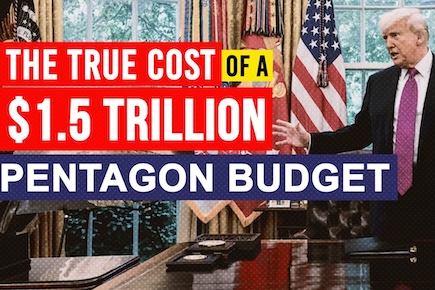
Lies, Exaggeration Fail to Justify Massive $1.5 Trillion Pentagon Budget

Interview with Melvin Goodman, a senior fellow at the Center for International Policy, professor of government at Johns Hopkins University and a former CIA analyst, conducted by Scott Harris

Melvin Goodman, whose latest book is titled, American Carnage: The Wars of Donald Trump, talks about his recent Counterpunch.org commentary, “The Sordid Politics of Defense Spending” and “Donald Trump: Killer of Arms Control and Disarmament,” regarding Trump’s requested increase of $1.5 trillion in defense spending justified by a massive exaggeration of national security challenges.

SCOTT HARRIS: We begin our program this evening with our good friend, Mel Goodman, a senior fellow at the Center for International Policy, a professor of government at Johns Hopkins University, and a former CIA analyst. Mel’s books include one of his more recent books titled American Carnage: The Wars of Donald Trump. Mel is the national security columnist with Counterpunch. And Mel, I appreciate you again making time to be on our program tonight to talk about all the “good news” we’re getting from all quarters.
MEL GOODMAN: It’s my privilege. I always look forward to being on the air with you.

SCOTT HARRIS: Thanks, Mel. So your recent article titled, “The Sordid Politics of Defense Spending,” that’s a topic that doesn’t get discussed as often as it should. It’s the largest piece of money there in our budget for many, many years. And I thought a good way to sort of introduce your own experience having been a CIA analyst and upfront and close with the decision-making about increasing the Pentagon budget every year. I think that’ll be instructive for what we’re going through now. But I’ll start with a quote from our president, Dwight D. Eisenhower. In his January 1961 farewell address, Eisenhower warned the nation about the industrial complex and the threat of just insane amounts of money going out the door. And of course, Eisenhower was a general during World War II, a military man. That was his career before he became president. And that was worth listening to.

Here’s a guy in the military and as president who really understood the threat of what he termed the military industrial complex.

MEL GOODMAN: Well, I was fortunate when I was at Johns Hopkins University as an undergraduate in the late 1950s and early ’60s. Ike’s brother Milton was the president of Hopkins University. And he used to meet with a group of undergraduates, a small group. I was fortunate to be a member of that group. And he told us a very interesting anecdote. And that was he was involved with his brother in the writing of that speech. And in the original draft of it, in Ike’s own hand, he had added the word “congressional.” So it was military, industrial, congressional complex. But when he gave the speech, he dropped the reference to the Congress. And when Milton asked his brother Dwight about that, the president said, “Well, it was enough to take on the military and the industry, but I couldn’t take on the Congress too. But frankly, I think that’s where the problem is.” And I always remembered that story because I think there’s a lot of truth to it.

I think the Congress is still a major problem when it comes to armed spending. Too many of them—often a large majority and they’re usually bipartisan majorities—think of the defense bill as a jobs bill. And they’re not going to give up programs in their own states. And that was true for liberals just as it was true for conservatives. So whether you had a Sen. Lieberman in Connecticut protecting the submarine industry in his state or the liberal senators from California protecting Lockheed Martin or the work of the Southern congressmen, particularly protecting military programs in their state, they weren’t interested in cutting the defense budget. I’m hopeful that for the first time, there’s some reason to think that the Democrats are starting to realize that they’ve got to do something about this defense spending. We spend more than the rest of the world spends on defense. And I don’t think that’s understood.

And then when you add in those countries that really are our allies and you add that to our defense spending, we overwhelm the spending of Russia and China, let alone Iran and North Korea who are considered our adversaries. And you have to wonder, what is this money being used for? Do we need to be spending this kind of money? Do we need to be modernizing nuclear weapons that already have an overkill capability? So Congress is part of the problem. The military certainly is the problem. They object to arms control, which I think is an important aspect of this. That’s why I give President John F. Kennedy a certain amount of credit for pushing the partial test ban treaty in the 1960s after the scare of the Cuban missile crisis. So a lot of work has to be done in this respect and it’s hard to find people running for the Congress who are taking this on as a major issue.

So I’m hopeful that maybe there’s some sign of recognition that we’ve got to reverse the spending on the military. We’re overspending. There’s the modernization problem, the overkill problem, the competition, the arms race. Most years we were in an arms race with ourselves. Now we have Russia and China in sort of a semi-alliance also increasing their modernization. So it’s a major turning point right now.

SCOTT HARRIS: Thank you for that, Mel. So in your recent commentary, again, the title of which is “The Sordid Politics of Defense Spending,” people can find that at the CounterPunch.org website. You recount the history of your direct experience at the CIA working as an analyst there of how the U.S. military budgets have skyrocketed on the basis of mostly exaggerated threats from Russia and/or China. And now Donald Trump is requesting a $1.5 trillion Pentagon budget, the largest in U.S. history and larger, as you said a moment ago, than the military spending of dozens of the world’s largest nations combined. And I was just reading this. The U.S. budget combined is larger than the next 18 to 34 countries. I mean, it’s hard to even understand the amounts of money going out the door there. And we always think about the peace dividend in the good old days after the Cold War ended with the demise of the Soviet Union.

Well, that peace dividend really never did materialize in any meaningful way. But I wonder if you would speak about the fact that the Pentagon, with all this money, the lion’s share of our budget, our national budget has never passed a financial audit.

MEL GOODMAN: That’s true. I think they’re the only agency in government that’s never passed an audit. But the classic situation that I can speak to was the 1980s. And that’s when you had Ronald Reagan come into the presidency, committed to a huge increase in defense spending, which amounted to the largest peacetime increase ever in history at that point. And to do that, he needed to get an intelligence argument that he could take to the Congress to explain the need for all of the defense spending. So he appointed an ideologue, an anti-communist ideologue, William Casey, as CIA director. And William Casey had a loyalist by the name of Robert Gates as deputy director for intelligence. And their job was to politicize the intelligence to make the Soviet Union look a lot stronger than it really was. And when you go back to the 1980s, this was the period of the great Soviet decline.

They were on their way to essentially the ash bins of history, eventually collapsing in 1991. But it started in the early ’80s and it was well known by the time Gorbachev came into power as the Soviet general secretary. So here was the Soviet Union beginning in a stage of collapse. We were rushing ahead with modernizing strategic weapons and increasing the defense budget. And the military has always been smart about how to exploit presidents. I remember when I was at the National War College in the 1990s, there was a meeting of the joint chiefs of staff with the president of the United States, Bill Clinton. And it was in 1998. And of course, this was the time that Clinton was in a lot of political trouble domestically because of the Monica Lewinsky affair and his lying about the affair. And this is when the Chairman of the Joint Chiefs of Staff Army General Hugh Shelton chose to bring Clinton over to the National War College.
I tried to get into the session, but of course I was denied entry. And Shelton laid out his demands for increased spending. And a week later, Secretary of State William Cohen, who was a Republican member of this Democratic administration, announced all of these changes in defense spending that would lead to very significant increases. So the military is smart about this. They know how to manipulate presidents, particularly at times of weakness. And now when you have a military that’s led by (Pete) Hegseth, as you mentioned and the absence of any diplomatic counter, because you really don’t have a Department of State at this opportune time, at this very important time, because Marco Rubio spends most of his day at the White House. I’ve talked to people at the State Department. They’ve never seen Rubio at the Department of State. And of course, he’s not only Secretary of State, but he’s also the National Security advisor.
So there’s no one who’s going to stand up to Donald Trump to sort of try to adjust this defense spending. He’s going to get what he wants. And usually you get bipartisan majorities. This is one of the few subjects in the entire political agenda where you get Democrats and Republicans agreeing. And since the nation is at war, the Trump administration will use that to their advantage to argue that anyone who opposes the defense budget at this time is really selling out American troops who are putting their lives on the line. Of course, we don’t talk about a war that’s totally unnecessary, illegal, and counterproductive. And basically when you look at the corporate media, the mainstream media, they’ve always been supportive of the military and they’ve always been supportive of this kind of military spending. The Washington Post regularly editorializes on the need for greater defense spending.
And the New York Times has moved in the same direction. So the idea that we need to spend more at this time, particularly on strategic weapons where there is this overkill capability, as I mentioned, is just ludicrous. But that’s where we are right now.
SCOTT HARRIS: Thank you for that, Mel. You’re listening to Counterpoint here on WPKN Radio and speaking this evening with Mel Goodman, senior fellow at the Center for International Policy, professor of Government at Johns Hopkins University, and a former CIA analyst. Mel, I wondered if you give us some examples from recent times or during your career at the CIA of the waste, fraud and abuse. I mean, we hear a lot about waste, fraud, and abuse. It’s kind of a buzzword. The rhetoric you hear from people like Donald Trump, Elon Musk, Pete Hegseth, but the Pentagon is certainly the center of a lot of waste, fraud and abuse we probably can’t even comprehend. I wondered if you’d just give us some examples of profiteering, incompetent military spending, or things like weapon systems that were obsolete before being built.
MEL GOODMAN: Well, we’re going through that right now because you have a president who wants to build more battleships. And I’m sure he’s going to name at least one of them after himself. I think we learned from World War II that the battleship has seen its day. And we’ve had presidents build additional aircraft carriers. I think the large aircraft carrier has been outmoded. The Chinese have come up with a very effective cruise missile system that could very easily take out an aircraft carrier. So we couldn’t bring an aircraft carrier close enough to the Chinese mainland to make a difference if there was actual war fighting.
But I remember when I was at the CIA in the 1960s, you had a Secretary of Defense Robert McNamara, who was making the case for creating a new defense intelligence agency. And his case was, and this was typical, that we would save money because we would do away with Army intelligence, Navy intelligence, Air Force, Marine Intelligence, Coast Guard intelligence, all those five bureaus that make up what is now 18 members of the intelligence community.
But we got the Defense Intelligence Agency, which has always been heavily politicized and subject to the influence of their joint chief masters. And we didn’t do away with any other intelligence agency or department in the government. So we just got additional costs. And McNamara—and I think he was one of the great problem secretaries of defense in my estimation—the Vietnam War is one example of that. But he made the case that nuclear weapons are going to allow real savings in defense spending because we can do away with conventional weapons. Well, we didn’t do away with any conventional weapons. And when you think of abuse and fraud, think of all the military facilities and bases we have around the world, keeping all the ones we had for World War II, and then adding additional ones along the way. There are probably as many as 600 to 700 military facilities and bases around the world.
There’s no other country in the international community that has a base structure. That’s why we don’t have this existential threat that we keep talking about from China or Russia. Russia had two small bases in Syria that have virtually been compromised by the revolution in Syria. And the only facility that China has outside of its own sphere of influence is a small contingent they have on the horn of Africa that we wanted them to build to deal with piracy in the Red Sea and the Indian Ocean. But we’re everywhere. We’re everywhere around the globe. And now our presence in the Middle East has become a real vulnerability. And no one’s addressing the obvious fact that we need to withdraw from the Middle East, not continue to expand. But tomorrow you have Benjamin Netanyahu coming to the White House. And I’m sure he’s going to make the case for US-Israeli Military Alliance.
He’s already bamboozled Trump on this unwise attack on Iran. We never should have been aligned with Israel in any use of military power. George H. W. Bush and George W. Bush weren’t the smartest tools in the armament business, but they knew when they had to go to war against Iraq in 1990, ’91, and then in 2003, that we paid Israel a lot of money to stay out of the war. We didn’t want to go to war with them. And that’s exactly what Netanyahu in that fateful meeting on February the 11th of this year convinced Trump we needed to do. And even though there were doubters in the room, John Radcliffe, the CIA director, objected to some aspects of Netanyahu’s briefing and so did Marco Rubio for that matter. And J.D. Vance, we’re told has always been a doubter on the war. And even the chairman of the joint chiefs said we don’t have the armaments to go to war.
And now we have real serious problems with our inventory in terms of air defense and cruise missiles. And that’s all because of a war that never should have been fought in the first place.
SCOTT HARRIS: Yeah. Well said. I did want to talk about briefly the issue of artificial intelligence in the military. There’s a lot of growing concern about the use of these remote drones and turning over decision-making on attacks of people or installations that could go very wrong if computers, artificial intelligence are in charge of making those decisions. We saw the horrendous results of a real huge mistake that killed over a 100 young girls at a school in Iran in the first day of the war on Feb. 28th. We don’t know exactly if it was artificial intelligence that carried out that strike. But what are your concerns about the growing use of artificial intelligence in our military companies?
MEL GOODMAN: Well, I have great concerns. Now it’s not widely known, but it’s part of the defense budget. It’s going to be at some level over $1 trillion. There’s $55 billion that’s allocated for something called the Defense Autonomous Warfare Group. Now the Defense Autonomous Warfare Group is going to be creating and designing and authorizing a new drone capability in which the software for how to strike and where to strike and when to strike will be on board. It won’t be like our current drone capability where you have an operator sitting maybe in New Mexico or Arizona for that matter, or somewhere in the Middle East ordering the targets and identifying the targets. These drones will have onboard software to do that.
And now with artificial intelligence, what took days and days to develop in terms of targeting can be done in minutes. And that horse is out of the barn. I don’t know if there’s any way of stopping that. But what is essential is the United States needs to sit down with China and Russia. We need a serious diplomatic dialogue on strategic weaponry and particularly the use of artificial intelligence because of this rapid targeting capability. And the fact that there are no limits on this kind of warfare right now. And if you look at the international community and you see where drones have operated, I mean, everyone’s familiar with what’s happening in Ukraine and Russia and Iran and Sudan, but there’s been drone activity around Yemen, Pakistan, Somalia, Syria, Nigeria. There’s no end to it.
And when you add that to Trump’s absurd idea that he surfaced last week to bring Saudi Arabia into the nuclear armament business by allowing them to buy nuclear reactors, which could provide a pathway to nuclear arms, you’ve got a lot of serious proliferation of nuclear weapons, which the Non-Proliferation Treaty was designed in 1968 and 1969 to stop.
And we haven’t even gotten into this artificial intelligence business where there are no limits whatsoever. And then finally in terms of limits, remember we lost our last remaining strategic weapons treaty with Russia. It was allowed to expire in February. And that was the treaty that limited Russia and the United States to 1,550 deployed strategic warheads. So we’re in a world without controls. We’re in a world without diplomacy and a world without negotiation. And I think this is a frightening moment, but when you read again, the corporate media or the mainstream media, you don’t get any sense of that. At least I don’t in my reading. And that’s a tremendous concern.
SCOTT HARRIS: Thank you for that, Mel. And glad you brought up the issue of the Trump deal with Saudi Arabia to give them nuclear power reactors giving a big payday to U.S. corporations here where there are some alleged Trump ties with these companies that would be providing these reactors. But it seems that there’s a lot of uncertainty around this deal because apparently there was some blowback from Israel and Trump belatedly after the deal was already signed had made another mandatory requirement that for this to go through, (Saudi Arabia) would have to sign onto the Abraham Accords and recognize Israel. Of course, Saudi Arabia for many years has said they would not do that unless there is a pathway for a Palestinian state.

MEL GOODMAN: Yeah. And this was the very demand that the Biden administration made, according to Jake Sullivan in an interview I saw that if the Saudis were going to get any kind of nuclear assistance, they would have to establish diplomatic relations with Israel. So what fascinated me is Trump announces one day last week that the Saudis will have access to these Westinghouse reactors. There will be no international monitoring whatsoever, which was a real setback to the non-proliferation treaty. And then less than 24 hours later, because I’m sure the pro-Israeli lobby led by his so-called diplomats, Steve Witkoff and Jared Kushner, made it clear that this isn’t going to make Israel very happy because they’ll lose their monopoly status that they have in the Middle East and the Persian Gulf. They’re the only country with nuclear weapons in that region.

And that raises the issue of those nuclear powers who weren’t part of the non-proliferation treaty. That would be Israel, India and Pakistan. I noticed that the press always refers to India and Pakistan as having nuclear weapons, but not being part of the non-proliferation treaty. They never mentioned that Israel has about 200 nuclear weapons. And when I was at the CIA as late as the 1980s, I know of no American official who ever got into Dimona, the headquarters of their nuclear research. So the United States has been kept in the dark by this so-called close ally on its building of nuclear weapons. And they probably have close to 200 of them, as does India and perhaps Pakistan. So we’re creating some dangerous neighborhoods in this area of nuclear proliferation, which had been under control for years. And the fact that there are only nine nuclear powers at all is thanks to the non-proliferation treaty from 1968, 1969, which was a Soviet idea that they brought to the United States because they were fearful of Germany’s finger on the nuclear button in Europe and any allied effort against the Soviet Union.

So in the wake of this Saudi deal, even though now it’s in a little bit of trouble, I would think, but who knows what will happen. Now you have countries without nuclear weapons talking about the need for nuclear weapons. There’s a discussion in Poland. There’s a discussion in Japan of all places, which is the only victim that we know of in nuclear warfare. France sent a nuclear capable fighter jet on a diplomatic flight to Germany, which I think was designed to intimidate Russia to some extent. You had the Russians threatening to use nuclear weapons in Ukraine. And that was taken seriously by a lot of people, particularly in the Biden administration. So there’s a lot to be concerned about that I just don’t think is being written about.

SCOTT HARRIS: Yeah. And I think that should be a top priority for a new administration, preferably not one of the MAGA. It should get a new administration. If we have elections.

MEL GOODMAN: We’ve got to get one, first of all.
SCOTT HARRIS: Yeah. It’s first things first. Well, Mel, thank you for your discussion about all these issues that, as you said, are really quite concerning and really should set off more alarm bells in our national discussion than they do. So thanks for bringing our attention on those. And our listeners can find your recent article we’ve been talking about. In fact, the new one that you sent me in advance will be published about the Saudi nuclear deal and non-proliferation. That’s coming up this week, right?
MEL GOODMAN: That should come out tomorrow or Wednesday, yes.
SCOTT HARRIS: Oh, okay. And that’s—
MEL GOODMAN: And thank you for the opportunity to talk about this subject. It doesn’t get enough attention.
SCOTT HARRIS: It’s CounterPunch.org where they can find you. And Mel, you have your own website as well. You want to mention that?
MEL GOODMAN: Yeah. Melvingoodman.com.
SCOTT HARRIS: Okay.
MEL GOODMAN: But Counterpunch archives all of my pieces.
SCOTT HARRIS: Got it. All right, Mel, as always, thank you for spending time with us in our audience. Thank you.

MEL GOODMAN: Pleasure was mine.
SCOTT HARRIS: Look forward to the next conversation. Thanks, Mel. Take care. Goodnight. That’s Mel Goodman, senior fellow at the Center for International Policy, a former CIA analyst.

Subscribe to our Weekly Summary