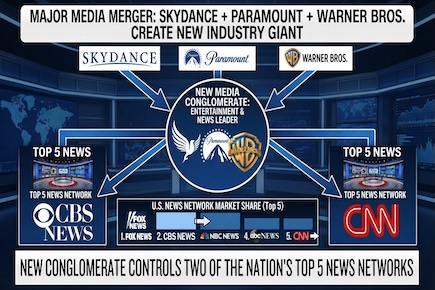
After months of controversy, Paramount completed its acquisition of Warner Bros. Discovery on Oct. 6, creating a combined global entertainment behemoth officially named Skydance Corporation. The new company brings together two major film studios, two global streaming services, premier television assets including HBO, MTV, Comedy Central, CBS and CNN.
Two of America’s most influential TV news organizations, CNN and CBS News, will now be under the control of billionaire David Ellison, whose father, Larry Ellison is a major Republican donor and close ally of President Donald Trump. The merger raises serious questions about the increasing concentration of corporate media ownership, editorial independence, the potential for political influence, and self-censorship in news coverage.
Twelve state attorneys general, led by California’s Rob Bonta, had filed an antitrust lawsuit challenging the merger. Negotiations resulted in a settlement requiring the merged company to establish a five-member News Editorial Independence Board to oversee journalistic standards and resolve disputes involving CNN and CBS News. However, all five members will be appointed by Paramount’s own corporate board of directors. Between The Lines’ Scott Harris spoke with Journalist and media critic Ari Paul, who warns that growing corporate media concentration threatens consumer interests and the diversity of viewpoints in U.S. news coverage.
ARI PAUL: In the broader sense for media consumers, this is an enormous scale of consolidation that I don’t know if we’ve seen anything like it in recent years. Paramount and Skydance merged to take over CBS a while ago, and now the latest acquisition of Warner Bros. Discovery has put a lot of Hollywood production now under one roof under the Ellison Jr., David Ellison. This has scared a lot of people in Hollywood about being a one- company town with this sort of level of consolidation. So I think there is a fear that this will affect the entertainment industry, although David Ellison was in the New York Times combating that idea saying that he’s up against Netflix and Amazon and Hulu and streaming so that he’s not taking everything over. But I think from the news perspective, I mean, I think there’s a very, very dangerous road that we’re going down.
The acquisition of CBS and CBS News by Skydance Paramount has been raising eyebrows among people who keep their eye on the news media ever since it happened. The installation of Bari Weiss as the editorial manager by David Ellison has made people very, very upset about the quality of news that’s coming out of CBS News. And there’s a fear now that that will also happen at CNN. So that the concern now is you’re going to have two major TV broadcast news stations going down this path of possibly firing veteran staff, reducing standards, and probably worst of all, bringing the perspective of the news more in line with the Trump administration rather than any real pursuit of the truth.
SCOTT HARRIS: And Ari, this is a page, is it not, out of the Viktor Orban establishment of authoritarianism in Hungary where Orban, while he was still in power—although he recently lost an election, but while he was in power—many of his friends, many of his oligarchic friends did take over the media in Hungary.
ARI PAUL: Yeah, I think that’s a really important point. I think a lot of times in the United States when we talk about a fear that our rating in terms of press freedom is going down or we’re losing press freedom in this country is that we’re going sort of some path like the People’s Republic of China where all outlets are either controlled by the state itself or by the ruling party. That’s not really what I think we have to fear in the United States. I think what we have to fear is sort of more what you said about what happened in Hungary under the old regime there, but also similarly in Putin’s Russia, the idea that you have privately owned media, they’re owned by private companies that are not the government, but that they are held only almost exclusively by regime adjacent oligarchs. So that is to say a series of very wealthy people whose interests are completely aligned with an authoritarian government, even if they are not direct agents of that government.
SCOTT HARRIS: In the future, Trump won’t always be president. It may be that the Democrats take over the House and Senate this year, maybe not, but there will be a future Democratic presidential administration if we don’t go into full blown fascism. So I guess the question is here, is there a potential that a future Congress, that a future president could break up this monopoly and put it in reverse and put these mergers in reverse?
ARI PAUL: It seems far off, but how could we even get to that point when we see so much depravity in the current administration? But keep in mind, we’ve had aggressive antitrust action in this country before. For this article, I was researching the breakup of the old Ma Bell system. I mean, there’s a lot of problems with the breakup of the old Ma Bell system into the Baby Bells, which created the Verizons and all the cell phone companies that we have today. But there was an ability of the American government to say, “No, this company is too big and it’s a monopoly and it controls the communication networks and it’s got to be broken up.” The pendulum can always swing and I think there is precedent for some kind of action to say, “Look, we can’t just have Ellison and Musk and Murdoch going back and forth controlling all these different things.” Elizabeth Warren has been very outspoken about doing this with social media and I think that’s a very, very good road to go down.
But I think especially with this Ellison takeover of Warner Bros. and by extension CNN, we’re really going to have to look at traditional media for that kind of bust-up as well.
Listen to Scott Harris’ in-depth interview with Ari Paul (15:49) and see more articles and opinion pieces in the related links section of this page. To subscribe to our podcasts, email newsletters, our Between The Lines Radio Newsmagazine Substack or social media, subscribe here.