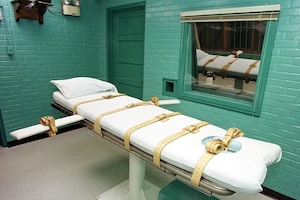
Two recent incidents have focused U.S. public attention on the death penalty. One was the botched execution of Christa Pike in Tennessee, who is back in prison after being hospitalized for the injuries caused when two doses of pentobarbital failed to kill her. The other was the announced and then withdrawn plan to livestream the December firing squad execution of U.S. Army psychiatrist Nidal Hassan, convicted of the 2009 Fort Hood murder of 13 people.
In response to Christa Pike surviving her execution, Tennessee Gov. Bill Lee suspended all remaining state executions for 2026, and ordered an independent third-party review of the execution protocol. Defense Secretary Pete Hegseth’s announced live streaming of Nidal Hassan’s execution faced fierce bipartisan opposition, with critics arguing that broadcast of the death sentence resembles methods used by oppressive regimes and terrorist groups.
Between The Lines’ Melinda Tuhus spoke with Robin Maher, executive director of the Death Penalty Information Center. Here she talks about the racial, gender and geographic bias in death penalty cases, recent trends away from its use and growing public opposition.
ROBIN MAHER: It takes events like what happened with Krista Pike and the announcement that the federal government planned to livestream a military execution to get the public’s attention about the death penalty, which I think is a shame because we should be paying attention to this issue more than we already are. There are really significant and serious issues with the administration of the death penalty, both in terms of fairness, the ongoing racism, the injustice and the inaccuracy of the death penalty, not to mention the extraordinary cost that goes into propping up the death penalty system.
MELINDA TUHUS: I noticed, and this did not surprise me, that of all the ones that have happened this year, out of the 32, 31 are in the South, one is in the West, and the states are almost evenly divided on those that have a death penalty and those that don’t. So there are states around the country that aren’t in the South that do have the death penalty, but apparently haven’t actually executed people. I mean, I guess it’s kind of a stereotype of southern justice, but is there any variation in the states and the South around the death penalty?
ROBIN MAHER: First of all, your observation is correct in that we see the most concentrated use of the death penalty in the former slave-holding states in the South, mostly concentrated in the southern part of the country. And that’s no accident. The sort of racism, the structural systemic racism that we see reflected in use of the death penalty today had its roots in the lynching and extrajudicial violence, racial violence that we saw in many of these former slave-holding states. So there’s a through line from those days to the use of the death penalty today. Very cultural, very specific, very racial. But if you zoom out and look at the country as a whole, what will strike you is that the majority of the country does not use the death penalty. This year, just 6 states have conducted executions, 6 states conducting 32 executions, the overwhelming majority of which took place in Florida.
And that’s down to a single individual. That’s Gov. DeSantis, who has decided to execute a record number of people during his time in office, both last year and this year. So we will again see a record number this year. He has already set 20 executions for this year. Last year, the state conducted 19.
MELINDA TUHUS: I want to go back a minute to the issue of women, especially women victims of killings. Do we know what the source is of these overwhelmingly female victims, at least in the year that I looked at? Is it mostly domestic violence or don’t we know?
ROBIN MAHER: Well, what we know is that the race and the gender of the victim often has a lot to do with the decision to seek the death penalty. And this gets back to racism as well. What we’ve seen historically is that the biggest determinant of whether the death penalty will be sought is if there is a black defendant and the victim is a white woman. Eighty-percent of the people who’ve been executed and nearly two-thirds of people who were sentenced to death over the past 50 years were convicted of crimes involving white victims. So that is a very powerful racial predictor of when the death penalty is sought. And that also tells us something about the way we value white life as opposed to the victims of color, which make up at least 50 percent of homicide victims nationally. And again, what we’re seeing this year is death sentences that were given out decades earlier.
The executions of this year are reflective of a time when there was greater public support for the death penalty, and there was also many overzealous prosecutorial policies, many of which had very serious racial implications. So the federal death penalty in particular was one that had some very serious racial problems. That was one reason that President Biden decided to commute so many people on the federal death row before he left office. And what’s interesting about the domestic violence question is that most of the women who are on death row, there’s 45 women on death row, most of the women who have been sentenced to death were convicted of crimes that involved an intimate partner. So many of them killed their abusive partners and received the death penalty. And that’s for reasons that others, historians and scholars have explained has to do with the way these women don’t fit our traditional stereotypical ideas of womanhood when they kill their partner, not accepting the abuse or responding to the abuse in a way that people find to be unacceptable.
There’s a great new burgeoning area of scholarship about women and the way that they have been victimized in capital trials, the kind of gender-based tropes and stereotypical ideas that are used against women—like they’re bad mothers, they keep dirty houses, they are sexually promiscuous. These are the kind of details that are used to sentence women to death, to aggravate their crimes and to distance themselves from feelings of mercy and empathy from the jury.
For more information, visit Death Penalty Information Center at deathpenaltyinfo.org and The Sentencing Project at sentencingproject.org.
See more articles and opinion pieces in the related links section of this page. To subscribe to our podcasts, email newsletters, our Between The Lines Radio Newsmagazine Substack or social media, subscribe here.