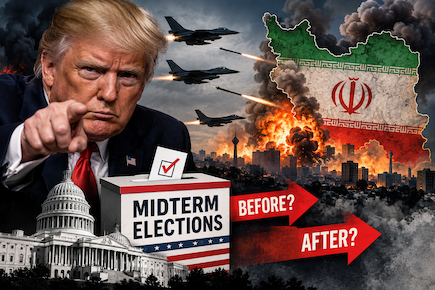
President Donald Trump is threatening a major escalation of the U.S.-Israeli war against Iran, warning that Washington could either negotiate a deal with Tehran or move militarily to “finish them off.” Although Trump has pledged not to launch new attacks before the Nov. 3 U.S. midterm elections, American and Israeli military officials have reportedly developed plans for renewed bombing campaigns soon afterward, potentially targeting Iran’s oil industry and energy infrastructure.
The threats come as Israelis voted Oct. 27 in a closely contested election shaped by the Iran war, with early exit polls showing neither Prime Minister Benjamin Netanyahu’s coalition nor the opposition bloc winning a parliamentary majority. Meanwhile, the conflict is spreading across the Middle East, with increasingly deadly fighting between Yemen’s Iranian-backed Houthi forces and Saudi Arabia, where Houthi missile and drone attacks on Saudi airports and infrastructure have killed civilians.
Between The Lines’ Scott Harris spoke with Jennifer Loewenstein, former associate director of Middle Eastern Studies at the University of Wisconsin-Madison, who examines Trump’s latest threat to escalate his war against Iran amid rising gas and diesel prices, and polls finding that between 65 percent and 74 percent of Americans disapprove of the president’s handling of the Iran war.
JENNIFER LOEWENSTEIN: I think right now that the United States and Israel are in fact planning another attack on Iran. A good friend of mine who is also a Middle East analyst has said he thinks it will happen after the Israeli elections and before the American ones. But of course, that’s just a prediction. None of us have crystal balls, so it’s hard to say what’s coming, but there certainly is a buildup in the Gulf. There are three aircraft carriers again in the vicinity. But I think the Israeli and American elections are very significant because both countries right now are involved in this ongoing sort of indefinite war against Iran. And it’s easy to predict the worst, which is all hell breaking loose and groups like Ansar Allah in Yemen—the Houthis they’re also called—Hezbollah and the popular mobilization forces in Iraq when all of them join forces together with Iran to go against Israel, its allies and the United States and its allies in the Persian Gulf.
SCOTT HARRIS: Jennifer, I did want to ask you about what a possible Trump decision to escalate the war in Iran could look like. There have been reports that Iran is putting in place a strategy of retaliation targeting more American bases in the region and other U.S.-related facilities across the Middle East. If Trump does give the green light for a major escalation of the war against Iran, already you have major U.S. bases in Bahrain and elsewhere that have withstood just utter destruction according to military families in the reports here in the U.S. And it’s very clear that across the Middle East, many of the countries who sponsor U.S. bases are having second thoughts given that these bases were supposed to assure security for these oil-rich monarchies, but it’s actually produced less security and more vulnerability to attack. But as we conclude, what’s your feeling about where Trump might go with relaunching, escalating this war in Iran?
JENNIFER LOEWENSTEIN: Yeah, I mean it’s hard to know when you’re thinking logically because Trump isn’t logical. He thinks that if you throw the biggest bombs in the world at them a few times over, that you win, you know, cause the most amount of destruction possible and then you’ll win. That’s not how this war is going to end. We are not going to beat Iran militarily. I think it’s already been proven that that can’t be done. So whatever he does, I suspect that he and probably Netanyahu with him will go all out and try to hit the energy infrastructure, basically break international law all over again, multiple times and cause the maximum amount of destruction within Iran as possible.
While Iran will do exactly what it says it’s going to do, which is to go after again, any bases that are in the Gulf and Qatar, UAE, Bahrain. As you said, a lot of them are already destroyed. The Fifth Fleet base (in Bahrain) is destroyed. But Iran has also said it’s going to hit much farther away. And there was an article by Patrick Coburn, a Middle East correspondent, a veteran correspondent who basically says it won’t be long before Iranian missiles can hit London and Paris. And I think that if they have them, they will definitely try to use them. I think they are basically pulling out all the stops and saying, enough is enough. If you’re going to continue to do this to us, we’re going to make life as difficult as humanly possible for everyone supporting this war. And there are lots of people who are cheering Iran on, not because they support the Islamic Republic, but because they’re so fed up with American arrogance and this need to be the number one power on the planet.
So I don’t see anything good coming of anything. Hezbollah and the popular mobilization forces and the Houthis have all said that they would join in with Iran if there’s another round. And that also is very scary.
Listen to Scott Harris’ in-depth interview with Jennifer Loewenstein (27:19) and see more articles and opinion pieces in the related links section of this page. To subscribe to our podcasts, email newsletters, our Between The Lines Radio Newsmagazine Substack or social media, subscribe here.