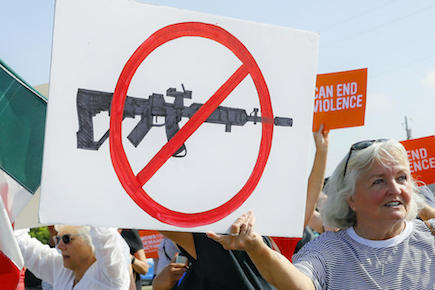
From July 28 through Aug. 4, America witnessed three more bloody massacres, bringing the total number of mass shootings this year to over 250. On July 28, a 19-year-old opened fire at Gilroy California’s Garlic Festival, killing three people, including a 6-year-old boy and a 13-year-old girl. More than a dozen people were wounded. Several days later, on the morning of Aug. 3, a 21-year-old white supremacist killed 22 people and injured 24 others in an El Paso Walmart, telling police after he was apprehended that his goal was to kill as many Mexicans as possible. Just 13 hours later, another mass shooter terrorized downtown Dayton, Ohio, where 10 people were killed, including the perpetrator, with 17 others shot and injured.
In a familiar and bitter ritual after mass shootings, politicians lined up at microphones across the country offering thoughts and prayers, but a growing number of Americans are now demanding the government take action to prevent future massacres. Despite opposition from the NRA and most Republican legislators, momentum is building to pass legislation strengthening the nation’s gun laws. There’s now an outside chance that the GOP-controlled Senate may take up portions of a bill – already passed by the House – to close loopholes in firearms purchase background check regulations, and a proposed “red flag” law that permits the confiscation of guns from individuals who may present a danger to themselves and others.
Between The Lines’ Scott Harris spoke with Dakota Jablon, director of federal affairs with the Coalition to Stop Gun Violence. Here, she discusses the impact that the three recent mass shootings could have in moving the U.S. Senate to pass legislation to strengthen federal gun laws.
DAKOTA JABLON: On average, there’s about 100 gun deaths every single day in this country. And that includes people who are dying by suicide, people that are dying in impacted communities, unintentional deaths, domestic violence. And we hear about the mass shootings, you know, four or so people, I think that’s what the FBI classifies as a mass shooting. But we don’t even hear about the daily gun violence that’s inflicted in our country every single day. And I think finally people are saying that this is enough and that this is not getting better, it’s getting worse and we need to do something about this
BETWEEN THE LINES: Dakota, your group and many other organizations across the country have worked very hard and I think maybe a breaking point was the Sandy Hook massacre, but people have been discouraged by the fact that Congress and presidents have not been able to pass legislation that would strengthen our gun laws – that the hope would be, would prevent some of these horrendous acts of violence.
DAKOTA JABLON: Yeah, it is very frustrating. It’s frustrating at the federal level, which is where most of my work is done. Luckily, it’s been a little bit better on the state level, so across the states we’ve seen some good policies actually gone into place. Specifically, the extreme risk laws that are now in place in 17 states plus D.C. And we’ve seen thankfully groups kind of push back against the terrible gun laws that the NRA tries to get through. So “stand your ground” laws and kind of “guns in schools and everywhere” like that. We’ve been able to really push back against that, but for some reason at the federal level, and I think a big part of it unfortunately is the NRA – it’s nearly been impossible to get anything done. Luckily, this year we saw the House pass HR 8, which was the universal background checks law, but we are still waiting for something to be done on the Senate side.
BETWEEN THE LINES: What’s your read about what the Senate may do and Senate Leader Mitch McConnell, who prides himself on being the “grim reaper” of any legislation that emanates from the House and Democrats. Is there really a chance that this will take a different path than we’ve seen other gun restriction legislation in the past?
DAKOTA JABLON: I’m cautiously optimistic, but exactly what you said with Mitch McConnell calling himself the grim reaper, I think it was the day after the Dayton shooting, (his campaign team) posted a photo of a graveyard with (his Kentucky Senate opponent) Amy McGrath’s name on a gravestone, so obviously didn’t really take to light what is happening in our country. But I’m cautiously optimistic that something can be done. Sen. Lindsey Graham, the chairman of the Judiciary Senate committee, has said that he is dedicated to doing something and wants to pass an extreme risk law which would incentivize states to pass these. I’m kind of at the point where we’ll see when it happens, but I’m not trying to put all of my hope into that happening.
BETWEEN THE LINES: One of the major pieces of legislation that passed in 1994 – the assault weapons ban – from my reading, that assault weapons ban actually resulted in fewer mass shootings, but that law was allowed to lapse in 2004 10 years later. What’s the movement like right now to bring back the assault weapons ban?
DAKOTA JABLON: We are definitely advocating to bring back the assault weapons ban. We saw that it works. We’ve seen that the weapon of choice from mass shooters really are assault weapons and it’s something that is just also a popular policy. It is overwhelmingly supported by many Americans in this country and in the House side, there is actually, I believe just shy of 200 co-sponsors. Chairman (Jerry) Nadler of the Judiciary Committee has said that that is something that he’s planning to bring up. So, we are hopeful that something could happen on the House side. Sen. (Diane) Feinstein who authored the 1994 version of the assault weapons ban, she has been bringing up her bill, reintroducing it every year since 2004 and yet still nothing has happened. So, I think that’s why it’s so important that we’re talking about background checks. We’re talking about extreme risk laws, but that we also are advocating to ban assault weapons finally, because there’s just no reason why those need to exist, those weapons of war need to exist on our streets.
Learn more about the work groups across the U.S. are doing to strengthen the nation’s gun laws by visiting The Coalition to Stop Gun Violence at csgv.org.