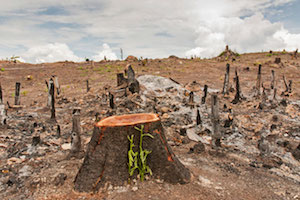
In the most recent report from the Intergovernmental Panel on Climate Change, the world’s top scientists defined the links between agriculture, deforestation and other human land use activities that contribute to climate change. Although public debate on climate change has focused mostly on ways to reduce greenhouse gas emissions in energy production and transportation, the IPCC report points out that land use was responsible for the second largest amount of global carbon emissions at 22 percent, with energy producing 35 percent, and transportation producing 14 percent.
The report acknowledges the major challenges ahead in balancing the short-term need to produce larger amounts of food for a growing world population, while at the same time changing agricultural practices such as clear-cutting forests to make way for planting crops. IPCC scientists also point out that meat consumption contributes to climate change through the methane gas produced by livestock and deforestation to expand pastures. A plant-based diet has long been recognized as a way to combat climate change, while also improving human health.
Between The Lines’ Scott Harris spoke with Georgina Gustin, a reporter with Inside Climate News, who summarizes her recent article titled, “IPCC Report Shows Food System Overhaul Needed to Save the Climate and Protect Food Security,” about the warnings issued by the UN about the link between climate change and land use.
GEORGINA GUSTIN: It’s a huge report. It’s about 1,300 pages and it was written by more than 100 scientists from more than 50 countries around the world. And they looked at the impact of climate change on agriculture and land use and the impact of land use on agriculture on climate change because it is a somewhat complicated scenario, one affecting the other. They made a lot of conclusions, but the essential conclusion – like a lot of other UN climate reports – is that we don’t have a lot of time and we need to bring everything to bear in the efforts to lower greenhouse gas emissions and control temperature rise and land. The way we use land is one of the more critical tools in that effort, because while land – especially the land we manage, that we farm and that we manage as forests that emits carbon – it can also be part of the solution by sequestering carbon. And if we improve land management, we can essentially trap carbon in the soil. It’s not the only thing we could do. We have to do many, many other things. Emissions from the transportation and energy sector under control for example, are not just under control, but pretty much stopped entirely. Our lands and the way we manage lands are critically important right now.
BETWEEN THE LINES: What are the ways in which the world can coordinate our actions, governments and industries and agriculture to really make the changes necessary? It seems a daunting task, but what are some of the suggested methods that we could use as a planet to make these changes?
GEORGINA GUSTIN: Yeah, it is a very daunting task because we also need to feed a growing population that’s projected to reach 10 billion by 2050. So we need all the land we have to produce food while we need it also to trap carbon. And we have to stop cutting down trees essentially, which is the primary driver of land-based carbon emissions. To get everybody on board globally is going to be very, very challenging because you look, for example, at Brazil where deforestation rates have gone up just in the last year since (Brazil President Jair) Bolsonaro took office and has basically done away with a lot of forest protections. You have in this country, the Trump administration rolling back some of the most important climate legislation or rules that were put in place by the Obama and previous administrations. When you see this happening, it’s pretty disheartening. On the other hand, you have a lot of corporations that are starting to look very deeply into their supply chains and to try to reduce their own carbon footprint.
You have consumers pushing on those corporations. You have countries making pretty stringent commitments, outside of the United States and Brazil and some other countries. But I think that’s why this report is so important because it’s a clarion call. It says, “Hey everybody, we need to be doing everything we can and we’re all in this together.” And when the IPCC gets together, the scientists write the report. But, governments approve it and our government delegation approved it. And so they’re essentially saying, “We agree. We agree with what’s in this report.” And so you have to kind of take that as a positive sign that when all these countries sign off on something like this, they’re saying, “Okay, we’re going to try to do something about it.” Now, whether that happens or not is another matter, but it is a good sign. And it was a really important report in that way. And actually the IPCC is coming out with another report this fall that’s looking at the Earth’s water and cryosphere – basically everything that’s in ice. And so that’s going to be another very important report that the IPCC puts out later this year.
BETWEEN THE LINES: Public opinion certainly critical in this. Do you see changes in public opinion that would force our leaders to make these changes?
GEORGINA GUSTIN: I think this issue is becoming more of a priority for voters. And I think we will probably see that in this coming election and in elections after that at all levels. This is becoming a really important issue for people who now realize that this is a crisis. And you have on the other hand, industrial interests, corporate interests that have a stake in perpetuating the denialist stance that has made solving this crisis so problematic and they’re not going away. Their messaging is a little bit different, perhaps. They might countenance the idea that climate change is real on the one hand, but, maybe not act in the most robust way to do anything about it. But you have to be hopeful that the U.S., as the world’s largest economy is going to actually be a soldier in this battle and not an obstructionist force. And, that will go a long way, I think, towards get getting things done.
For more information and related analysis, visit Inside Climate News at insideclimatenews.org.