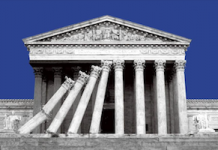
The end of the Supreme Court’s 2022 term brought impactful to devastating rulings on women’s health, guns, rights of the accused, the rights of tribal nations, and the climate. In West Virginia v EPA, the court ruled 6 to 3 to limit the Environmental Protection Agency’s ability to regulate greenhouse gases that are a major cause of climate change.
The justices ruled that Congress must specifically legislate what the executive branch is authorized to do on so-called “major questions,” while denying government agencies wide latitude to impose regulations on industry. Of course, the vast majority of members of Congress are not environmental or climate experts and would be unable to write such specific bills.
Between The Lines’ Melinda Tuhus spoke with Jason Rylander, senior attorney with the Climate Law Institute at the Center for Biological Diversity, about the ruling. Here, he explains that although the Supreme Court’s ruling in the West Virginia v. EPA case is moving the U.S. in the wrong direction, it’s not as sweeping as the ruling that reversed abortion rights under Roe v Wade. He maintains that the Biden administration still has many tools available to address the climate crisis. But Rylander expresses concern that the ruling opens the door to future high court decisions affecting all government agencies that could negatively impact life for everyone in the U.S.
[Producer’s note: The audio version of this interview transcript has been edited for broadcast time constraints.]
JASON RYLANDER: Since the Supreme Court decided Massachusetts v EPA in 2007, it has been essentially settled law that EPA has the authority to regulate greenhouse gases under the Clean Air Act, and there have been a couple of cases since then that have reaffirmed that proposition. One of the things we were concerned about when the court took up West Virginia v EPA for that term was that they might revisit that finding, and they did not. So that’s one good thing right off the bat – this case did not change fundamentally EPA’s ability to regulate greenhouse gases under the Clean Air Act.
This case is really about the 2015 Clean Power Plan, a plan that was developed by the Obama administration that relied on Section 111 of the Clean Air Act to reduce emissions from power plants. And it did that by setting overall caps on greenhouse gas emissions and letting states develop plans to meet those targets. And there are a variety of ways that the states could have met those targets. They could install or require power plants to install technology at individual plants to reduce emissions or it also could authorize trading or other limitations that could have the effect of shifting transmission to renewables. And I think that’s what really got the attention of the Supreme Court – the idea that this regulation would force a shift from fossil fuel-powered plants to renewable energy plants.
But the plan never actually took effect. Right after it was passed, the court stayed the rule before the D.C. Circuit ever got a chance to rule on whether it was legitimate, and then the Trump administration repealed it. They developed a different plan that also never was in effect. So the court was really deciding a case about nothing in the sense that there was no rule in place. it’s really an advisory opinion that sets some of the terms as to how the Biden administration can move forward with a new regulation addressing emissions from power plants.
MELINDA TUHUS: So, this ruling that was handed down at the very end of the Supreme Court term this year – what does it do?
JASON RYLANDER: Fundamentally what it does is curtail EPA’s ability under Section 111 of the Clean Air Act to explicitly rely on generation shifting to meet climate goals. Now if that sounds narrow, it’s because it actually is. The Court’s ruling really only affects one portion of the Clean Air Act as it was interpreted in the Obama Clean Power Plan that never went into effect. So, EPA still has authority under Section 111 to regulate power plans in a different way, and it also has authority through other portions of the Clean Air Act, like the national ambient air quality standards section, where it could regulate greenhouse gases more generally from other sources. And EPA is already working on new regulations to address greenhouse gases from the transportation sector.
So, in terms of actual impact from the case, it deals with a rule that’s not in effect, the goals of which have already largely been met by market forces. And to the extent it prescribes EPA authority, it does so in a fairly limited way.
Now that being said, the way the court went around the decision is really concerning. They use something called the Major Questions Doctrine, which is a new doctrine that the court has just recently in a few cases begun to espouse. And what it basically says is that when an agency passes a regulation, they’re going to look at it to see if Congress spoke clearly to that issue and explicitly gave the federal agency the ability to do whatever the agency’s trying to do. The words they use are things like “novel” or “surprising” or the rule would have economic or political significance, which is really most rules, and the concern is that this is just a license for judicial activism.
So, most of the time Congress passes pretty broad laws. They’ll pass the Clean Air Act or the Clean Water Act, or other public health and safety regulations that set a goal in mind, like cleaning up the nation’s air and water, and then they will leave to the agency the discretion to figure out how to do that. And statutes vary by the level of specificity, but in general, Congress gives the agency an order and then says, You go and figure it out. And that’s especially true in cases where there’s scientific questions involved. So, Section 111 tells EPA to come up with the best system of emissions reductions.
Now, that can change over time as technology changes. It involves expert determinations of what would work and what would not – all the kinds of things that Congress doesn’t really have the expertise to do. But the court seems to be saying that unless Congress explicitly says, You can do X, Y and Z, then it’s not clear if the federal agency can do those things.
And what it means is that Congress is no longer able to delegate authority in the way that it has traditionally done it. The courts are stepping in or could continue to step in and kind of impose their own judgment of what is significant or novel or surprising. And as the dissent indicates in this case, that could be quite frightening if the court appoints itself instead of Congress or the expert agency the decision-maker on climate policy.
For more information, visit the Center for Biological Diversity at biologicaldiversity.org.
For the best listening experience and to never miss an episode, subscribe to Between The Lines on your favorite podcast app or platform: Apple Podcasts, Spotify, Stitcher, Google Podcasts, Amazon Music, Tunein + Alexa, Castbox, Overcast, Podfriend, iHeartRadio, Castro, Pocket Casts, RSS Feed.