SCOTT HARRIS: Right now I’m very happy to welcome back to our program, Sam Carliner, a freelance journalist covering U.S. foreign policy, immigration policy, and social movements. He’s written for a slew of important publications, including Middle East Eye, Truthout, Mondeweiss and others. Sam is an editor at Left Voice, part of the La Izquierda Diario International News Network. And we’ve invited Sam to talk about a new article he’s got out published at Counterpunch.org and I think on his own Substack page, which we’ll give out the address for. But the article’s titled, “Pro-Palestine Academics Have Been Fighting the New McCarthyism.” Sam, thanks so much for making time to talk with our Counterpoint audience tonight. Thanks.
SAM CARLINER: Of course. Thank you so much for having me.
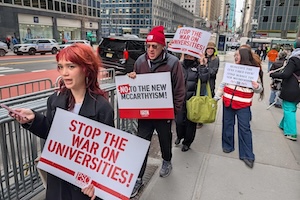
SCOTT HARRIS: So in this new article I just mentioned, you examine the McCarthyite tactics of the Trump regime to target activists who are protesting or organizing against Trump administration policies. And we’ve seen that sort of escalate in recent weeks. And as you point out, there was this document out of the State Department talking about Cuba as being the center of 21st century communism and then listing almost every progressive group in the country as being willing dupes of the communist Cuban menace. It’s kind of cartoonish, but very dangerous. But you point out that given the targeting of Palestinian activists, pro-Palestine activists in the country, that many of the academic pro-Palestine activists in academia were fired and persecuted early on in Trump’s second term. And there’s some lessons there for us. Sam, maybe you could give us the overview of the kind of job loss and other persecution and suffering that people who’ve publicly come out to oppose the genocide in Gaza and to otherwise fight for Palestinian human rights.
SAM CARLINER: Yes. I mean, one thing that I think is worth noting that I don’t get into in the article, but that for a long time you actually have had a repression of the movement for Palestine all over the place. But of course universities, students, academics who would speak out have long been facing repression. So it’s not like this is necessarily new, but because of the surge in awareness of Israel’s oppression of Palestine and the surge in solidarity that that produced in 2023 it was, I believe, which feels like forever ago, there in a way was also a surge in even more high-profile cases of repression. And so what I write about is essentially some of how people who organized around Palestine and were hit with this escalation of repression of the Palestine movement at universities. And I think an important thing that I get into the piece is that we really saw, I mean, reminiscent of the McCarthyist House and American Activities Committee, you have this committee by the House, I believe Ways and Means, I forget exactly what it was, where they questioned university, heads of universities asking what they’re doing to essentially crack down on Palestine solidarity.
And a lot of professors essentially came in the fire, either were fired from their jobs or demoted or put on probation, in general punished for their academic research or advocacy regarding Palestine. One thing I want to note before we get more into this is that I did not specifically write about the attack on the student movement in this article. I focused on academics, professors who have been facing repression. But of course, as we’ve seen with Mahmoud Khalil and many, many other student activists who were targeted by the Trump administration, that is another layer of how the Palestine movement sort of marked the first escalation of Trump’s McCarthyist methods of repression.
SCOTT HARRIS: Thank you for that, Sam. Are there any estimates out there how many people lost their jobs, were demoted or otherwise suffered in their careers because of the persecution of anyone who raised their head to speak out for Palestinian human rights? Do we know the numbers at all?
SAM CARLINER: I admittedly do not know the numbers off the top of my head. However, there was a database I refer to in my article, which has been, and let me see if I can pull it up actually now while I’m talking to you because I want to give people the resource, but there is a database which has been tracking Trump’s attacks on academic freedom. And it isn’t just accounting for Palestine. Again, I’m pulling up the database, but it’s also getting into academics who have been punished for talking about racism, for talking about LGBTQ+ rights. But if you go through them, many, many, many of what is being cited is people who were punished for their Palestine advocacy. And it’s certainly hundreds. It might be thousands, but I want to check that. So let me just apologize for not. Oh yeah, hundreds of academics.
And this has been tracked by FIRE. It is, let me see, it’s a resource, fire.org, which has been tracking it.
SCOTT HARRIS: Yeah. I’m familiar with that group. Yeah, our listeners can get there for more information about the numbers we’re talking about. But Sam, as you point out in your article, one of the tactics being used to persecute, fire or otherwise just harass people in academia who are speaking out for Palestinian human rights is the conflation of anti-Zionism or opposition to the Israeli government actions with antisemitism. And it’s intimidated a lot of people as it has for many, many years. But it seems like there is a point in time we’re at where that is not working anymore because we have public opinion turning against Israeli policy and the horrible and just obscene loss of life in Gaza among the entire population there. But yeah, say a word if you would, about how this is being used—the conflation of anti-Zionism or criticism of Israel with antisemitism—how it’s been used successfully in this intimidation campaign.
SAM CARLINER: Of course. I mean, I think there’s the issue of the right can’t fully get away with attacking academic freedom on their own because you always have these far right ideologues who want to crack down on any type of progressive advocacy. And because universities at their best are sites of free exchange of new ideas, they become a target of the right. But that can’t be done on its own because there’s a lot of people who might see that happening and be horrified by attacks on basic free speech, basic democratic rights, and institutions for the development of thought. So they have to rely on something which will get more liberal or otherwise progressive sectors to, if not fully be on board with their attacks on the Palestine movement, at least have these progressive or liberal sectors not engaging in any organized opposition or pushback. And so in that regard, using the weaponization of antisemitism is sort of their best option.
And as you noted, because so many people witnessed the horror of the genocide, people now have a better understanding of what Israel really is about. And I would also add to the mix that many more people have seen the rise of anti-Zionist Jewish voices, whether it’s a Jewish Voice for peace, whether it’s intellectuals like Ilan Pappé or Norman Finkelstein. In fact, one of the main people I spoke with for my article is a longtime Jewish anti-Zionist activist. And I think more people now understand the complexity of the community in that while it’s still an ongoing discussion, there are those in the Jewish community, which I’m also a part of, who are themselves or ourselves anti-Zionist. So it’s not as effective, but I do think because there is an ingrained sense of progressive people not wanting to be bigoted in any way, not wanting to be part of oppression of any group that has historically been a victim of the right, there are still cases in which that accusation, while still weaker, does have the impact of getting certain people who are maybe more progressive on issues of LGBT+ rights, immigrant rights, racism, things like that, to essentially shy away from taking up the fight for Palestine and defending their colleagues who are coming under attack for pro-Palestine advocacy.
SCOTT HARRIS: We’re speaking with Sam Carliner, freelance journalist, and we’re talking about his recent article titled, “Pro-Palestine Academics Have Been Fighting the New McCarthyism.” And Sam, I wanted you to briefly summarize, we only have a few minutes left, but I wanted you to briefly summarize the importance of labor unions in fighting back against some of these firings of activists in academia who’ve been speaking out for Palestine human rights. I know you focused on the City University of New York with the group known as the Fired Four, but you also talk about other places, Rutgers University, San Jose State University. But yeah, talk about the importance of labor unions in the fight back against this persecution of folks speaking out for Palestinian human rights.
SAM CARLINER: Of course. I think it’s one thing to defend your rights as a brave individual or as a brave individual with some support from colleagues or friends. It’s another thing, and that’s important, but it’s another thing to defend your rights with the backing of an institution that has a large membership base, that has an established presence at your workplace, that has resources at its disposal. And unions, when they take up the fight for Palestine, are able to provide that support for their members. And there’s ongoing debates and discussions in the labor movement. There are, as Jeff Schuhrke writes in his recent book, there are certainly limits to what we’ve seen of unions taking up the fight for Palestine.
But there have been important examples of unions taking up that fight, whether it’s the really, really progressive and profound ways in which the union at CUNY has fought for the reinstatement of four of its members who were fired for pro-Palestine activism. Rutgers, which the union has put out very strong statements in defense of academic freedom and also connected the issue of Palestine to other issues concerning academic freedom.
SCOTT HARRIS: And I do want to cite one more example that I didn’t touch on in my article, but that I think is really important, which is the union at the University of California when the encampments happened and the encampment at, I believe it was UCLA was attacked and repressed violently, the union actually members organized a strike. They went on strike to basically show that they were willing to use their power to defend their students and their members’ rights to engage in this activism. And so just to reiterate, I think it’s in general, speaking up and sort of calling the bluff of these attacks is really important to not let these attacks go unchallenged and to expose them for the undemocratic moves that they are.
That’s important to always be doing, but in particular, it takes it to another level when unions take up the fight because they’re working with such a different level of organization and resources at their disposal.
Well, Sam, this is really important. I highly recommend this article to our listeners. “Pro-Palestine Academics Have Been Fighting the New McCarthyism.” Your website, I know you have a Substack page and any other resources, but we’re going to run out of time in less than a minute. So hopefully we can get all that in.
SAM CARLINER: Yes. So I am @saminthecan. If you search me on just about any social media platform, including Substack. I don’t even know what the official title of my newsletter is, but you can find me there @Saminthecan, all other socials. I’m an editor at Left Voice as well, and we do a lot of coverage of the repression and ways in which people are fighting back, among other things. So that’s probably the best way for everyone to keep up with the various work that I’m doing.
SCOTT HARRIS: Well, thank you for joining us tonight, Sam, and appreciate your important work in this article. We’ll stay in touch. I know you’re writing about some important issues, so we’ll have you back soon. Thank you.
SAM CARLINER: Sounds good. And thanks for all your important coverage too.
SCOTT HARRIS: Thanks, Sam. Good night. That’s it for this edition of Counterpoint. Stay tuned to WPKN in Bridgeport.