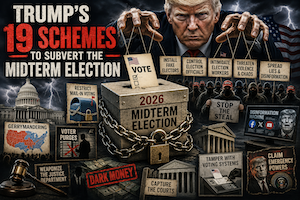
In an unprecedented campaign to interfere with and manipulate the outcome of the Nov. 3 midterm election, President Trump and the Republican party have launched literally dozens of executive orders, legislative initiatives and lawsuits with the goal of disenfranchising voters they view as supporters of the Democratic party—the latest being new restrictions on mail-in voting, an issue now before the U.S. Supreme Court.
The overall strategy to control the outcome of the election and which party holds power in Congress, revolves around provably false claims of widespread election fraud. Specific methods include aggressive partisan and racial gerrymandering; voter-roll purges; imposing restrictive proof-of-citizenship and voter-ID requirements; closing polling locations; withholding federal funds to force states to turn over voter data and change election procedures; as well as targeting election officials for prosecution.
Other actions openly discussed by the president include deploying ICE agents, Justice Department officials, or the U.S. military to intimidate voters at key polling places and/or seizing ballots, voting machines, and election records. Between The Lines’ Scott Harris spoke with Justin Glawe, an independent journalist and editor of the American Doom newsletter. Here he discusses his recent Zeteo columns, written with Asawin Suebsaeng, that examine Trump’s 19 schemes to subvert the midterm election, and the Democrats’ plan to fight back.
JUSTIN GLAWE: I think the biggest probable threat is the seizure of ballots post-election or even on Election night in November. Trump wanted to do this back in 2020. He said in December that he wished he had done it in 2020. He was talking about voting machines, but it’s sort of the broader principle of the seizure of election equipment and records. And of course, in January, the FBI raided a Fulton County (Georgia) elections warehouse and took ballots from 2020. Of course, that’s a far different scenario than seizing ballots in an ongoing election, but I think that’s probably the highest potential threat because if they seize the ballots prior to certification, well, how do you certify an election that you can’t tally the votes for? In addition to that, the phrase “national emergency” has been thrown around a lot. People are worried about ICE or National Guard at the polls.
To me, that’s an important thing to be concerned about, but that’s kind of more of an intimidation tactic, whereas the seizure of ballots really affects the outcome of the election in a much more concrete way. There is no precedent in American history for the federal government seizing ballots from any election, whether it is past or ongoing. So when the FBI seized ballots from the 2020 election in Fulton County back in January, that has never happened before in American history. And it certainly has never happened in an ongoing election.
SCOTT HARRIS: Justin, I did want to ask you about an article you wrote over at Zeteo, and it’s titled, “Trump Wants to Steal the Midterms,” but the Democrats actually have a plan to fight back. I wanted to ask you if you have faith in the Democrats’ plan to fight back and defend free and fair elections and concerns you might have about complacency within the Democratic party and the larger array of democracy defender groups who may not be fully aware of the threat that’s in the offing here for the November election.
Listen to Scott Harris’ in-depth interview with Justin Glawe (19:33) and see more articles and opinion pieces in the related links section of this page. To subscribe to our podcasts, email newsletters, our Between The Lines Radio Newsmagazine Substack or social media, subscribe here.