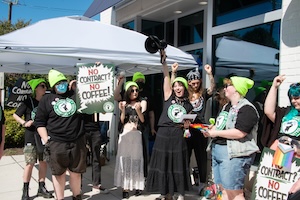
Since the first Starbucks coffee shop unionized in 2021, more than 700 have followed, with more stores unionizing every week. That’s out of a total of about 17,000 locations in the U.S.
Over these past five years, the company has refused to negotiate and sign a contract with members of the union, Starbucks Workers United, which represents 15,000 workers. On Aug. 28, the union called for a total boycott of Starbucks, hoping to pressure the company to negotiate in good faith.
Between The Lines’ Melinda Tuhus spoke with Nick Parker-Smith, a barista who’s worked at several Starbucks locations in Missouri for three years. Here he discusses the current situation for Starbucks workers and the goal of the nationwide boycott.
NICK PARKER-SMITH: I mean, ultimately the frustration is part of what fuels not just our actions now, but also is what fuels the stores to organize as well. What we’re seeing is that Starbucks has been breaking labor law more than any other company in modern history. The union busting is quite intense. There’s been over 500 cases of unfair labor practice charges that have been made against the company. So we’re seeing a lot of resistance and that is incredibly frustrating. What we want is to go to a place where we feel respected and where our very reasonable demands can be met. And what we’re finding is that the company is reeling back and choosing to dig in their heels instead.
MELINDA TUHUS: What are the demands? How specific are they when you said you basically want a contract? It’s been five years since the first union was organized. So what are your demands? Are they very specific?
NICK PARKER-SMITH: Yeah, so there’s a few specific ones that we are really putting a lot of pressure on. One of them, like I mentioned, is a wage that we could live off of. Seventeen dollars an hour minimum starting wages for the lowest paid level of baristas and annual raises that match the rising cost of living. So 4 percent is the specific number that we’re looking for in that contract. We just want to be able to go to work, do our jobs with dignity, and go home and be able to survive off of that. Also, more specific things like a fair and less restrictive dress code and designating existing hours to existing employees rather than just hiring on new ones and stretching them thin as well.
MELINDA TUHUS: Under Biden, it was a pretty labor-friendly National Labor Relations Board, and now I’m sure it’s the opposite. So is anybody going to the NLRB to try to get resolution to any of these or do you feel like that could backfire and make things even worse?
NICK PARKER-SMITH: We’re certainly still working with the Labor Relations Board. We still file unfair labor practice charges as they are relevant. We are looking to the government on some degree, but I think that what we’re finding still is that the company is not afraid to break the law. And so at the end of the day, we aren’t looking to the Labor Relations Board to save us. We are taking the power and building the power in our own hands as well. And so while I can’t speak too much about how the current NLRB is operating, I do know that baristas are not content to wait for the NLRB to do it for us. And so at this point we are absolutely taking the power in our own hands.
MELINDA TUHUS: So my understanding is that members of Starbucks Workers United were asking people like over last year basically to boycott the company, even not just the stores where there were active strikes ongoing. And so now you’re coming out and saying, “Yes, we want everybody to boycott all the stores.” What changed? What’s different now?
NICK PARKER-SMITH: Yeah, great question. So with the “No Contract, No Coffee” pledge, we were ultimately going to consumers and saying, “Vote with your dollar and join us in putting pressure on the company for the duration of this strike and to bring Starbucks back to the bargaining table.” And what we’re finding is that Starbucks is continuing to make bargaining very difficult and continuing to dig in their heels and not operate fairly and give us what we’re looking for. And so we’re going a step further.
And so we’re asking not just consumers, but also institutions and elected officials to really dig in in support of those baristas. And so we’re seeing that kind of support crop up already with teachers unions, elected officials, prospective elected officials come in and voice that support and really make this a watershed decision and say, “You can’t at the same time be a customer of Starbucks and be in support of workers.” And so we’re seeing it go further than just individual consumers.
MELINDA TUHUS: Yeah. So that raises the question. If your boycott is successful, it seems like a lot of baristas would be getting laid off because you won’t have the business.
NICK PARKER-SMITH: We certainly could see the company take negative action against the baristas, but we also know that the company has the resources at hand to end this boycott immediately. What we see is that when Starbucks has those resources, they are not investing it in their workers. And again, we ultimately believe that they can and they’ve shown that they can with their earning statements and with what they spend. And so we’re certainly hopeful that it doesn’t result in that.
MELINDA TUHUS: Starbucks says that you get higher than minimum wage and there are a number of benefits connected with it, healthcare and access to higher education or something like that. Do you see any of those benefits and do you think that that could impact some of the baristas’ willingness to join a union or really push the company?
NICK PARKER-SMITH: I think ultimately what we are seeing is that the benefits that we have, even if it’s better than industry standard, are simply not enough to live off of. We’re not so much looking at comparison with other chains. We’re looking at our real lives. We’re looking at the bills that we can’t afford. We’re looking at the medical bills that we can’t pay and we are looking around and we see the company choose to invest the funds that they have on things that are not benefiting the workers.
See more articles and opinion pieces in the related links section of this page. To subscribe to our podcasts, email newsletters, our Between The Lines Radio Newsmagazine Substack or social media, subscribe here.
Subscribe to our Weekly Summary