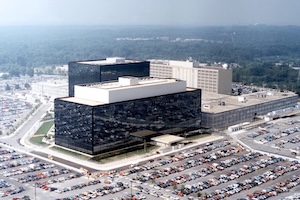
In mid-September, the National Security Agency, or NSA, announced it would undergo another massive restructuring, this time under its new director, Gen. Joshua Rudd, who’s only led the agency since March this year. The change would create five new organizations inside the NSA, focusing on artificial intelligence, China, cybersecurity, combat support or warfighting, and global intelligence.
Between The Lines’ Melinda Tuhus spoke with Thomas Drake, a former NSA senior executive turned whistleblower, about this latest development at his former agency. Twenty years ago, Drake revealed the George W. Bush administration’s post 9/11 warrantless mass surveillance program, 9/11 intelligence failures and multibillion-dollar fraud and waste. To tell his story, Drake first went through all the proper government procedures, but finally talked to a newspaper reporter after he believed all established whistleblower channels had failed. He was indicted by the Obama administration in 2010 under the Espionage Act and faced up to 35 years in prison if convicted on all counts.
He was indicted by the Obama administration in 2010 under the Espionage Act and faced up to 35 years in prison if convicted on all counts. Eventually, the case collapsed and Drake pleaded guilty to one minor misdemeanor count, with all other charges dropped. Here, he says there may be justification for the NSA reorganization, but he’s skeptical about what it would accomplish and the rushed timeline for implementation.
THOMAS DRAKE: It is a restructuring, but it’s a response based on a lot of pressure to look like they’re doing something. And so they’re apparently setting up these new mission centers. Apparently, it’s all based on a demand for faster intelligence. And so remember, this is a new director and my sense is trying to impose some kind of updated, but his own operational command philosophy in what is a very technically centered National Security Agency. It’s also a reset administratively because of all the leadership upheaval, all kinds of workforce losses, and apparently dissatisfaction with the earlier reorgs. So the five mission centers is, I understand it, again—AI, China, cybersecurity, combat support, war fighting and global intelligence—and each of those would be headed up by sort of an equivalent of an NSA deputy director. Now, public evidence would suggest that it doesn’t demonstrate that the proposed new structure would solve any of the problems attributed to the old one.
Yeah, there’s a number of unresolved questions. What does it replace? Does it overlap with existing? Who controls budgets? The classic response when you’re faced with a dilemma of what do you do with the future that’s emerging in the present today is reorg. It also kind of hides the issues and problems that may have arisen. And by the way, none of this is new. I went through a massive reorg when I was there or just before I even joined. Apparently, as I understand, about 10 years ago, they had proposed yet another reorganization. It’s classic. There’s a great temptation when an institution—and I’m just going to cut right to the chase, Melinda—confronts a hard problem, it changes the boxes and it tells itself, sometimes even convincingly, because it has to, that it changes behavior. When you do a reorg like the one you’re asking about, you move all those interests around without ever actually having to deal with the underlying problem or challenge.
You basically avoid confronting it, but you’re going to be very, very busy for a while reorging. Here’s the problem. Nowhere is it addressing who owns the decision, the money, the people, the data and any legal responsibilities. This may be just another bureaucratic response. But see, what’s not addressed here, this is what I have to deal with, is the culture that lies underneath all this. It’s far harder to give up certain monies for others because a lot of silos, there’s a lot of equities, there’s a lot of careers that are riding on programs more and more, especially in the last 25 years or even going back further, turning everything over to contractors. How do you preserve technical expertise? It also obscures what’s really going on from any policymakers from the outside, especially oversight committees that may ask about what’s going on and what will this answer.
It really gives new leadership at least the appearance or the illusion of control. This was part of the problem over 25 years ago—there was urgency, urgency. You need to meet demands of the 21st century. But then what about analytic challenges? What about minimization when it comes to constitutional constraints with U.S. persons? What about auditing? Those things are the things bureaucracy often doesn’t really want to deal with, sort of the safeguards. So a lot of times the reorganization is just ceremonial. It will answer pressure from the outside. Are you doing something? So you tell Congress, you tell the White House, you try to answer for them and others who are on your back, you’ll receive perhaps realignment of resources and personnel. But a label, by the way, is not a capability. The label is not the actual mission. Someone who’s been designated a mission director—just announcing that it’s not accountability.
If you fail, what are the consequences? Where’s that being measured? The timetable that they’re proposing, I think it’s a warning sign. They’re saying the plans of this massive reorg are due at the end of this month. Well, that’s tomorrow. The rollout’s supposed to take place in October as I understand it. And then, and this is a classic phrase, full operating capability will actually occur sometime in January. That is an incredibly ambitious schedule. You’re transforming this vast, incredibly classified, technically complex agency in just a few months.
For more information, visit the Thomas Drake Eyewitness to History website.
To subscribe to our podcasts, email newsletters, our Between The Lines Radio Newsmagazine Substack or social media, subscribe here.