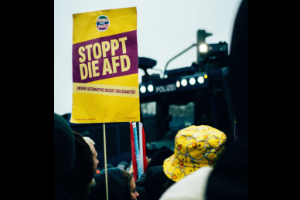
Recent media headlines across the U.S. and world amplified the story line that Germany’s far right-wing party, Alternative for Germany (or AfD) is on the rise. The party that many chillingly compare to the historical Nazi party—considering their shared anti-immigrant rhetoric, directing hatred toward scapegoats, and nationalist ideology—won the most votes, 44 percent in the federal state of Saxony-Anhalt’s Sept. 6 election. Two weeks later the AfD again won the most votes, 38 percent, in Mecklenburg-Western Pomerania state.
But the narrative of an unstoppable far right surge across Europe oversimplifies a complex political reality where, for example, the far-right AfD has thus far failed to form a government in the two states where they won a plurality of votes. Instead, dissatisfaction with centrist, establishment parties, are driving voters to support new political movements, on the right and left, that they hope can make democratic government more responsive to their concerns.
Germany’s Die Linke, or Left Party scored a historic victory in Berlin’s Sept. 20 election, where the AfD finished third, and left-wing coalitions are expected to govern two of the three states that recently held elections. Between The Lines’ Scott Harris spoke with Cas Mudde, Stanley Wade Shelton UGAF Professor of International Affairs at the University of Georgia, who provides an overview of increasing support for European far right parties, and the parallel success in Germany of parties on the left.
Listen to Scott Harris’ in-depth interview with Cas Mudde (17:35) and see more articles and opinion pieces in the related links section of this page. To subscribe to our podcasts, email newsletters, our Between The Lines Radio Newsmagazine Substack or social media, subscribe here.