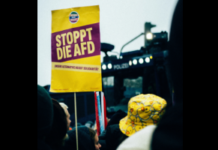
During Climate Week actions in New York City, Sept. 20–27, tens of thousands of activists, community organizers, scientists, government officials and business leaders participated in more than 1,500 events, coinciding with the annual meeting of the United Nations General Assembly. Climate activists took to the streets demanding urgent action to address the climate crisis, while challenging fossil-fuel expansion, corporate greenwashing and the rapidly growing energy and water demands of AI data centers.
Protesters targeted major technology companies including OpenAI, Google and Amazon, underscoring activists’ argument that the promise of technological innovation and corporate climate pledges must be matched by concrete reductions in fossil-fuel use and greenhouse-gas emissions.
A rally outside New York Gov. Kathy Hochul’s Manhattan office opposed her support for building new nuclear power plants in the state to address surging demand from AI data centers and other energy-hungry projects. One of the rally speakers was Kimberly Scott, executive director of Georgia Women’s Action for New Directions Education Fund. Between The Lines’ Melinda Tuhus was there and spoke with Scott, who describes Georgia as ground zero for recent nuclear power development with all its attendant harms, and what her group is doing to help utility ratepayers cope.
KIMBERLY SCOTT: Georgia’s lived through this nuclear future where some states are now considering this so-called nuclear renaissance. We work on and advocate for, educate, inform our constituents, our neighbors, our friends, as well as regulatory agencies and elected officials about environmental protection, climate resiliency and nuclear harm reduction in Georgia. Our frontline communities, particularly in southeast Georgia, are downwind and immediately adjacent to the nuclear industry. And they’ve seen firsthand some of the environmental economic impacts of this industry. And also we advocate for our energy-burdened communities in Atlanta who have experienced firsthand the economic burdens of what expanding these nuclear industries have done to their utility affordability. I tell you, it’s been something that we have gone through for a while and this is really a cautionary tale to states like New York about what this means or could potentially mean for them from an economic and environmental standpoint.
MELINDA TUHUS: If you could just talk about what it meant to build those plants in Georgia and some of the environmental and economic costs, especially for the people close by, but also anybody who’s within the utility framework that is basically charging people to cover the costs of the building, right?
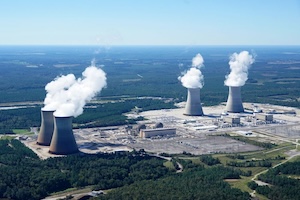
KIMBERLY SCOTT: Right. So Plant Vogtle Units 3 and 4 are the same AP 1000 units that Gov. Hochul is pretty much trying to bring to the state of New York. We built two, the only two that have been built in the last 30 years representing the most expensive power plant on earth. The project took 15 years to construct. It was seven years behind schedule. Original price tag was $14 billion. By the time they got finished, it was close to $37 billion. Obviously, these costs exceeded more than the original estimate and it left Georgia families facing additional costs. We, and I’m a rate payer, took the majority of that cost through our power bills. That’s why we call Plant Vogtle a cautionary tale.
The question is for New York and other states that are considering this so-called “nuclear renaissance,” it’s not whether or not the nuclear reactor or this new reactor can produce electricity. It’s who pays for the project if it runs late or over budget, how the frontline communities, where these new reactors are going to be constructed, how are they protected, and then whether or not faster or more reliable renewable options are available. And so that’s kind of like what we’re trying to push to not only New York state, but any other state that is looking at this. For 2.2 gigawatts, which powers about a million or so households, Texas for the same price, they got more renewable energy options. And Texas obviously is a red state just like Georgia. And so we’re saying if that state can be more forward thinking when you’re talking about moving the state to a clean energy economy and provide renewable options, why couldn’t Georgia have done the same thing? But yet they went to the most expensive power option that is available.
It’s not cost effective obviously and it’s not something that can be deployed in a timely manner. So they did renewable energy options in 4 years versus the 15 years that it took for us to construct and it was so much more money. We got less power and no renewables. However, they got more renewables, less time for the same price tag.
MELINDA TUHUS: Are they talking about building any more new plants? And if so, are they talking at all about these SMRs, these small nuclear reactors, which don’t really exist yet, but there’s been a lot of talk about how they could really kind of save nuclear?
KIMBERLY SCOTT: So at this point, they’re not talking about building new nuclear reactors, but what we are doing from a civic engagement standpoint is making sure that the communities are educated around the Georgia Public Service Commission. From a civic engagement standpoint, we’re also looking at the election for the Georgia Public Service Commission, which is happening this November, because that’s the regulatory board that is supposed to provide this oversight for the utility. But yet what we’ve seen is six rate increases in the last three years. Twenty-five percent of that is directly related to Plant Vogtle.
For more information, visit Georgia Women’s Action for New Directions Education Fund at gawand.org.
See more articles and opinion pieces in the related links section of this page. To subscribe to our podcasts, email newsletters, our Between The Lines Radio Newsmagazine Substack or social media, subscribe here.