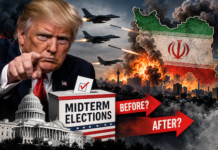
As Americans cast early ballots in advance of the Nov. 3 midterm election, there’s growing concern about Donald Trump’s recent actions to investigate and criminally prosecute his perceived political enemies, including former FBI Director James Comey, officials who investigated his conduct; former administration officials who criticized him; and individuals who testified about his conduct before Congress.
In recent weeks, the administration has escalated threats against state and local election officials, warning of possible imprisonment for counting ballots cast by suspected noncitizens while challenging the eligibility of tens of thousands of voters despite little or no evidence of widespread fraud. Civil liberties advocates and Democratic party officials argue that these actions constitute an unprecedented campaign of intimidation threatening free speech, political dissent, and independent election administration.
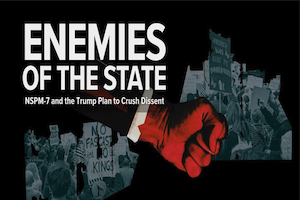
A new report from the media democracy group Free Press, titled “Enemies of the State: NSPM-7 and the Trump Plan to Crush Dissent,” warns that Donald Trump’s National Security Presidential Memorandum 7, issued in September last year, is a blueprint to criminalize political dissent and suppress constitutionally protected free speech. The report examines how the White House is coordinating the Justice Department, FBI and Department of Homeland Security to expand surveillance, investigations and prosecutions of peaceful protesters, immigrant rights advocates, election protection groups and other administration critics. Between The Lines’ Scott Harris spoke with Shilpa Jindia, policy counsel with Free Press and co-author of the “Enemies of the State” report, who sounds the alarm about Trump’s threat to U.S. democracy.
SHILPA JINDIA: This presidential memo was released last September and September 2025, weeks after Charlie Kirk was killed. And its stated goal is to “uproot and disband networks and organizations that promote political violence.” And it does this by citing the threat of Antifa or anti-fascism. But the way that it describes that, this memo would apply to any group that it considers anti-American, anti-capitalist, extreme on migration and gender. And really it’s a response to the anti-ICE protests that had been the most visible and consistent opposition to this administration and their mass deportation agenda. And so what it really does is gives the administration the pretext of domestic terrorism to again, investigate, surveil, and prosecute a wide range of civil society groups. And within days after it was issued, there was news that the DOJ was starting to prepare an investigation into the Soros Foundation, which didn’t ultimately end up happening at this time, but they’ve been threatening the Soros or OSF as well as CARE, the Council on American Islamic Relations and other organizations that have really been at the forefront of challenging the Trump administration.
SCOTT HARRIS: Your report warns that ordinary activities, exchanging text messages, sharing political literature, participating in protests and organizing in community resistance can be used as evidence of terrorism by this administration. Can you explain how prosecutors are transforming constitutionally protected activities into the basis for criminal charges? We have examples, of course, with the Prairieland Texas defendants. There are 15 defendants. They were connected to the July 4th, 2025 protest at the Prairieland ICE Detention Center. Those 15 defendants received a combined total of over 556 years in federal prison. We also have an example of the Minnesota 15 case where organizers of basically peaceful protest have been indicted. But tell us about how constitutionally protected speech can be turned into charges of terrorism.
SHILPA JINDIA: Thanks for pointing out those two important cases in Texas and Minnesota. At its core, NSPM-7 is about labeling enemies based on ideology. It’s really about targeting people based on their beliefs, that is core First Amendment activity. And they’re doing this to suppress opposition and dissent. So you’ll see in the cases they brought against the protesters in Texas and in Minnesota, charges of a criminal conspiracy. The evidence that they’re using are the most common activities that make up political organizing. So in the Prairieland case, the DOJ cited evidence like creating and distributing zines, which they call insurrectionary material or making plans to attend a protest. This all becomes evidence of a criminal conspiracy and they cite chats from Signal, they use their Signal names, and this is supposed to be encrypted technology. And so it’s a very clear sign to protesters and activists that these communications are no longer secure.
The way that the DOJ is treating this is similar to how they have prosecuted groups like the mafia or gangs, again, as a conspiracy, as an entire network of people. And as long as you charge people with just a conspiracy, all you need to show is an agreement amongst people that they show up to a protest together and that becomes evidence of some kind of terroristic conspiracy. We’ve seen in the past authoritarian regimes, they always use criminal investigations and charges to go after their dissidents to try to scare people into silence. But we’re really seeing here how that kind of weapon is being scaled up to go after groups of people as a whole. And in doing so, they’re really trying to strike at the heart of political organizing and political education because that’s really the lifeblood of resistance to the administration and to authoritarianism as a whole.
But I think more largely, the bigger picture that we, again, want people to remember is that with the threat that NSPM-7 presents, the voice of the public becomes paramount. This is the case with voting itself with casting your vote on Election Day, but then also in protecting democracy. If there is election sabotage, then one of our best defenses is solidarity and community protection. We urge people to stay engaged in the last eight days before the midterms, but then in the weeks afterwards and finding local community organizations that are on the front lines and seeing how you can provide them support is the most important thing that people listening to this can do.
For more information, visit Free Press at freepress.net.
Listen to Scott Harris’ in-depth interview with Shilpa Jindia (17:57) and see more articles and opinion pieces in the related links section of this page. To subscribe to our podcasts, email newsletters, our Between The Lines Radio Newsmagazine Substack or social media, subscribe here.