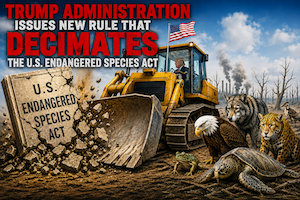
Since it became law in 1973, the Endangered Species Act has used a broad definition of “harm” to animals by including any significant “modification or degradation” of habitat that kills or injures animals by impairing their ability to eat, shelter or breed. But on July 10, the Trump administration’s Interior Department and Commerce Department announced a final rule that rescinded this longstanding interpretation.
Under the new rule, destroying an endangered species’ nest or habitat would no longer be considered illegal. As would authorizing destruction, logging, or developing lands that protected species rely on, provided the species are not directly injured or killed in the process. Under two additional rules, newly listed “threatened” species will no longer automatically receive the same sweeping protections as endangered species.
Environmental and tribal coalitions have already filed multiple lawsuits in federal courts in Washington and California attempting to vacate these rules. Between The Lines’ Melinda Tuhus spoke with Delcianna Winders, director of the Animal Law and Policy Institute at Vermont Law and Graduate School, who talks about the devastating impact of the new rule on endangered and threatened species.
DELCIANNA WINDERS: The Endangered Species Act is an incredibly powerful statute. The U.S. Supreme Court has recognized that it is the strongest law of its type in the world. And because it is such a strong law, it has helped 99 percent of the species who’ve been listed under its provisions. Under this new rule, I would say basically all species on the ESA lists are in danger. And the reason I say that is that habitat loss, habitat modification is the number one reason that species get endangered in the first place. The number one reason they end up on the ESA list—that reason is more than all of the other reasons combined. And so it’s more than 90 percent of species who are listed are there at least in part because of habitat destruction and modification. So it’s really hard to overstate the significance of this.
MELINDA TUHUS: We heard something not too long ago in the second Trump administration about the God Squad that supposedly, I mean, I guess they can decide if a species is going to live or die, but what’s the normal process and how does the God Squad fit into it? DELCIANNA WINDERS: Bottom line is that if an action is going to jeopardize the continued existence of a species or of critical habitat, the ESA prohibits moving forward with that activity because it, as the Supreme Court said, it codifies institutionalized caution, a precautionary principle because we’re talking about something as serious as extinction. And so what the God Squad is able to do is basically say on a case by case basis, you don’t have to follow the law. But there are a lot of procedural mechanisms in place to limit how often that can happen and it has almost never happened before. And yet with very little analysis or consideration, the Trump administration got the God Squad back together for the first time in a very long time and they summarily signed off on oil drilling in the Gulf that we know is going to harm endangered whales and other endangered species.
MELINDA TUHUS: How many species are on the endangered list right now and has it gone up or down a lot since 1973 when the law was passed?
DELCIANNA WINDERS: Almost 300 species have gone from being on the list and then been removed because of successful recovery. But we have about 1,600 species on the list now and that includes foreign species. Elephants, for example, though we don’t have elephants natively in the U.S., they still have those protections. And frankly, that is almost certainly a vast undercount because we are still learning more every single day and there are still efforts afoot to get additional species listed and ongoing battles about whether certain species should be listed or not.
MELINDA TUHUS: What is happening in terms of there’s a period for comment? I mean, are there already lawsuits?
DELCIANNA WINDERS: Yes, multiple lawsuits have already been filed challenging it. There are two main lawsuits currently. One is a coalition of environmental protection groups. So that includes, I mean, Earth Justice is involved, Center for Biological Diversity. And then there’s separately a case brought by tribes, Native American tribes.
MELINDA TUHUS: You said that you weren’t sure it would help industry. Why wouldn’t It?
DELCIANNA WINDERS: A big part of the reason why the definition of “harm,” which was just rescinded, was created in the first place was to provide guidance to industry, to let industry know when they would be running afoul of the Endangered Species Act, when they needed to get a permit. And that’s really important, particularly when you have a statute like this that has what’s called a citizenship provision. So it’s not just that the government can enforce it. Citizens can enforce the law. Nonprofit organizations can enforce the law. And so whether you are drilling for oil, logging, grazing, all of those activities, if you are harming a protected species, you are liable to be sued.
The agencies have declined to put a new definition in its place. So they’ve gotten rid of a definition and very explicitly said, “We’re not going to provide a regulatory definition.” Yet another example of the administration saying, “You know what? We don’t like what the Supreme Court has said. We don’t like what Congress has said, so we’re just going to do what we want. ” And that’s not something that they’re constitutionally allowed to do. And they will get slapped down, but how many species will go extinct in the meantime?
For more information, visit the Animal Law and Policy Institute at the Vermont Law and Graduate School’s website. To subscribe to our podcasts, email newsletters, our Between The Lines Radio Newsmagazine Substack or social media, subscribe here. Subscribe to our Weekly Summary