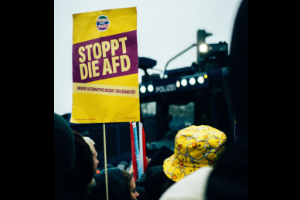
Recent media headlines across the U.S. and world amplified the story line that Germany’s far right-wing party, Alternative for Germany (or AfD) is on the rise. The party that many chillingly compare to the historical Nazi party—considering their shared anti-immigrant rhetoric, directing hatred toward scapegoats, and nationalist ideology—won the most votes, 44 percent in the federal state of Saxony-Anhalt’s Sept. 6 election. Two weeks later the AfD again won the most votes, 38 percent, in Mecklenburg-Western Pomerania state.
But the narrative of an unstoppable far right surge across Europe oversimplifies a complex political reality where, for example, the far-right AfD has thus far failed to form a government in the two states where they won a plurality of votes. Instead, dissatisfaction with centrist, establishment parties, are driving voters to support new political movements, on the right and left, that they hope can make democratic government more responsive to their concerns.
Germany’s Die Linke, or Left Party scored a historic victory in Berlin’s Sept. 20 election, where the AfD finished third, and left-wing coalitions are expected to govern two of the three states that recently held elections. Between The Lines’ Scott Harris spoke with Cas Mudde, Stanley Wade Shelton UGAF Professor of International Affairs at the University of Georgia, who provides an overview of increasing support for European far right parties, and the parallel success in Germany of parties on the left.
CAS MUDDE: Particularly in the 2010s, the far right has pretty much entered every parliament of an EU member state, but more importantly, far right parties from Giorgia Meloni in Italy to Victor Orban who just got out of power in Hungary to law and justice in Poland, these are now either the biggest right-wing party or the second biggest. They are often in government or they’re considered an acceptable partner for government. And those are the two most important changes over the last 15 years. It is first of all, the far right is now often the biggest right-wing party and they are pretty much normalized within the right-wing block. And therefore, because European politics is coalition politics, they’re seen as eligible coalition partners.
SCOTT HARRIS: Professor Mudde, talk a bit, if you would, about the causes of voters across Europe being attracted to these far right politicians and parties that often offer simple solutions to complex problems that often revolve around identifying scapegoats, amplifying racism and hate that has in many instances provoked political violence.
CAS MUDDE: Well, in many ways, the causes are fairly similar to the support for Donald Trump in the U.S. in the sense that there are a lot of grievances which center first and foremost on immigration or immigration-related topics. There is an element of economic anxiety to that too, but it is not necessarily the case that the poorest people or the people in the areas with the highest number of immigrants vote for the far right. But people who vote for the far right believe mostly that immigration is the most important issue. They also believe that the other parties are either corrupt or incompetent.
SCOTT HARRIS: In early September, to get to the German elections, there was frightening headlines in the U.S. that framed the results of elections in the German federal state of Saxony-Anhalt as a victory, 44 percent for the far right alternative for Germany party or AfD. Fill in for our listeners what these headlines and news stories left out of providing a more complete and accurate picture of where German voters are today.
CAS MUDDE: Yeah, so there were three elections in three different states in Germany and they had different stories. So in Saxony-Anhalt, it was the far right AFD, which came close to a majority, and that was validly the major story. But then in another former communist state, Mecklenburg-Vorpommernk, the far right also won, but there was a major story because the mainstream right Christian Democratic Union (CDU) didn’t make it into the parliament. And those two together became the real story and that became the narrative, which was mainstream crumbles as far right wins. But what it missed was first of all that in Mecklenburg-Vorpommernk, we’re going to get a left-wing government because the social democrats, the so-called Left Party, which is sometimes seen as radical left, and the Greens together are constituting majority. And in Berlin, which has almost more voters than the other two, it was actually the so-called radical left, which really is closer to democratic socialism called the Left, which won the election and stunningly won more than 50 percent of the vote of young women.
And that was almost completely ignored. And again, Berlin will probably get a left-wing government. And so this is not to minimize the electoral relevance of the AfD or the threat to democracy from it, but it is problematic to reduce this whole complexity to the mainstream crumbles because the far right wins because this creates the image that the person who is not happy with how the mainstream works votes for the far right. But what we actually see is while this is true for particularly older white men, younger white women actually vote for left-wing parties.
Listen to Scott Harris’ in-depth interview with Cas Mudde (17:35) and see more articles and opinion pieces in the related links section of this page. To subscribe to our podcasts, email newsletters, our Between The Lines Radio Newsmagazine Substack or social media, subscribe here.