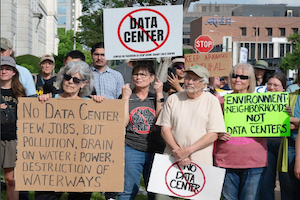
On May 11, the Baltimore City Council joined more than 60 local governments—large and small, rural and urban, Democrat and Republican all over the country—in declaring a moratorium on building data centers powering artificial intelligence while local officials study the issue.
The Maine legislature recently became the first state to pass such a law, but it was vetoed by Democratic Gov. Janet Mills. While the legislature’s veto override failed, Gov. Mills created a commission to study the issue, which was part of the original bill. Last October, Food & Water Watch became the first national group to call for a data center moratorium, now joined by more than 250 other organizations across the U.S.
Data centers require enormous amounts of energy and water, create noise and air pollution depending on how they’re powered—and create very few jobs. Between The Lines’ Melinda Tuhus spoke with Thomas Meyer, strategic organizing projects director for Food & Water Watch and Food & Water Action. Here he talks about the fight to stop or at least slow down the building of AI data centers in Maine and other states across the nation.
THOMAS MEYER: What we have been pushing for and saying is that we need a moratorium on data centers basically until and unless we can figure out a way to make them compatible with a livable and sustainable future. So far, so many of the proposals have been powered by fossil fuels using enormous amounts of water; creating a lot of noise and disruption for communities; buying up farmland that obviously could be productive in other ways. Conditions or the stipulations of lifting a moratorium would probably differ state to state until there is obviously some kind of national framework. There’s a lot left to be figured out. And so we think that it’s prudent to hit pause and give both the public and policymakers time to figure out how to move forward sustainably. The cities and towns where this is being so hotly debated, we know that opposition to data centers has been bipartisan and we know that in other states, certainly there have been proposed moratoriums that are bipartisan and led by both Democrats and Republicans in the legislature.
MELINDA TUHUS: Maine was the first state to pass a statewide moratorium. And then the governor vetoed it. She vetoed it because she said she wanted a particular one to go through when she said it would be 400 construction jobs and 100 permanent jobs, which sounded a litle fishy to me because I know it doesn’t take much human labor to run these things. What does your research show in terms of jobs that would be provided with these data centers?
THOMAS MEYER: Food and Water Watch has a recently published research report that looks at the variety of reasons why a data center moratorium is prudent and one of them is the kind of empty promises around jobs and revenue. Looking at Virginia specifically, which is where the most data centers have been built and proposed, found that with a $54 million investment in a data center, you would get one permanent job and with $54 million invested in non-data center projects, you would get 168 jobs. And so you’re right that the math from this project really just doesn’t add up. Really part of the rationale for data centers and for artificial intelligence and for automation is to eliminate jobs. That is the project of the big tech and corporate trusts that are pushing these.
MELINDA TUHUS: In Maine, well, I understand that the governor vetoed it and then she created, I guess by a executive order, a body to study the issue, which is partly what the moratorium was going to do. Do you know what’s happening next in Maine in terms of trying to fight back against her veto?
THOMAS MEYER: As I understand it, was brought back up to override the veto and did not quite have the numbers necessary to override it. So to my knowledge, it’s dead for this legislative session, unfortunately. There is a push in Maine—as in so many other states—to pass moratoria or ban or restrictions at the local level in Maine. What we’ve seen everywhere in the country is that the local, the municipal, county level is where the kind of fiercest opposition has been and where local elected officials have taken action, not in as many cases as they should.
MELINDA TUHUS: Gov. DeSantis in Florida said that any data centers coming—and he didn’t say they weren’t welcome—but they would have to provide their own energy, but that doesn’t really address the issue of, first of all, what kind of energy and also the issue of water use. Is it possible to have a data center without using up an awful lot of water?
THOMAS MEYER: There are some systems more expensive, less common. It’s why the industry doesn’t want to use them. To my understanding, there are some data center systems that would use less water, would recycle water for cooling in some way, would use the heat generated by the thing that’s happening in all the servers to actually provide heat or energy for other buildings.
To subscribe to our podcasts, email newsletters, our Trump authoritarian playbook Substack or social media, subscribe here. Subscribe to our Weekly Summary