As Americans cast their ballots in the Nov. 3 midterm elections, voting rights advocates and democracy watchdog groups raised alarms over the Trump administration’s unprecedented efforts to interfere with the electoral process. President Trump and his allies have promoted conspiracy theories alleging widespread voter fraud, challenged the eligibility of hundreds of thousands of voters, and deployed the Justice Department to pursue lawsuits and threaten election officials with criminal prosecution. Adding to these concerns is the appointment of 2020 election deniers to influential federal positions overseeing election-related matters.
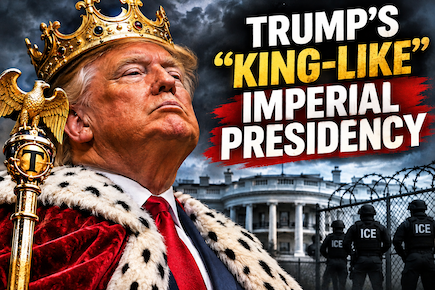
In a recent Center for American Progress article titled, “The Trump Administration Is Interfering in the 2026 Midterm Elections to Entrench the Imperial Presidency,” co-authors Michael Sozan and Ben Olinsky argue that Trump’s election interference is part of a larger effort to consolidate presidential power, rooted in an extreme interpretation of the controversial unitary executive theory — a doctrine the administration has invoked to justify sweeping executive authority and weaken checks and balances embodied in the U.S. Constitution.
Between The Lines’ Scott Harris spoke with Michael Sozan, senior fellow at the Center for American Progress, about the Trump administration’s efforts to manipulate the 2026 midterm elections, and the long-term threat these actions pose to American democracy, especially the president’s pursuit of establishing what Sozan describes as an imperial presidency.
MICHAEL SOZAN: I mean, underlying all of it, the foundational element that is so concerning of course, is Donald Trump’s continued lie about widespread voter fraud. We know that is not happening. It’s extremely rare in our electoral process, yet he and his allies continue to say it over and over again. And of course, that drives mistrust in elections. But what he’s done is he has stocked the administration full of election deniers and his allies and key positions throughout the Department of Justice, the Department of Homeland Security, and tons of other agencies and departments. And so all of those are combining right now so that we just see multiple attempts at sabotage and subversion by these election deniers and his allies. And it’s really unfortunate. And I think that one that I’m really looking at for the coming days is how he continues to try to interfere with the vote-counting process.
And will the administration try to involve troops or federal personnel in some way to do that? You’ll remember that Donald Trump famously said just a few months ago that he regretted not having the National Guard seize voting machines in the 2020 election. So I think that there are going to be additional pieces of the puzzle that are going to emerge in the coming days, and we’re going to be in a chapter right after Election Day during the vote counting period where we’re going to have to stay very, very alert. But all that being said, I’m still optimistic, cautiously optimistic that we will have a free and fair election, especially when we see so many new voters coming out. I think that the American people are going to make their voices heard.
SCOTT HARRIS: Michael, in your August report, you warned that the Trump administration is interfering in the 2026 midterm election as part of a broader effort to entrench what you describe as an imperial presidency. And Donald Trump, the Supreme Court and the Heritage Foundation’s Project 2025, they all advocate for something called the “unitary executive theory,” really in my mind, a euphemism for ignoring institutional checks and balances embodied in the U.S. Constitution. And I think they want to establish what in essence is a presidential dictatorship. What’s your concern that Trump has succeeded in normalizing his version of this dictatorship and the critical actions Congress and the American people, regardless of the election results— what do we need to do to eliminate this, what I believe is a fascist threat to our democracy, this unitary executive theory?
MICHAEL SOZAN: Yes, that is one of the many reasons why we are in such a challenging chapter for our democracy. And you’re right, the unitary executive theory, it’s really a fringe theory and it really hasn’t up until recently gotten any sort of currency. It’s something that’s been rejected before and it’s something that really would help to build what I call an imperial presidency. That’s what the report that you’ve referenced is a series that I’ve written with my co-author Ben Olinsky about how Trump is trying to build an imperial presidency and has taken many steps towards it. We started tracing this all the way back to Project 2025, which you allude to. So there’s got to be a concerted effort going forward to knock down this theory, to knock down this march towards an imperial presidency, to knock down the authoritarian playbook that has been imported from abroad now into this country.
And that’s why I know many people are hoping that pro-democracy forces, including Democrats, have a very strong day on Election Day and that a message can be sent that Americans don’t want an imperial president. I mean, we fought a war to gain our independence against a monarchy. That’s why we’re at an important inflection point. And I think that we’ll see how the people register their voices here and how they want to chart the course for our country. But yeah, I think that there’s going to have to be a lot of rebuilding in the future. I shouldn’t even say rebuilding. We’re going to have to build for the first time a democracy that is strong, resilient, has checks and balances that can survive a president who might try to tear them down and can survive a president who may be thoroughly corrupt, and also just a democracy that can finally make sure that everybody has a fair shot at the American dream.
There’s a lot that’s going to unfold over the next days, weeks, months, and even years. And I know that so many of us are working to try to make sure that fringe theories like the unitary executive theory or notions that somehow this country can turn into an autocracy, get tossed into the trash bin and that we can really open a new healthy chapter.
Listen to Scott Harris’ in-depth interview with Michael Sozan (28:18) and see more articles and opinion pieces in the related links section of this page. To subscribe to our podcasts, email newsletters, our Between The Lines Radio Newsmagazine Substack or social media, subscribe here.