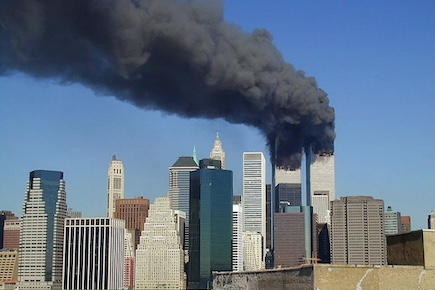
The 25th anniversary of the Sept. 11, 2001 attacks was marked this year by solemn ceremonies at the World Trade Center ground zero site in New York City, the Pentagon in Washington, D.C., and the Flight 93 National Memorial near Shanksville, Pennsylvania, honoring nearly 3,000 people killed that day.
The anniversary also brought renewed scrutiny of the government’s irresponsible conduct and false declarations about the safety of the toxic cloud that blanketed Lower Manhattan that’s responsible for illnesses that killed as many as 9,600 people in the years after 9/11. At the same time, families of 9/11 victims renewed long-standing demands that the federal government declassify and release all remaining records concerning possible Saudi Arabian government links to individuals who supported some of the 9/11 hijackers—15 of 19 of whom were Saudi nationals.
Brown University’s Costs of War Project estimates that post-9/11 U.S. wars and counterterrorism operations directly and indirectly claimed the lives of 4.5 to 4.7 million people around the world, and cost approximately $8 trillion.Between The Lines’ Scott Harris spoke with Stephanie Savell, director of the Costs of War Project, who summarizes her group’s research on the human and monetary cost of U.S. wars launched after the 9/11 attacks and these conflict’s impact on our nation’s security, foreign policy and civil liberties 25 years later.
STEPHANIE SAVELL: I think a lot of these human war costs are not ones that we Americans are always aware of when we think about war—obviously when they’re killed, they can’t sustain their families anymore.
And there’s the environmental costs of war as well. The way that uranium and lead, for example, has been found in bone samples at much higher rates in Fallujah, Iraq, for example, which is a place that the U.S. bombed heavily in a couple of different bombing campaigns. So those are the kinds of human indirect death costs. And, of course, for every death—a public health expert sees that as a red warning flag—what they call a sentinel health event at the tip of the iceberg of a chain of suffering. So for every death, there’s a whole host of people that are suffering the ill effects. And when you look at the best available methods for calculating numbers, it’s really hard to get a sense of scale. And that was one of the things that I tried to do with my research—was a kind of how do you put a sense of what scale we’re talking about here when we’re thinking about indirect deaths in the post-9/11 wars?
And I found that it was about 4.5 million people died as a reasonable and conservative estimate of total direct and indirect death in the war zone. So it’s a really astronomical number.
SCOTT HARRIS: Stephanie, I just wanted to talk a bit more about the other costs, consequential costs of the wars that emanated from 9/11. And that includes the erosion of civil liberties with the Patriot Act legislation, mass surveillance, aggressive U.S. foreign policy, and the lack of accountability for U.S. government officials who ordered the torture of U.S.-held prisoners in violation of U.S. and international law that took place at Guantanamo.
STEPHANIE SAVELL: That’s right. You named a lot of what we see as the social and political costs of the post-9/11 wars and these include indefinite detention, torture and mistreatment of those suspected of terrorism. But also domestically, the dramatic expansion of mass surveillance and intensified police militarization, which is not just kind of an accidental result of the post-9/11 wars, but an intentional, oftentimes, policy decision to transfer military equipment to police departments throughout the country. So when you think about the effects of intensified police militarization, you have to remember that it’s going to be the marginalized and racialized groups, Muslims, Arabs, Black, indigenous organizers, migrants. We’re seeing more and more of that today. These are the populations who are bearing the brunt of these social and political costs of war.
Listen to Scott Harris’ in-depth interview with Stephanie Savell and Elizabeth Miller (26:27) and see more articles and opinion pieces in the related links section of this page. To subscribe to our podcasts, email newsletters, our Between The Lines Radio Newsmagazine Substack or social media, subscribe here.