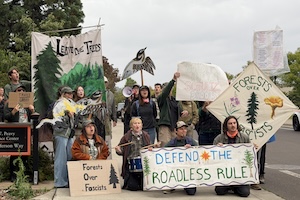
In January 2001, the Clinton administration put in place the so-called Roadless Rule, which enacted major protections for 58 million acres of national forests, mostly in the West and Alaska. The Rule, which now covers 44.5 million acres, effectively blocks clearcut logging and other extractive industries, while not banning all resource extraction.
President Donald Trump attempted to roll back the Roadless Rule without success in his first term, but he’s now working again to fully repeal the rule, this time with strong allies in federal agencies responsible for enforcement.
Environmental organizations and indigenous groups are now fighting to keep the Roadless Rule in place, which protects clean water resources, fish and other wildlife, as well as the general quality of life for those living in the forests and the population in general. Between The Lines’ Melinda Tuhus spoke with Wanda Culp, a Tlinglit woman from the Tongass forest in southeast Alaska, who has fought against corporate clearcutting near her home, since the 1980s with a group called Tongass Women for Forests. Here she explains what difference the Roadless Rule made and how indigenous people are fighting to save it.
WANDA CULP: Southeast Alaska villages, the village areas, the small communities were attacked. So our hunting and fishing grounds were literally clear cut and there was no prior notice that this was going to happen. When it started in Juna, one of my grandmothers, said her and her husband was coming down from the mountain and saw the first clear cuts and she was crying, touching her heart and saying, “See what they’re doing to us?” And she repeated it again, “Do you see what they’re doing to us?” And that’s how I became aware of the fact that nobody knew what was going on. I was baffled why nobody had said anything locally, but there hadn’t been an outlet for anybody to. Nobody knew how to go about it. It was 1980-’81 when I uprooted my daughters from Juneau and moved to Juna where it’s my village. I had been working with the Bureau of Indian Affairs, the federal government.
So I was pretty aware of the federal law and understanding how the federal laws work and how they impact the communities. And the state of Alaska was in on it, too, under Alaska Native claim settlement. They took the authority to bring in the clear cut operations and started clear cutting around our villages, our hunter and fishing grounds. They changed our habitat forever.
MELINDA TUHUS: Well, so then you had this experience. So what did you and working with other people, what did you do to get the Roadless Rule in place?
WANDA CULP: I started by talking to the elders and then there was a group of us that brought in experts on tribal authority and things like that. We had a workshop, brought that forward because Tlingit and Haida in southeast Alaska, we have tribal jurisdictional authority. Getting the perception of this across to everybody, the power that we have and the authority had to be explained that what’s going on around us, we have a right to say something. That is when the Council of Elders created a resolution 9101, because it was 1991, to recognize our traditional jurisdictional authority, which has been reaffirmed through Goldschmidt and Haws.
MELINDA TUHUS: Is that a Supreme Court decision or what is that?
WANDA CULP: It ended up to be a Supreme Court decision, yes. It became very controversial within the community because it was providing jobs to our younger guys for logging, taking down our trees and things like this. There’s so many lawmakers that see indigenous people as exterminated. This is where it became very controversial where nobody wanted to face the fact that as indigenous people in Tlingit and Haida country, we have a say. When the federal government like Trump and those that are pro-industry are saying they can control public-owned land, we need to stand up and say that’s not so. Don’t take away our tongues, our brains and our integrity.
MELINDA TUHUS: So after the Roadless Rule went into effect, what impact did it have? Did it help with slowing down or stopping the clear cutting of the forest?
WANDA CULP: Yeah, of course. That big huge contract was canceled with the Forest Service, Ketchikan and Prince of Wales, they had that 50-year free-for-all contract that was canceled. And the big complaint from us was create local jobs and harvest with respect. And the roadless rule, I want to mention right now, let’s bring this right into today’s controversy. It’s all set up. The reason why we need it in place is because mining is priority right now in the state of Alaska.
MELINDA TUHUS: What are you trying to do now to stop the role this rule from being repealed?
WANDA CULP: We’ve got a mapping project going on. We’ve turned to visuals because visuals is the way to get to people to realize what we’re talking about, how huge it is. We need the media to bring it forward. Everything that is happening with Trump and them billionaires and Alaska Native claims settlement land has to do with literally raping the resources without respect at all. And he’s shortening any comment period. It’s like, “We don’t care what you say, we’re just going to do it.” That is the attitude that’s happening right now as if we don’t have a say. That’s very insulting.
See more articles and opinion pieces in the related links section of this page. To subscribe to our podcasts, email newsletters, our Between The Lines Radio Newsmagazine Substack or social media, subscribe here.