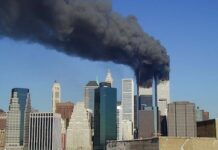
On the 25th observance of the 2001 9/11 terrorist attack that killed nearly 3,000 people at New York City’s World Trade Center, the Pentagon in Washington, D.C. and in a crashed airliner in Shanksville, PA, Atlantic staff writer Graeme Wood, examines what happened to the Al-Qaeda terrorist group responsible. He observes that after their spectacularly successful and horrific 9/11 attack, the group progressively weakened and ceased to function as an effective terrorist force well before the U.S. killed Osama bin Laden in 2011.
(“What Happened to Al-Qaeda?” The Atlantic, Aug. 5, 2026)
During a high-profile state election in eastern Germany, the far-right part Alternative for Deutschland won nearly 44% of votes cast in the small state of Saxony-Anhalt — three votes short of an absolute majority in the state parliament. If the AfD forms a majority coalition, it would be the first time that a far right party will govern a German state since the fall of Adolph Hitler and end of World War II. Although the AfD was predicted to win, the election outcome sent shockwaves across Europe. The conservative Christian Democrats came in a distant second, followed by the center left Social Democrats.
(“A Far-Right Win Puts Pressure on Germany’s Leader,” New York Times, Sept. 8, 2026; “With Messaging that Mirrors Putin, Far Right Party Gains Ground,” New York Times, Sept. 10, 2026)
Under a new Trump administration Colorado River rationing plan, southern Nevada could—in future years—lose over 70 percent of its already-sparse water allocation — while Colorado, Utah, New Mexico and Wyoming won’t face any mandatory cuts at all. Nevada officials have filed a lawsuit to stop the plan, and warn of potential “catastrophic impact” on the state economy, and on Las Vegas in particular, where the Colorado River provides 90 percent of the water supply for 76 percent of Nevada’s population.
(“Fearing ‘Catastrophic Impacts’ from Water Cuts, Nevada Sues Feds Over Colorado River Plan,” Inside Climate News, Aug. 24, 2026)