On Aug. 28, Donald Trump announced that his administration had reached an agreement with the government of Venezuela, which he described as the “biggest oil deal in world history!” Venezuela’s concessions came nearly nine months after Trump ordered the U.S. military to kidnap the nation’s President Nicolás Maduro and his wife Cilia Flores, who were remanded to the U.S. to stand trial on narcoterrorism charges.
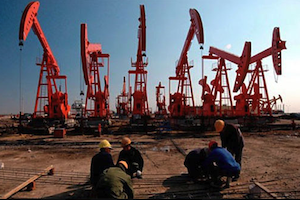
Acting Venezuelan President Delcy Rodríguez said the deal involves the development of 17 oil fields with a proven potential of 65 billion barrels. She said the agreement could draw $100 billion in investment into Venezuela’s oil industry and yield over $209 billion in taxes. Despite Trump’s usual bravado, there’s little chance the Venezuelan agreement will bring Iran war-triggered record-breaking oil prices down in the U.S. any time soon.
Under the agreement, the U.S. is entering into a private joint venture with North American Blue Energy Partners, owned by Venezuelan businessman Alejandro Betancourt. Between The Lines’ Scott Harris spoke with Steve Ellner, associate managing editor of Latin American Perspectives, author, and a retired professor of Venezuela’s Universidad de Oriente where he lived for over 40 years. Here he examines the U.S.-Venezuelan oil deal that many observers maintain is nothing less than brazen, neocolonial piracy—an agreement made at gunpoint.
STEVE ELLNER: Trump has imposed on Venezuela nothing short of a neocolonial relationship with Venezuela. And this is demonstrated by the terms of the agreement. It involves proven reserves containing 65 billion barrels of oil. That’s more proven reserves than all of the United States. And the United States gets 20 percent of those reserves according to the agreement. Trump is guaranteed 20 percent of those reserves at cost and also priority for the purchase of the remaining oil, 100 percent of it. The deal involves 17 fields, but of those 17 fields, several of those fields have already been committed to China. One has been committed to Russia, so they lose that. China has protested. This is a violation of their legal rights.
Furthermore, the main company that will have the operating rights, it’s a Venezuelan company owned by a young Venezuelan capitalist by the name of Alejandro Betancourt. Thirty-five percent of the operating company will be in the hands of the Pentagon.
I think, Scott, that the thinking behind the arrangement is that Trump, after the Jan. 3rd kidnapping of President Maduro, who you mentioned, Trump claimed that now $100 billion would be invested in the Venezuelan oil industry. That didn’t happen. It didn’t happen in part because of the uncertainty, because powerful political actors in Washington want to get rid of the pro-Hugo Chavez leadership. And Delcy Rodriguez in particular, they want to see the right-wing leader Maria Corina Machado in power. So the companies were reluctant to invest certainly large sums of money. Exxon made it clear from the outset that they weren’t going to invest large amounts of capital. So by making this arrangement in which the U.S. government is organically involved in the Venezuelan oil industry, the multinational companies will invest. I think that’s the thinking behind it because certainly this guy, Alejandro Betancourt, who’s a nouveau riche, he’s not in a position to inject large sums of capital in the Venezuelan oil industry.
And the state oil company, Peneveza, has been devastated by the sanctions against the Venezuelan oil industry going back to the first Trump administration in 2017. So they’re in no position to reactivate the Venezuelan oil industry. I think the strategy there is to get large sums of U.S. capital into Venezuela.
SCOTT HARRIS: And Steve, I did want to take note of the fact that this oil agreement appears to have been made under the threat of further U.S. military intervention in the country’s domestic affairs and policies. And as you said at the outset of our discussion tonight, this is a case of brazen neocolonialism, the mafia state here under Donald Trump and piracy.
And Rodriguez herself, who the Guardian quotes, she herself said that Rubio gave her and the second-in- command, Diosdado Cabello—who was the second command under Maduro—Rubio gave him 15 minutes to decide what they wanted to do and if not, they would be decapitated. So there’s no question about it that there is a mafia-style operation here.
Listen to Scott Harris’ in-depth interview with Steve Ellner (17:47) and see more articles and opinion pieces in the related links section of this page. To subscribe to our podcasts, email newsletters, our Between The Lines Radio Newsmagazine Substack or social media, subscribe here.