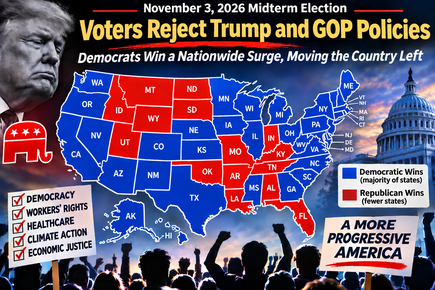
In a historic political earthquake, voters across the nation delivered a sweeping repudiation of President Donald Trump and the Republican party in the Nov. 3 midterm election, producing one of the most dramatic Democratic victories since the 1974 post-Watergate wave that followed President Richard Nixon’s resignation.
Democrats captured control of both the U.S. House and Senate, winning Senate seats in longtime Republican strongholds including Texas, Kansas and South Carolina, while flipping dozens of House districts, at least five governors’ seats and electing a new generation of progressive candidates in state legislatures.
Driven by voter anger over corruption, the affordability crisis, Trump’s authoritarian policies and threats to democratic institutions, the election has dramatically transformed the nation’s political landscape, raising urgent questions about whether the incoming Democratic congressional majority will deliver the fundamental reforms voters are demanding. Between The Lines’ Scott Harris spoke with Norman Solomon, cofounder of RootsAction.org, and Jim Hightower, longtime progressive political commentator and the last Democratic commissioner of the Texas Department of Agriculture from 1983 to 1991. Here they discuss priorities they’d like to see Democrats take up when they take control of Congress in January and challenges to current party leadership.
NORMAN SOLOMON: Medicare for All, that’s key. Yes, if Trump vetoes it, well, at least it’s out on the table and it’s fought for. And if it’s fought for now, you’ll lay the groundwork for the education, the agitation to then be successful and enacted into law. Free or very low cost childcare, free public education. I wouldn’t say just free public college, but education. Why is it that K through 12, because people fought for it for decades, is public, but somehow we haven’t gotten it through our collective noggins that higher education beyond 12th grade should also be free. That’s something that we need to be fighting for. And of course, rolling back the fossil fuel industry’s power. And it all is going to hinge on, as Jim pointed out, the key word, we got to get organized, more organized. The victories have come when people did get organized and the mass media don’t encourage us to do that.
On the contrary, they’re looking for the great man theory or great woman theory sometimes. They’re going to pull it off for us. No, all the changes that we have to be proud of are because people organize going back centuries and in the last few weeks and months. I think it is going to be crucial in the next weeks, really in the next days, to do all we can to unseat the soon to be or wants to be majority leader in the Senate, Chuck Schumer. There is reporting just in the last few hours that Chris Van Hollen, the senator from Maryland, is opening the door more than a crack, that he will challenge Chuck Schumer to be the majority leader of the Senate. Newsweek reported a couple of hours ago that our organization Roots Action is among those demanding that there be a really open contest.
This should not be a coordination. We could go on for hours and I won’t go on even for minutes about the corruption of Chuck Schumer who hauled in one year, 15 percent of the entire amount of money coming from Wall Street from a 100 people in the U.S. Senate. He’s been a bag man and a recipient for corporate America for decades. That’s not the kind of leadership we need in the Democratic party. We need quite the opposite.
SCOTT HARRIS: Thank you for that. Jim, you want to comment on agenda for the next hundred days of the Democrats when they move into Congress in January? And also of course we can talk more about Democratic party leadership too.
JIM HIGHTOWER: Well, the leadership just expressed itself, the people themselves. They shoved it up (unintelligible) of the political establishment. I mean, people are sick of the consultants and just the established arrogance of saying, “We are the Democratic party.” No, you’re not. The Democratic party is the Democratic constituency, the people themselves. And this time they began to express themselves. But I will say they’ve been expressing themselves for quite a few years now. What happened in Texas did not happen in the last year. It did not happen because of (James)Talarico and also and some superb candidates that we put forward. It happened because ordinary people have been doing grassroots organizing against the established Democratic party to create a possibility for this revolution to have happened. And it is a revolution. It’s not a revolution that is firmly established yet, but it has expressed itself in very, very firm terms to say, “This is where we want to go. Where the hell are you going to take us?”
And we know where that is going to be. That is going to be, as they already are saying, back to more establishment kind of “get along to go along. Let’s not get too extreme here. We’ve got to be calm and we’ve got to just do modest kind of incremental changes.” No, people want fundamental radical changes in the way things are operating because the way things are operating is screwing them.
NORMAN SOLOMON: In political terms, we need to point out that while you can try to buy elections, often if people organize effectively, as we’ve seen in Texas, we saw in Wisconsin in the state Supreme Court race, Elon Musk was not able to do it. Structurally, of course, we need to change the rules. The corporate spending is not speech, unlike what the Supreme Court said. I think in another aspect, and this is an “and, it’s not a but,” we should really look even more closely at the reality that the Democratic party from the DNC onward and the so-called leadership in the House and Senate, they really are addicted to the gazillionaires and that’s who they’re worried about not offending. Whereas, how did Bernie Sanders get all the money he really needed to run for president twice? What, he averaged $27? And that is the model that’s really frightening to the corporate power structure.
So I see it as a two-fold simultaneous process. Get the structural legal changes done big time, like overturning every which way we can legislatively and in terms of the Constitution what Citizens United has done. But also we need to find ways to finance people-powered election campaigns in all sorts of levels from county commissions to president of the United States.
For more information, visit Jim Hightower’s website at jimhightower.com and subscribe to his newsletter at hightowerlowdown.org. visit Norman Solomon’s website atnormansolomon.com and Norman Solomon’s Roots Action at rootsaction.org.
Listen to Scott Harris’ in-depth interview with Norman Solomon and Jim Hightower (29:20) and see more articles and opinion pieces in the related links section of this page. To subscribe to our podcasts, email newsletters, our Between The Lines Radio Newsmagazine Substack or social media, subscribe here.