
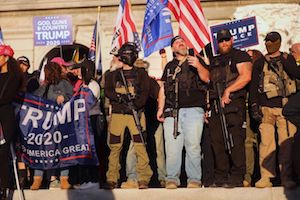
During Donald Trump’s 2016 campaign for president, the candidate often spouted violent rhetoric, such as urging his supporters to beat up any protesters who showed up at his rallies. As president, Trump continued to use the same type of language when talking about police treatment of suspects or dehumanizing immigrants who crossed the U.S. southern border.
On Jan. 6, tens of thousands of Trump supporters attacked the Capitol, many carrying weapons – and some openly calling for the execution of Vice President Mike Pence and Democratic party leaders. Five people died as a result of the violence carried out during the Jan. 6 insurrection. Alarmingly, much of the GOP has aligned itself with armed white supremacists terrorist groups including the OathKeepers and Proud Boys. Since Trump’s defeat, the former president’s allies have directed thousands of death threats to election officials, legislators as well as their family members including children.
Now as federal and state investigators pursue multiple allegations of Trump’s criminality, the former president and his allies have ramped up their violent rhetoric. Calls for political violence from Trump supporters, echoed by many extreme right- wing commentators peaked recently after the FBI searched Trump’s residence at Mar-a-Lago for classified and national security documents. In addition to hundreds of online threats directed at federal law enforcement agencies, a man attacked the Cincinnati FBI office on Aug. 11 who was later killed in a standoff with police. Between The Lines’ Scott Harris spoke with Dr. Bandy Lee, a forensic psychiatrist and president of the World Mental Health Coalition. Here, the best-selling author examines Donald Trump’s and the Republican party’s dangerous embrace of political violence.
DR. BANDY LEE: Violence and political violence is a natural, logical consequence of having so mentally impaired a president for so many years. In fact, we were hoping very much as mental health professionals that our warning or our scientific basis and clinical background that would tell us how dangerous the situation is in the spectrum of dangerous situations and also what interventions are necessary.
And what was necessary was an early intervention. Three months after our book was out — The Dangerous Case of Donald Trump: 27 Psychiatrists and Mental Health Experts Assess a President — within three months, we were able to raise the topic to the number one issue of national conversation. In fact, I was invited to every cable and news network news program. I didn’t accept them all, but I was invited to all. There was not one I wasn’t invited to.
But after the American Psychiatric Association stepped in using its clout essentially to protect the president over the public because it gets federal funding, essentially shut down the discussion, even though the number one emergency of the Trump presidency was psychiatric. The current problem that’s occurring throughout the nation is more mental health related than anything else.
I often say that fascism is not a political ideology, but mental pathology in politics. Of course, it would like to present itself as an ideology, but we quickly learn that it has nothing to do with ideology. It can attach itself to any kind of ideology.
SCOTT HARRIS: We have Donald Trump, who is of course, at the center of the Republican party. But what explains, in your study of this situation here in the United States, the widespread embrace of political violence that might have started with Donald Trump, but has now metastasized across the right, across the Republican party specifically and the commentators and those in the right-wing blogosphere who echo the calls for violence.
It just seems we’re in a very dangerous time.
DR. BANDY LEE: Yes, we are indeed. Well, the principal warning that we had and the reason why we were framing the problem of Donald Trump as a public health problem was because of his psychological dangerousness — and he is a violent personality with a violent psychology. If we did not contain that violent psychology, it would translate and spread into social, cultural, geopolitical and civic dangerousness and violence. And we are seeing it all across the board.
Now, we have had Donald Trump not only complete the full presidency, he’s about to run again and he’s never been held accountable. His dangerousness has never been contained. And that sends an enormous signal not just to the violent elements in society, but to our very overall culture. So this is actually is not surprising and a natural consequence of the Trump presidency and still a consequence of Trump’s influence.
In fact, if we contained him now, we’re talking about indictment of charges, prosecution after the Jan. 6 Committee hearings and the attorney general is finally stepping up after much time when we would have advised. If we had any say that time was a dangerous thing to allow; that the situation would not remain neutral. But violence would grow, as we have seen currently from a therapeutic perspective. Indictment, prosecution and containment of these dangers is a very urgent step because there’s a contagious effect to violence and violence proneness.
And that, coupled with not only the violent rhetoric, but the detachment from reality and cherished beliefs that people have taken on because of the president’s mental impairments, emotional investment and believing that the 2020 election was stolen, for example. Subconsciously, you may know that they aren’t true, so in order to defend your beliefs, you become more and more defensive and therefore violent.
For more information, visit Dr. Bandy Lee’s web site at bandylee.com.
Listen to Scott Harris’ in-depth interview with Dr. Bandy Lee (19:28) and see more articles and opinion pieces in the Related Links section of this page.
For the best listening experience and to never miss an episode, subscribe to Between The Lines on your favorite podcast app or platform: Apple Podcasts, Spotify, Stitcher, Google Podcasts, Amazon Music, Tunein + Alexa, Castbox, Overcast, Podfriend, iHeartRadio, Castro, Pocket Casts, RSS Feed.


