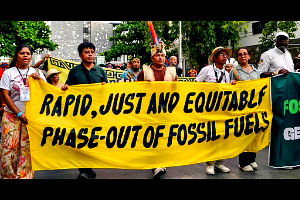
After 30 United Nations climate meetings, known as Conferences of the Parties, or COP, the world has made very little progress toward reining in the deadly impacts of the climate crisis that include rising global temperatures, wildfires, floods, droughts and sea level rise. Years of inaction is due in large part to the fact that countries opposed to reducing fossil fuel use, like the U.S. and Canada, block agreements that must be unanimous. Another issue is that gas, oil and coal companies send more than a thousand lobbyists to climate conferences in order to influence the outcome.
Earlier this year, the first-ever conference on transitioning away from fossil fuels took place in Santa Marta, Colombia, co-hosted by then-Colombian President Gustavo Petro and the Netherlands. No fossil fuel lobbyists were allowed and only countries that made a commitment to drawing down their emissions were in attendance. One of the key issues discussed at the conference was the Fossil Fuel Treaty Initiative, a global campaign advocating for a new binding international legal agreement to halt the expansion of fossil fuels and phase out the use of coal, oil, and gas.
Between The Lines’ Melinda Tuhus spoke with Tzeporah Berman, founder and chair of the Fossil Fuel Treaty Initiative. Here she discusses the importance of cutting the supply as well as the demand for fossil fuels, and action nations and individuals can take to support that goal.
TZEPORAH BERMAN: Eighty-six percent of the carbon that’s physically trapped in our atmosphere causing the fires and the floods and the extreme weather around the world, 86% just comes from three things: oil, gas, and coal. And so I started doing research on what international agreements do we have between countries on reducing the production of these projects of oil, gas, and coal. And I found out we don’t have any, that the words oil, gas, and coal and fossil fuels don’t even exist in the Paris Agreement. Somehow we’ve created a system where we’re trying to cut with one-half of the scissors, the demand and not the supply. So we started convening a group of diplomats and lawyers and experts from around the world asking them, how do we create supply side climate policy? How do we help countries and discourage them from making the problem bigger? Closing what’s now called the production gap.
United Nations Environment Program created the production gap report, which shows us that we’re on track today to produce 120 percent more oil gas and coal by 2030 than we can ever burn if we want to stay below two degrees and meet the goals of the Paris Agreement. We need to stop expanding production and manage a decline, not just in our use and emissions, but also in fossil fuel production. And that conversation has become very distorted inside the United Nations climate negotiation space by vested interests, countries and also companies who argue that we can reduce emissions just by putting in place technologies to store carbon. And that way we can continue to grow fossil fuel projects. So they advocate for carbon capture and storage or direct air capture or land capture, but it doesn’t work. Every year, governments pour more billions of dollars into these technologies and every year they fail to meet the promises and projections that the industry has said.
And we now have over 25 countries at the table developing a fossil fuel treaty, a massive global movement that’s growing around the world to call for a fossil fuel treaty as a companion to the Paris Agreement.
MELINDA TUHUS: Isn’t it true that there are some fossil fuel-producing countries that are among those 25 countries, but not of course the U.S. and not Canada?
TZEPORAH BERMAN: There are smaller producers like Timor-Leste and others. There’s one very big producer, the fifth largest coal exporter in the world, which is Colombia. And when President Petro, the former president of Colombia, joined the Fossil Fuel Treaty, he made a really big speech saying, “We know every day we make the problem worse, but we can’t stop because no country can do this alone and we need to cooperate to change the frameworks that are pushing us all into making the problem worse.” He actually was, I think, one of the first decision-makers to refer to fossil fuels as today’s weapons of mass destruction, which I don’t think is overblown. We now know that fossil fuels are the greatest single cause of premature death in the world. About seven million people died last year just from air pollution due to fossil fuels alone. And then when you actually add up the climate impacts, well, of course, one person is dying every minute right now due to lethal heat, which is primarily caused by fossil fuels.
The Santa Marta Conference was the first ever international conference on fossil fuel phase out. That was a diplomatic conference, a convening of countries, but it was outside the UN process. Now, it’s important to understand that that conference is separate from the Fossil Fuel Treaty, although the Fossil Fuel Treaty was one part of it. And honestly, they’re one of the things that really gives me hope right now. I mean, to be in Santa Marta and see the creativity, and when I really started probing and asking questions of academics or faith leaders or ministers, why is this working? And they all said the same thing, “Because we’re not fighting about whether we need to do fossil fuel phase out, we’re just talking about how.” We see the Fossil Fuel Treaty and this new momentum on fossil fuel phase out as being additional tools to help meet the goals of the Paris Agreement.
A lot of people get frustrated with the current conference of the parties and the UN negotiations on climate and can’t see the progress. But I firmly believe looking at the science and the agreements that have been made there that if it wasn’t for the Paris Agreement, it would be much worse. I think it’s really important for people to get involved, to not just watch what these countries are doing, but actively encourage them to do it, to actively encourage your governments to engage in it or your states or your cities.
For more information, visit Fossil Fuel Treaty Initiative’s website at fossilfueltreaty.org.
See more articles and opinion pieces in the related links section of this page. To subscribe to our podcasts, email newsletters, our Between The Lines Radio Newsmagazine Substack or social media, subscribe here.