Since Donald Trump returned to the White House in January 2025, his administration has been methodically implementing a multi-pronged strategy to suppress voter turnout, manipulate election rules and undermine public confidence in the results of the midterm election. The president has pressured Republican-controlled states to gerrymander districts to favor GOP candidates; attempted to restrict mail-in voting; demanded access to sensitive state voter data; used flawed citizenship databases to challenge voter eligibility; and promoted unsubstantiated claims of widespread election fraud and foreign interference.
Trump has also threatened to declare a national emergency and deploy ICE agents, the U.S. military and other federal officials to polling places to intimidate voters, seize voting machines and ballots, or halt the counting of votes.
Between The Lines’ Scott Harris spoke with former California administrative law judge and legal commentator Bill Blum, who warns that even if Democrats win control of Congress in the Nov. 3rd election, the president and his Republican allies could attempt to prevent victorious candidates from taking office, triggering a constitutional crisis on Jan. 3, 2027, when the new Congress convenes. Here, he argues that Jan. 3 could become a repeat of the Jan. 6, 2021 GOP attempt to overturn an election, this time through manipulation of congressional procedures, lawsuits, recount demands and allegations of massive voter fraud.
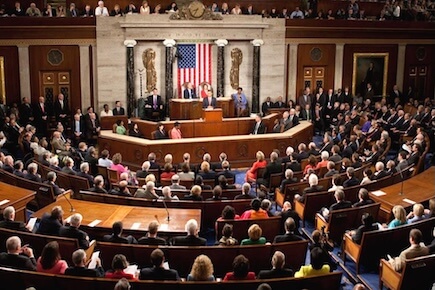
BILL BLUM: Donald Trump is not going to relinquish power easily, if at all. He’s going to do anything he thinks he can to retain power, which as far as the midterms are concerned, means that he wants the Republicans to keep control of both the House and the Senate. So a multi-pronged attack on voting rights has been initiated. It’s been going on for a long time. It’s going to culminate, in my view, on Jan. 3rd when under the Constitution, the new Congress convenes. So what happens on Jan. 3rd? What happens on Jan. 3 varies from chamber to chamber. In the House, and this is something I wrote about first in March and Judge Michael Luttig then wrote a really long and very good article recently for the New Republic is that an administrator called the clerk of the House gathers all of the election certificates from the states and then creates what’s called a roll of the representatives-elect.
Remember, every member of the House is elected every two years, so it’s not a continuing body like the Senate. Only those people who are listed on the roll will, according to this scenario, then be sworn in. So a certain number of Democrats might be kept out because Mike Johnson, the current speaker of the House, has unilateral authority to dismiss the current clerk of the House, who’s apparently an even-handed individual, and replace him with a MAGA loyalist who will not enroll all the Democrats who have been legitimately elected. And so you’ll have a situation where you’ll have an artificial Republican majority, at least on the surface at the outset in the House. And in the Senate, something similar will happen except that it will be JD Vance who is responsible as the president of the Senate, since he’s the vice president of the United States, to swear in all new members.
And there’ll be 35 new senators. There are two special elections and there are 33 who are up in the regular course of business. And if he refuses to swear in a certain number of Democrats depriving the Democrats of the majority, then you have another situation where the Republicans at least initially maintain control of both houses. So here’s what could happen. I think that ultimately there will be litigation and that ultimately those who are elected legitimately, mainly Democrats, will be seated, but that will take some time. We don’t know how much time will be consumed. It could be days, it could be weeks. Within that framework, the country will effectively be without its article one branch of government. It won’t have a legislature. And so if it doesn’t have a legitimate legislature, that’s actually, in my view, a national emergency. And unlike many of the other emergency declarations that Trump has promulgated, this would be a real one, even though it’s artificially created.
So what will he do? He will issue some kind of national emergency declaration. I’m not sure what that would be, no one knows, but it will certainly not be one inspired by democratic norms and values. And that’s, I think, the scenario that we have to keep in mind. Even as we have all this litigation that’s going to happen after the election, you’ll have challenges to various contests, say in Michigan, say that’s a really tight Senate contest. You’ll have demands for recounts. You will have lawsuits filed. You’ll have all sorts of propaganda flying around saying that the Chinese and the Iranians have interfered with the election. And there’s already a national emergency declaration on the books issued by Trump, I think in January, where he is authorizing the intelligence agencies to conduct a review of foreign cyber interference. What would he try to do? It’s hard to say.
This is different from declaring martial law. There is no federal definition of martial law, but something similar to that could possibly be coming down the pike. If you think that it’s hyperbole, you have to ask yourself, given everything that Donald Trump has done so far, do you think for a moment that he is going to allow himself to be subject to the kinds of investigations and potential accountability which would come about if the Democrats control even one chamber of the legislature? And I think the answer is he’s not going to put up with that at all. And I think the best preparation is to get out and vote in numbers so overwhelming that any claims of fraud or having a rigged election in favor of the Democrats are so absurd that they won’t get off the ground, that they’ll be killed in the crib. That’s the message that I’m trying to send.
For more information, visit Bill Blum’s webpage at Truthdig.com.
Listen to Scott Harris’ in-depth interview with Bill Blum (16:15) and see more articles and opinion pieces in the related links section of this page. To subscribe to our podcasts, email newsletters, our Between The Lines Radio Newsmagazine Substack or social media, subscribe here.