
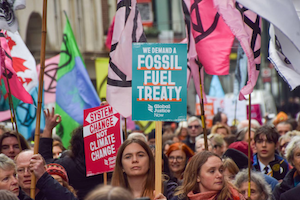
From April 24-29, Colombia and the Netherlands will be co-hosting the historic first Fossil Fuel Treaty Initiative Conference on transitioning away from fossil fuels, in the city of Santa Marta, Colombia. This gathering is different than the 30 United Nations-sponsored climate conferences of the parties, or COPs, that have been held since 1992. The U.N. climate meetings allowed the participation of large numbers of representatives of the fossil fuel industry and also required unanimous agreement for anything to move forward.
More than 50 countries will be participating in the Colombia conference, including some that are world’s biggest fossil fuel producers, but the U.S., China, India, Russia and the Gulf petro states will not be attending. Between The Lines’ Melinda Tuhus spoke with Osprey Orielle Lake, the founder and executive director of WECAN, the Women’s Earth and Climate Action Network. Many of its members, including frontline women leaders from around the world, have participated in previous UN climate summit meetings and will be involved in this conference as well. They will be participating in discussions to propose solutions to the climate crisis, such as the need for investments in reforestation, renewable energy and food sovereignty.
OSPREY ORIELLE LAKE: I think this is a really exciting opportunity that Colmbia’s hosting the first conference on transitioning away from fossil fuels. And what’s really interesting is that the high-level sessions will be on April 28 and 29, and the period before that is specifically designed so that there can be really strong civil society input. There’ll be regional meetings for civil society and then breaking into sectors in different interest areas. And then taking all of that meeting and discussions and convening and submissions, civil society will meet with the governments the day before the high-level session occurs to receive those inputs.
You know, we’re at COP30. There’s been 30 years of negotiations around the climate crisis. And the COP space, UNFCCC space is very important because we need multilateral engagement on the climate crisis because no one country can solve this on their own. This is something that impacts the entire world.
And one of the things that has been really difficult and compromised about the UN space during the COP is that there’s so many fossil fuel lobbyists who enter into that space and really influencing decisions. We can all see the lack of logic in that. We should not be having those industries engaged in a process which we’re trying to end, not perpetuate. And so not only are there fossil fuel lobbyists, there has been so much difficulty in getting agreement around talking about fossil fuels and ensuring that the phase out is central to the discourse at the COP. And some of that is not only because of the fossil fuel lobbyists, but fossil fuel-producing countries and also fossil fuel countries that are very engaged in the fossil fuel economy and the geopolitics behind that and the power structures behind being a fossil fuel economy. And so we’re up against big forces when we’re at the COP space to get real progress.
And it’s not to say that COP isn’t valuable. This last COP30 in Brazil, because of civil society advocacy, countries did adopt the just transition mechanism, which is going to be a really important tool going forward to make a roadmap for actually how do we have a transition off of fossil fuels. So that was a really important victory. When we look at the Paris Climate Agreement, the fact that there’s a 1.5 degree guardrail that countries agreed to was very hard work by countries, but a lot of that was a push by civil society demanding that guardrail. So there’s a real role and real progress we’ve made sort of at the granular level at the COP. But other than that, it must be said that COP30 really failed to talk about the thing we all need to talk about, which is phasing out fossil fuels, which are coal, oil and gas and the source of the climate crisis.
At the end of COP30, that was not in the outcome documents. And it was very powerful because many countries wanted there to be this discussion and there to be more final negotiations around the phase out. And Colombia with the Netherlands then held a press conference at the end of COP30 stating the announcement for this conference that is now going to be happening in April in Colombia. And so since then, there’s just been a lot of activity since the beginning of this year to organize for that. Our organization, WECAN, and many others have been engaged in many civil society meetings and sending in submissions to the government about what we see in the fossil fuel phase out, what’s needed, how would it get funded, how do we have climate justice frameworks and many other components to ensure that we are starting off on the right foot as this process begins.
It’s, I think, a historic event and it’s a conversation that really needs to be had. And I hope people will really put a lot of attention and support into governments making this big move to have a real discussion about the fossil fuel phase out.
MELINDA TUHUS: Can any country come or who gets to attend?
MELINDA TUHUS: Right. And we know the U.S. won’t be there.
OSPREY ORIELLE LAKE: No, the United States won’t be there. However, I will say that at the subnational level, the U.S. will be engaged. There will be some members of Congress and others attending. So it’s not to say that there isn’t room for foreign progress in the United States, just not at the federal level at this stage.
Learn more about WECAN, the Women’s Earth and Climate Action Network at
wecaninternational.org.
See more articles and opinion pieces in the related links section of this page. For periodic updates on the Trump authoritarian playbook, subscribe here to our Between The Lines Radio Newsmagazine Substack newsletter.


