
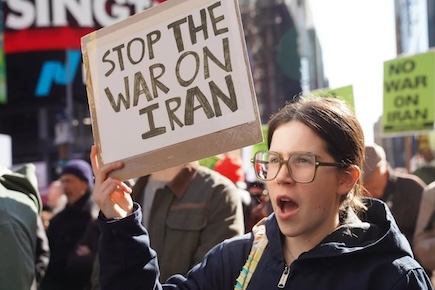
At the 11th hour, President Trump extended a two-weeklong ceasefire indefinitely that was due to expire on April 22, as U.S.-Iran peace talks scheduled to begin in Pakistan on April 21 were put on hold. Trump had directed the U.S. Navy to continue to enforce a blockade of Iranian ports, despite Iranian officials’ declaration they would not negotiate while the U.S. blockade continues. On April 19, a U.S. Navy destroyer fired on and seized an Iranian flagged cargo ship in the Gulf of Oman. One day earlier, Iran fired on two Indian-flagged ships in the Strait of Hormuz that Tehran said challenged their blockade.
Recent public opinion polls find that a strong majority of Americans are dissatisfied with Trump’s job as president, with two-thirds of respondents disapproving of his handling of the Iran war. As Americans’ opposition to the war rises, pressure on Congress to invoke the war Powers Act is building. The Republican-led House and Senate have defeated multiple Democratic party attempts to invoke the War Powers Act to limit military action against Iran. On April 16, the GOP House narrowly defeated a War powers resolution by just one vote, 214-213.
Between The Lines’ Scott Harris spoke with Kevin Martin, president of Peace Action and the Peace Action Education Fund. Here, he assesses mounting pressure on Congress to invoke the War Powers Act to rein in and provide oversight on Donald Trump’s illegal, erratic war on Iran.
So it would have won by one-vote margin. Now that would not have automatically stopped the war in and of itself. But a lot of this is about the political pressure, especially on the Republicans and making it very clear that they just own this war that is so not only illegal, but very unpopular with the American public. The other votes that are potentially more politically significan: Last week we saw the strongest votes ever to stop two particular weapons transfers to Israel. Now that’s related obviously, but it’s a separate vote. So on the war powers, it’s almost entirely a Republican defense of Trump and rejection of the constitutional authority of Congress. Let’s be serious about that. It’s the constitutional authority of the United States Congress to declare war, not to just defer to the presidency. But of course, even though Trump’s approval ratings are in the tank and gas prices are up and food prices are up and the war is illegal and unpopular, the Republicans and Congress are still standing by him with only two exceptions of all Republicans in Congress.
And on the other side, the Democrats, for the most part, are opposing the war and trying to uphold their constitutional authority. That may continue because in both the House and the Senate, they’re talking about the Democrats continuing to force these war powers resolutions. And Republicans are whining about that like, “Oh, this is just a messaging bill and they’re trying to gum up the works and they’re taking up floor time, blah, blah.”
Well, that’s okay. That’s appropriate as far as I’m concerned when there’s an illegal war of aggression going on. So Republicans can whine about that if they want, but they can’t really stop these votes from coming forward. But again, as I said, and if you want to move on to this, we could. The votes last week were really remarkable in terms of stopping particular weapons transfers to Israel.
SCOTT HARRIS: Kevin, explain to our listeners a bit about how the War Powers Act, the war powers resolution, if passed. What effective change could it mandate on where the United States is now with this war on Iran, which is in this very precarious ceasefire. We don’t know if this war is going to resume any minute.
For more information, visit Peace Action at peaceaction.org.


