
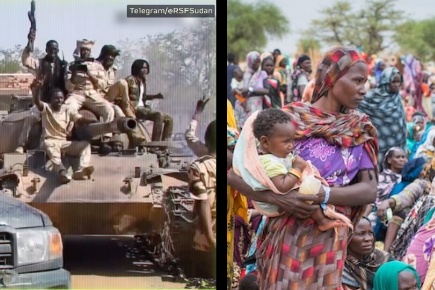
Another humanitarian crisis is underway in war-ravaged Sudan. Last October, the city of El Fasher in North Darfur in western Sudan fell to the Rapid Support Forces, or RSF, the rebel army that’s been battling Sudan’s military since 2023. The year-and-a-half siege of El Fasher led to widespread starvation and then the genocide of tens of thousands of Black African residents of Darfur, including women and babies in the city’s maternity hospital.
Now, the city of El Obeid, the capital of North Kordofan state in south-central Sudan, may also soon fall to the RSF. After an 18-month blockade, more than 500,000 civilians in the city are in immediate jeopardy due to the RSF’s escalating attacks and intensive drone strikes.
Nathaniel Raymond, executive director of the Humanitarian Research Lab at the Yale School of Public Health, has been using satellite imagery to investigate the humanitarian crisis in the contested region. Between The Lines’ Melinda Tuhus spoke with Raymond, who explains how this potential catastrophe differs from the genocide committed against the people of El Fasher last year. He also discusses which nations are supporting Sudan’s warring armies and what could be done to prevent another humanitarian disaster.
NATHANIEL RAYMOND: It’s a dire humanitarian crisis in El Obeid. And El Obeid is its own situation, its own problem. What the RSF is trying to do in El Obeid is not related to the people who live there, which was the case in El Fasher. It’s related to the strategic value of the road on the back end of El Obeid. El Obeid is a funnel. There’s one road in and one road out. That road that goes out of the city from the Southeast is currently controlled by the National Army of Sudan. And that road is very important because that road head at the back of El Obeid is the access point to the capital. Historically, El Obeid has been a stop on the Hajj for Muslims who have traveled from West Africa to Saudi Arabia for the annual pilgrimage to Mecca. So whoever controls El Obeid controls the road to Khartoum and Omdurman, the twin cities of the capital.
And so what RSF is trying to do is to recapture the approach to be able to threaten the capital where Sudan armed forces have control.
MELINDA TUHUS: This war in Sudan has been, in the Western media at least, portrayed as a civil war between the Rapid Support Forces and the Sudanese armed forces. I’ve been reading more recently that it’s been called a proxy war. I’ve been hearing that the United Arab Emirates are supporting the RSF with all kinds of military aid. Who’s supporting the Sudanese armed forces if this is in fact a proxy war?
For more information, visit the Humanitarian Research Lab at the Yale School of Public Health at ysph.yale.edu/hrl.
See more articles and opinion pieces in the related links section of this page. To subscribe to our podcasts, email newsletters, our Trump authoritarian playbook Substack or social media, subscribe here.


