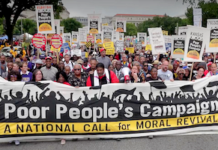
What’s widely known as the ‘affordability crisis,’ describes the plight of more than half of Americans who struggle every day to afford the basic necessities of life: food, housing, healthcare, education and transportation. Early in Donald Trump’s second term, the tariffs he imposed on nations around the world triggered a significant rise in inflation here at home. The U.S.-Israeli war on Iran launched on Feb. 28 closing down the Strait of Hormuz has driven up gas and utility costs, while increasing food prices and mortgage rates.
But last year, before the war, the Republican-controlled Congress passed Trump’s federal budget bill that cut taxes for the nation’s wealthiest families and profitable corporations while slashing millions of Americans’ access to health insurance and food assistance. At the same, time billions more taxpayer dollars were allocated to the Pentagon and Trump’s ICE mass deportation campaign.
The National Priorities Project at the Institute for Policy Studies has released its annual Tax Receipt report, which found that during 2025, the average U.S. taxpayer paid more than $4,000 to the Pentagon, veterans programs and ICE secret police mass deportation enforcement — while contributing only $2,500 for Medicaid. Between The Lines’ Scott Harris spoke with Lindsay Koshgarian, program director with the National Priorities Project, who summarizes the findings of her group’s “Tax Day 2026” report.
LINDSAY KOSHGARIAN: So every year at Tax Day, April 15th, we put out a tax receipt showing people where their income tax dollars went for the previous year. So when we file our taxes, you file your tax return, you’re actually paying your taxes for 2025 right now. So we did find that the average taxpayer in 2025 paid over $4,000 for war and weapons. And as you said, this is before the war in Iran even started and it was before some of the increases in military spending that the administration is asking for now. And so we’re potentially looking at that number skyrocketing even more. And of course, it’s even more significant right now because people are also paying in other ways for this war. We have higher gas prices that are a result of the Iran war. And we also—this is something that we’re not hearing about as much—but we also have climbing national debt that is going to be a result of all of this increased military spending.
And that’s something that we’ll be paying for as well. So there’s actually three different ways that folks will be paying for this war in the long run. They did pass a historic tax cut bill last year, but what it mostly was, was tax cuts for the wealthy and the tax cuts for people on the lower end of the spectrum were in fact completely wiped out by the cuts to social programs. So if you’re at the lower bottom 20 percent of the income spectrum in this country, you may have gotten a small tax cut from that bill, but you would lose more in benefits like Medicaid and SNAP than you got as a tax cut. So you’d actually end up losing money.
SCOTT HARRIS: Lindsay, in terms of Pentagon spending, the current trillion dollars that’s being spent on defense and the wars, as well as the $1.5 trillion Pentagon budget for 2027—as I look at some of the stats on this, the American budget for our military is really an amount of money that’s staggering, as we’ve said, but it really totals much, much more than the top 10 or 12 countries in what they spend on their military combined. Maybe you could just address that quickly because just to put it in perspective in terms of, yeah, America has the world’s most deadly military force as we’re seeing in Iran. But it dwarfs any other military, in fact, a combination of a dozen other militaries.
We absolutely have to stop that because it will result in more wars and more of this type of violence all over the world.