Donald Trump’s first 1½ years in his second term as president have been characterized by an aggressive assault on American democratic institutions, diversity programs, the media, universities, the slashing of dozens of federal agencies and programs, public health systems—and rampant corruption as well as selective, vindictive prosecution of his perceived political enemies.
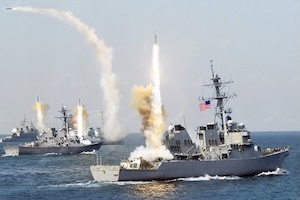
During Trump’s three campaigns for the presidency, he professed his strong opposition to U.S. involvement in “forever wars,” pledging to use his office to prioritize “America First” policies. But in September last year, Trump ordered the military to begin attacking what he claimed were drug boats in the Caribbean Sea and Pacific Ocean as part of a pressure campaign on Venezuela that killed more than 185 people on 50 boats.
The destruction of these boats on the high seas, in violation of international law, was a prelude to the Jan. 3 night-time raid on Venezuela’s capital, killing 100 people, where U.S. forces kidnapped Venezuelan President Nicolás Maduro and his wife Cilia Flores, who now face narco-terrorism charges in the U.S. This was followed in quick succession by Trump ordering a U.S. naval blockade of Cuba on Jan. 29 to stop all tankers from delivering oil to the island nation and the launching of the Feb. 28 U.S.-Israeli war on Iran that’s killed thousands across the Middle East and stopped the flow of oil, fertilizer and other cargo through the Strait of Mormuz. Between The Lines’ Scott Harris spoke with Steve Ellner, a retired professor at Venezuela’s Universidad de Oriente where he lived for over 40 years, author of more than a dozen books, and currently associate managing editor of Latin American Perspectives. Here he examines Trump’s wars on Iran, Venezuela and Cuba, that he describes as a new stage in U.S. imperialism.
STEVE ELLNER: I would say that there are two main aspects which define the moment and shed light on U.S. actions. In the three cases that you just mentioned, Iran, Venezuela, Cuba, one is the weakness of the justification for the use of military force. There are always justifications. I mean, Hitler had justifications, so that’s a constant, but the weakness of the justification compared to past administrations. And the other element that I would emphasize is that since the end of World War II, since the beginning of the Cold War, the United States has militarily intervened in countries throughout the world, but the military element is now predominant. And the military aspect was never so blatant and so simultaneously widespread. I mean, the Vietnam War lasted—U.S. involvement has lasted about 10 years, but during that period, you didn’t have so many different military theaters of U.S. action taking place simultaneously with such flimsy justifications.
The U.S. blew up since the beginning of the second Trump administration. It has blown up 55 boats in the Caribbean and the Pacific. They’ve killed at least 186 men. No names have been provided. Even though a spokeswoman from the Pentagon stated that they know the names of all these people who have been killed and yet, they haven’t released the names of these supposed drug smugglers. And even if they were drug smugglers, it didn’t justify their fate. In the past, interdiction was used. Boats would be taken over and these men would be apprehended. That’s the standard practice up until the second Trump administration. In the case of the kidnapping of Maduro and Cilia Flores that you mentioned, the justification being that they belonged or that he, not Cilia Flores, but Maduro headed the Cartel de los Soles, supposed military cartel. And that was used, I mean, going back to the first Trump administration. (William) Barr, the attorney general, used that shortly after the United States recognized Juan Guaidó as president of Venezuela.
In other words, that was a political maneuver on the part of the first Trump administration. So the justification for going after Maduro all along was that he headed this Cartel de la Soles. No evidence at all for that, no concrete specific evidence for that. And so much so that after Maduro, charges were brought against Maduro in New York in January, the Cartel de la Soles practically was not referred to. It was referred to one or two times, but referred to as something like a culture of corruption in the military. So that’s kind of a misnomer because a cartel is not a culture of anything. A cartel is a top-down organization, as we know in the case of the cartels in Mexico, of Mexico. So those are the two elements that I would emphasize. The military element is now dominant, more so than in the past.
And the justification for these military actions are extremely flimsy. Legitimacy of the actions are very much up in the air.
SCOTT HARRIS: Thanks for that, Steve. You wrote in this commentary that since the Cold War era, the U.S. has perfected its use of economic sanctions to punish nations that weren’t compliant with Washington’s policy priorities. And for many years, the U.S. imposition of sanctions has been used as what I think people in the countries that are targets would interpret as collective punishment. And we’re talking about Cuba, Venezuela, Iran, Nicaragua. I mean, there are dozens of examples around the world. And they’re sometimes predicated on a struggle for democracy, but of course there’s a double standard. The United States is aligned with, provides money and arms to many countries that are not democracies, that are monarchies or brutal dictatorships. What are the effects of sanctions on those nations’ internal policies that often leads to security states that close down space for dissent and/or repression of democratic movements that Washington often likes to say they support?
And Iran might be an example of that. Donald Trump talked about help was on its way to the democratic movements. There were, by many accounts, thousands of protesters in the streets in January that were killed by Iranian security forces, but these sanctions and this war certainly are not helping that movement by many accounts that I’ve heard.
STEVE ELLNER: Certainly, Scott. And there’s a double standard also. If you consider that all of the studies of international sanctions, there’ve been a lot of them used by the United States. The studies indicate that the sanctions really amount to acts of war and that war and democracy are incompatible. And you mentioned the case of Iran. Under Obama, in 2015, a deal was reached. A treaty was signed, and as a result, the sanctions were eased. And as a result in Iran, there was a relative, I say relative, I don’t want to overemphasize that, but there was a sort of a liberalization process in the country. The hardliners associated with (Mahmoud) Ahmadinejad who had been president prior to that lost out. And there was somewhat of an opening up process. Maybe it didn’t go very far. There wasn’t much time for that to happen because Trump came back in 2017 and John Bolton was largely in charge, was the architect of foreign policy for several years then.
And his position was one of regime change in Iran. But there is a correlation there between sanctions and repression.
Listen to Scott Harris’ in-depth interview with Steve Ellner (20:26) and see more articles and opinion pieces in the related links section of this page. For periodic updates on the Trump authoritarian playbook, subscribe here to our Between The Lines Radio Newsmagazine Substack newsletter. Subscribe to our Weekly Summary