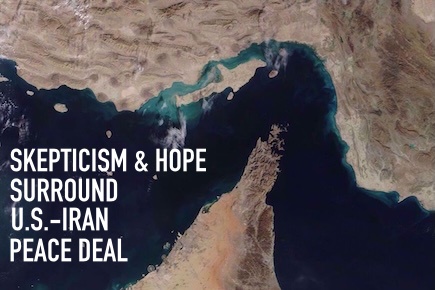
For the 39th time this year, Donald Trump took to social media on June 14 to announce that the U.S. and Iran were close to finalizing a Memorandum of Understanding (MOU) to end the U.S. war against Iran that was launched with Israel on Feb. 28. The MOU, scheduled to be signed in Geneva, Switzerland on June 19, will extend a ceasefire for another 60 days, during which time all sides will negotiate the details of a final agreement to permanently end the conflict.
Although the specific framework of the deal has not been made public, Iranian and U.S. officials have leaked conflicting accounts of what’s in the agreement. Those points include the U.S. lifting its naval blockade of Iranian ports, in exchange for Iran reopening the Strait of Hormuz to global commercial traffic. While Iran says the U.S. will end economic sanctions and release $24 billion to $25 billion in frozen Iranian assets during the 60-day negotiation window, the U.S. says those outcomes depend on Iran’s agreement to restrict its nuclear program, limit its missile arsenal and curb support for regional allied militia groups.
Iranian officials maintain that the peace deal with the U.S. requires Israel to withdraw its forces from Lebanon, where it occupies 20 percent of the country, after it launched attacks against Hezbollah in March that have killed more than 3,000 people. Between The Lines’ Scott Harris spoke with Jennifer Loewenstein, former associate director of Middle Eastern Studies at the University of Wisconsin-Madison. Here she examines what we know about the agreement framework to extend peace talks by 60 days.
JENNIFER LOEWENSTEIN: It’s a good thing if countries are not dropping bombs on each other so that in the most abstract sense, I do think it’s a good thing. But there are good grounds for the skepticism that is going around. If you do look at the Memorandum of Understanding, the few items that have been leaked are very good for Iran and not good for the United States. I think we have to view this as a U.S. loss. I think it’s a deserved loss considering we started the war and we started it for no good reason. But the skepticism remains and part of that is, in my view, the biggest part of that has to do with Lebanon and that is because I don’t see either the Netanyahu government or any government that comes in after him, if he’s not re-elected honoring the parts of that agreement that have to do with Lebanon.
And in fact, there have already been ceasefire violations—not major ones—but enough to cause many people to raise their eyebrows and to say, “What’s going on here?” So I think that the U.S. and Iran do want to stop pounding each other. And again, I would stress that Iran was the one attacked. We were the aggressors and aggression is the supreme international war crime as Justice Robert Jackson said at the Nuremberg Tribunals. So there are good reasons to be glad, but there are also many reasons to be skeptical and we have to understand that this is not a peace agreement. This is a Memorandum of Understanding that has only 60 days in which some of the really thorny issues are supposed to be decided and agreed upon. So we have yet to see whether that comes to pass.
SCOTT HARRIS: There’s a lot of skepticism about Israel and its compliance with whatever peace agreement comes out of this, even over these next 60 days where the ceasefire …
SCOTT HARRIS: … has been extended. But what do you think (Israeli Prime Minister Benjamin) Netanyahu’s goal is in Lebanon in terms of the tax on both Hezbollah, but also the civilian infrastructure of even the capital city of Beirut?
But Israel does not want to relinquish its goals of doing what it’s doing in Lebanon and even though that is advertised as trying to destroy Hezbollah, I don’t believe that is ultimately Israel’s goal because what it wants more than anything else is to turn Lebanon into another Syria—a nation that is weak, demilitarized, divided, bordering on internal chaos, especially in Lebanon. If there’s any kind of civil war that results from the various factions of the government not being on the same page with each other, that’s what Israel wants.
It doesn’t want to destroy Hezbollah because that would get rid of the main source of destabilization as far as the Maronite and Sunni sects are concerned. So what it wants is to weaken Hezbollah enough that it ceases to be a kind of deterrent power to Israel, but that it continues functioning as a destabilizing and this force within Lebanon and that’s what Israel wants.
Listen to Scott Harris’ in-depth interview with Jennifer Loewenstein (16:42) and see more articles and opinion pieces in the related links section of this page. To subscribe to our podcasts, email newsletters, our Trump authoritarian playbook Substack or social media, subscribe here.