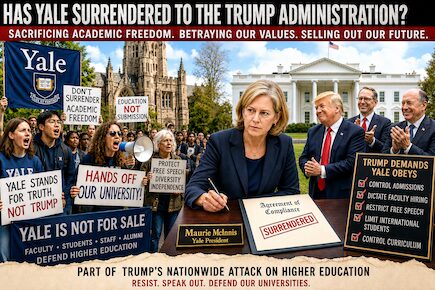
In a months-long campaign, the Trump administration is seeking to control university and college admissions policies, curricula and hiring guidelines, as it attempts to demolish academic freedom and suppress campus protest. The regime is threatening some of the nation’s most elite institutions with millions of dollars in federal funding cuts, the withdrawal of accreditation and the loss of nonprofit tax status to compel compliance.
On Aug. 3, Trump’s education secretary, former World Wrestling Entertainment CEO Linda McMahon, demanded all of the nation’s universities publicly respond to a series of questions about institution’s admissions policies, foreign influence, affordability, and campus free speech guidelines by the end of this year by the end of the year.
Yale University’s admission policies have been under investigation by the Trump Justice Department since May and Yale President Maurie McInnis is currently negotiating with the administration to reach a compliance agreement that’s drawn strong opposition from faculty, staff, students and alumni. McInnis acknowledged receiving McMahon’s demands, stating that she’s gathering input from the campus community on how the university should respond. Between The Lines’ Scott Harris spoke with Jason Stanley, professor of philosophy and chairman of American studies at the Munk School of Global Affairs at the University of Toronto, and author of “How Fascism Works.” Stanley, who until last year was a professor at Yale, relocated to Canada with his family, citing deep concerns over Donald Trump’s authoritarian rule. Here, Stanley discusses his principled opposition to Yale or any other university, surrendering their independence to the Trump regime’s demand for political and ideological alignment.
JASON STANLEY: Linda McMahon, the secretary of education, has issued a letter to ask universities to prominently post on their websites how they’re addressing the “crisis of higher education” and statements of principle to be posted prominently on institutional websites. They’re manifestly completely incoherent. They call for intellectual pluralism, which here is of course calling essentially to hire conservatives. It calls for depoliticizing academia, but at the very same time, it says that American universities must put Americans and American interests first and orient the research enterprise to support the country’s economic insecurity needs and putting American societal success out of global commitments. I just want to say that this is what far right movements, including the Nazis, said universities were for—to promote national interests. So authoritarians regularly call on universities to promote “national interests” above, say, interests of truth, knowledge, freedom, human rights. So this is very clearly a politicization of the university.
It’s calling on the universities to serve in American security interests. So the interests of American empire, so for example, presumably the interests of Israel is the current Israeli government and whoever else the United States is saying is an American security interest. So this is a clear call for the politicization of the university. And President McInnis sent a letter taking this very seriously and saying, “Oh, well, let’s have a universitywide discussion of how we can meet this,” when this is a very clear call to politicize the university, to stack the university with people with certain political viewpoints, so bypassing experts. And McInnis’ cover letter has no critique of this at all. It’s a complete whitewashing. It’s basically saying Yale is going to support and stand in line with this. There’s no critique of this obvious political document. Furthermore, the Trump regime, Linda McMahon has given two examples, which are really the Trump regime’s now signature documents that the Trump regime is using as its flagship statements for its higher education policy.
McMahon writes, “In May, Yale’s Committee on Trust in Higher Education boldly acknowledged that the dilution of academic standards and domineering monoculture have badly eroded public trust.” They also list the charge from the presidents of Vanderbilt and Washington University—unfortunately a committee of scholars, four of whom are analytic philosophers as I am—which decry the politicization of the humanities and humanistic social sciences. So history’s going to remember the two documents that really stand for the Trump administration’s policies and views of higher education as Yale’s Committee on Trust in Higher Education and this committee, what we’re calling the Boghossian Report in philosophy.
So Yale really looks like it’s really trying to angle to be the face of the Trump regime’s remaking of higher education. And I know that many people who were involved in the Yale’s Committee on Trust in Higher Education didn’t want to go down in history this way, but unfortunately it was easily foreseeable that this would happen, that the whole premise here is that the public has lost trust in higher education
SCOTT HARRIS: Is there any chance that the organizing of faculty, staff, students will have some impact, have some positive effect on President McInnis and the board of trustees and how all these negotiations or what may be, as you describe—capitulations—will turn out?
Listen to Scott Harris’ in-depth interview with Jason Stanley (27:25) and see more articles and opinion pieces in the related links section of this page. To subscribe to our podcasts, email newsletters, our Between The Lines Radio Newsmagazine Substack or social media, subscribe here.