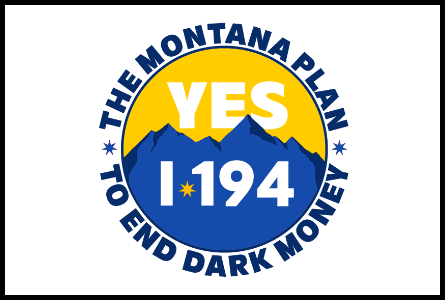
Sixteen years after the U.S. Supreme Court’s controversial Citizens United ruling opened the floodgates to unlimited independent political spending by corporations and labor unions, voters in Montana have approved a bold challenge to the influence of Big Money in American elections. Ballot Initiative 194, known as the “Montana Plan,” declares that corporations are not entitled to the same constitutional political spending rights as individuals, setting the stage for a potential legal showdown that could ultimately reach the U.S. Supreme Court. Supporters hope the initiative will provide a pathway to overturning or sharply limiting Citizens United and restore the power of states to regulate corporate political spending. But less than 48 hours after voters approved the ballot measure 66 to 34 percent, a lawsuit was filed in federal court charging that the new law violates the First Amendment of the U.S. Constitution.
The Montana initiative is attracting attention beyond the state’s borders, with reform advocates exploring similar measures elsewhere. In May, Hawaii’s governor signed legislation into law that also challenges corporate political spending rights.
Between The Lines’ Scott Harris spoke with Jeff Mangan, Montana’s former commissioner of political practices, and founder and president of the Transparent Election Initiative, the organization that led the successful campaign to pass the Montana Plan on Nov. 3. Here he talks about the Montana Plan to becomes effective on Jan. 1, 2027 and the growing movement to curb the influence of unlimited and unaccountable corporate spending in U.S. elections.
JEFF MANGAN: We don’t overturn Citizens United with the Montana plan. What it does is make Citizens United moot in Montana. It makes it irrelevant because our corporations will no longer look to Citizens United for any kind of guidance because it won’t have that power to spend in our politics. Really, if you go back to what Citizens United said, lots of folks believe what Citizens United and other rulings have basically given corporations personhood, said that they basically are the same as you or I. But what Citizens United said, what they said in Citizens United was independent spending by corporations in politics cannot be corrupting, therefore it’s legal. And they literally made that definitive statement that that type of spending cannot be corrupting. As a matter of fact, they even went one step further and said, not only cannot be corrupting, it can’t give the appearance of corruption. But that’s what they believed where, of course, all of us in the field and others were saying, “Oh no, no, that’s not the case.”
We saw that back in Montana in the early 1900s when we first passed our own bicitizens initiative, the Corrupt Practices Act of 1912, because corporations were literally buying elections in Montana and sent William Clark to the U.S. Senate literally by throwing money into legislators’ offices over the transom in the state capital. So we had a whole century of knowing what corruption can do in elections. The Supreme Court of 2010 said, “Oh, that’s not the case. It can’t be corrupting.” But I think we all have seen what’s happened in the last 16 years and on any given day you can throw a stick and hit something that we know is corrupt because of money and politics.
SCOTT HARRIS: Jeff, maybe you could talk about when your initiative, the Montana Plan, goes into effect on Jan. 1, 2027, what actually happens? What changes for corporations in Montana?
JEFF MANGAN: Corporations will basically be defined as entities that cannot spend in Montana’s elections, whether that be local, state or federal elections. And not only Montana corporations, but corporations from outside the state, they attempt to spend in our elections that’s deemed as doing business in our state. They will not be able to spend in our elections either. So in a sense, after January one, corporations will no longer be able to spend in our elections. That means all for-profit corporations, nonprofit corporations, unions, associations, etc. Of course, C4 corporations are those nonprofit corporations that have been the vehicle, the conduit, if you will, for dark money to come into elections across the United States where all that anonymous dark money is basically in a sense, laundered through a C4. So when it’s disclosed, they only disclose the name of the corporation, the C4, rather than the underlying donors, that kind of spending will go away as well.
So I think we will see elections that are only funded by individuals fully disclosed under Montana law, and Montana citizens will finally have the ability to do their due diligence and find out who in fact is attempting to influence their candidate or a ballot issue in the state of Montana.
SCOTT HARRIS: Jeff, critics of the Montana plan argue that states cannot circumvent First Amendment free speech protections simply by redefining corporate privileges. What’s your strongest constitutional argument and response? And are you confident at all that the current conservative majority of justices on the U.S. Supreme Court would accept what the Montana plan puts forward?
JEFF MANGAN: We are confident that we’re looking at this in a whole different light. We’re not looking at this as a First Amendment case. We’re looking at this as a 10th amendment. The states have always had the absolute right to determine what powers their state’s corporations have or incorporations that work in their states have. And quite honestly, the courts have not ruled on a campaign finance regulation or a case like this on any corporation that hasn’t had that power. States have always given them the power, those general powers, basically the same powers that you and I have. So they’ll be looking at a whole different basically class of corporations in the state of Montana, one that does not have the power to spend. And I think if they take a look at the way we expect them to take a look using corporate law, not First Amendment law, that we will be successful in making that argument.
Listen to Scott Harris’ in-depth interview with Jeff Mangan (18:37) and see more articles and opinion pieces in the related links section of this page. To subscribe to our podcasts, email newsletters, our Between The Lines Radio Newsmagazine Substack or social media, subscribe here.