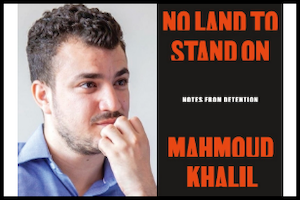
Mahmoud Khalil, a Columbia University graduate student and lawful permanent U.S. resident, became a national symbol of the Trump administration’s crackdown on pro-Palestinian activism after federal immigration agents arrested him in March 2025. Khalil, who played a prominent role in campus protests against Israel’s war in Gaza, was held for 104 days in a Louisiana ICE detention center, despite never being charged with a crime. His arrest and imprisonment triggered nationwide protests against the Trump administration’s use of immigration enforcement to silence political dissent.
In his newly released memoir, No Land to Stand On: Notes from Detention, Khalil recounts the ordeal of his imprisonment, separation from his wife and missing the birth of his first child while he remained behind bars. His story offers a deeply personal account of the human cost of political repression, while examining the broader struggle for Palestinian rights and civil liberties in the U.S.
Mahmoud Khalil, who was released from detention in June 2025, remains free while his attorneys petition the U.S. Supreme Court to issue an order protecting him from re-arrest and deportation as his appeals proceed. Between The Lines’ Scott Harris spoke with Mahmoud Khalil, who discusses how the Trump regime’s attempt to criminalize dissent in his case, endangering every Americans’ right to free speech.
MAHMOUD KHALIL: If I, a random student, at that time is a foreign policy threat to the United States, we must ask ourselves what kind of foreign policy does the United States have to have someone like me a threat to it. But it is like the Trump administration, they have no evidence or any legal grounds to detain me. That’s why they weaponized immigration law because the court documents showed that a day before the administration tried to bring material supportive terrorism charges against me, they couldn’t find anything illegal. They couldn’t find anything through surveilling me. So they shifted to the weaponization of the immigration law because in this country, immigration law very much is under the control of the administration or of the executive branch and they can do whatever they want. But the question we should be asking is how is the Trump administration making every American more unsafe?
If you do not adhere to what Trump permits, you will be criminalized, demonized and silenced. And it’s not only about immigrants. The case of Congresswoman Ilhan Omar shows how this administration can weaponize immigration law. There is a case of Dr. Badar Kansuri, another scholar who was detained about 10 days or two weeks after my detention. He did not do anything wrong and the Trump administration came after him because his wife is an American citizen and they couldn’t go after her. So they went after her husband who was on a visa in this country. So you could see how this is just like one part of the authoritarian practices that this administration is currently waging against its own citizens, its own people. ICE is a paramilitary militia that’s acting or that’s only answering to a close circle of the president the same way Mukhabarat and intelligence agencies back in the Middle East would answer only to the president.
So I don’t see any difference between these two. And no government should have the power to make someone disappear just because they don’t like what they have to say.
SCOTT HARRIS: Mahmoud, looking back on your imprisonment and the movement that demanded your release, what lessons have you drawn about solidarity, public protest and nonviolent resistance? And what message would you offer Americans who might believe that democratic victories in Congress in this most recent midterm election alone will be sufficient to protect democracy and prevent future abuses of government power?
MAHMOUD KHALIL: On the first part of your question, I think what kept me going in detention was knowing that there are so many people who are standing and still standing with me and with my family. Because without that I don’t think I would have had the stamina and really the will to fight my case because the fight is very expensive, takes a huge toll on my life, on my family’s life. But to me it is worth it. It is worth it because this case is not only about whether I get to stay in this country, it’s about whether anyone here can speak their mind without being punished for it. Whether I win this case tomorrow and decide to leave — or that’s totally different. And also it’s about whether I and all immigrants in this country can actually live here without that fear. And this is why I wrote this book.
I wrote this book to raise the alarm because what’s happening behind ICE detention walls is a stain on this country’s consciousness. So is the Palestine exception. The fact that free speech, the rule of law and basic dignity do not extend to Palestinians. And I find some sort of vindication and accountability when I see that progressive candidates are being voted into Congress because that’s part of our fight is to shift public narrative on Palestine, but also on basic dignities and basic human rights. But it’s not enough. Unfortunately it’s not enough. And my message is basically people think that the rights we have right now are ours like to keep or we take them for granted, but if we don’t fight for them, they would be stepped away from us. The rights that we have right now did not come because the Supreme Court or Congress or the government woke up one morning and decided to extend these rights to people.
We have these rights because we fought for these rights, whether it was during the Civil War, the Reconstruction era, the Independence War, the Civil Rights movement and so on. So I don’t want people to take these rights for granted because they can be stripped away from us at any moment. And for me, the fight is worth it. I want to leave a world where my son would grow up in equality, with dignity, with freedom, just like any other human being in this country. So I hope that others also would want that future for themselves and their children.
Follow Mahmoud Khalil on X @mahmoudkhalel and on Instagram @justice4mahmoud.
Listen to Scott Harris’ in-depth interview with Jeff Mangan (23:00) and see more articles and opinion pieces in the related links section of this page. To subscribe to our podcasts, email newsletters, our Between The Lines Radio Newsmagazine Substack or social media, subscribe here.