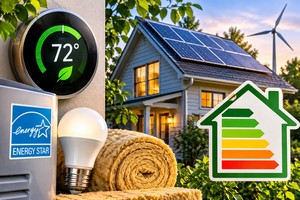
Energy efficiency is the cheapest energy, because it’s energy that’s not generated or used. A recent report from Wallet Hub on the most and least energy efficient lower 48 U.S. states, found that California, Vermont, and New York, were at the top of the list, while West Virginia, Alabama and South Carolina were at the bottom.
Energy is one of the biggest household expenses for American consumers. The average U.S. family spends at least $2,000 annually on utilities, with heating and cooling alone accounting for more than half the bill.
Between The Lines’ Melinda Tuhus spoke with Leticia Colon, who has worked in Energy efficiency policymaking and Environmental Justice at the state level in Connecticut and nationally. Here she describes her dismay at her state’s fall in the rankings to #26, although other ways of determining rankings puts Connecticut at #14, and talks about the critical role that energy efficiency must play in our energy transition and in our fight for affordability.
LETICIA COLON: The report was interesting because it was based on heating degree days versus usage, which there’s all different ways to measure efficiency. I feel that, one, I’m sad that my state, which I feel was a leader in efficiency has fallen so far behind. And I really feel that the issue that has come into play for efficiency is all of the barriers to being able to access and truly upgrade people’s properties and homes. So Connecticut has some of the oldest homes in the nation. We’re a very old state and a lot of our housing is still standing from 1700 and 1800s, surprisingly. But a lot of these places are in historic districts and haven’t had the chance to get the upgrades due to historic rules. They make it very complicated to upgrade historic homes in Connecticut. And then the other sector that I really see are people that are financially strained and their houses are just aging and they’re not being able to do those normal upgrades like replacing a roof.
The cost, for example, of replacing a roof used to be about $15,000 to $20,000, and now roofs are more around $20,000 to $30,000. So it’s double the cost really of upgrading homes. The other barriers that are in people’s homes in Connecticut and elsewhere is knob and tube electric. So if you have knob-and-tube electric in your walls, in your attic, in your basement, and you want to make your home thermally sound so that you’re not going to use so much heating, oil, gas, or any type of electricity to heat your home—it doesn’t matter what the fuel source is—the less you use, the less it’s going to cost us, the state and you as an individual, because the less fuel we use in our homes means the less peak demand our state has. And peak demand is what sets the cost of energy as well.
So how much energy we use is tied to our pricing. Therefore, it’s really important that we draw down demand by doing things like air sealing, insulating, replacing windows and doors. And then right after that, the next step that has to happen is to ensure that they have the right heating equipment for their home style and type. So a lot of people could be converted, for example, to heat pumps, which if installed correctly can bring down our demand for heating and cooling. The difficulty is that in Connecticut, a lot of the houses have knob-and-tube or they don’t have a 210 connection for their electric. And so upgrading for that could again be $10,000 to $21,000. I just saw a recent quote for someone’s home. And these are not covered by our insurance plans. These are things that we have to do to upgrade our homes to have the energy efficiency we need and also to make them healthier inside.
MELINDA TUHUS: People are always talking about forms of kinds of energy like gas or oil and coal, which isn’t used so much anymore, versus clean energy in which some people include nuclear and others don’t, but wind and solar. I feel like nobody talks about energy efficiency. How does energy efficiency relate to forms of clean energy that people are moving toward?
LETICIA COLON: Great question. So energy efficiency is the cleanest type of energy we can use. It’s the least expensive as well. Energy efficiency is the energy we don’t use by making choices in advance to choose either high efficiency heating and cooling equipment, to choose to insulate the home and make sure our thermal boundaries are correct so that when we are heating and cooling, it stays on the inside of our house where we want it. Energy efficiency is also your lighting, which people are not talking about anymore, but lighting is a huge draw in Connecticut. Look, it’s getting dark at like 5 o’clock right now. So if you think about our peak in winter and fall, how much more energy we’re using at night, having all of our lights on. We’re also very dependent as people on our electronics, our computers, our televisions, our gaming systems, and all of this is a draw on our electric grid.
But if we draw down demand at the residential level or at any level, it lowers the cost of energy and it means that we don’t have to go into the dirty fuels. So for example, we still actually do use oil in Connecticut in our peaker plants. For example, we could spend in Connecticut on expanding rooftop solar and expanding parking lot solar. And if we did those things by investing in them, we would be generating more clean energy and thus relying less on things like natural gas, which is again at all time high. Oil, which again is at a very high price and even electricity depends on gas, so natural gas. So when we draw down our use of electricity, we’re also lowering fossil fuels and lowering the price of our fuel mix.
MELINDA TUHUS: When Biden was president, there was a lot of money available for different clean energy programs. Now that even though Trump is going to be president for two more years, now that the Democrats are going to control both the House and the Senate in Congress, do you have any hope that there might be more funding available or do you think it just won’t get through with Trump still as president?
LETICIA COLON: So some of the projects have moved forward. I think that the question that you asked earlier about why is efficiency not talked about so much is that it’s not exciting. And I worry that because efficiency is in your attic and in your basement and your walls where you’re not looking at it versus people are excited, for example, about upgrading a bathroom or a kitchen, that there isn’t enough investment mentally for people to think about how important it is to do more with less. And that’s really what efficiency is.
See more articles and opinion pieces in the related links section of this page. To subscribe to our podcasts, email newsletters, our Between The Lines Radio Newsmagazine Substack or social media, subscribe here.